The best glute exercises for building strength at home combine a squat, hip hinge, single-leg movement, and direct hip-extension exercise. Start with controlled bodyweight versions, then add dumbbells, resistance bands, or a loaded backpack when you can complete every repetition with stable form.
Your glutes respond to consistent resistance, not to a complicated exercise menu. This guide ranks practical home options by loading potential, ease of progression, balance demands, and how well each movement fits a small-space routine. It also explains how to combine them safely and what to do when an exercise feels too easy or uncomfortable.
1. Choose exercises that cover the main glute functions
The gluteus maximus contributes strongly to hip extension, while the smaller glute muscles help control the pelvis and thigh. A balanced home session should therefore include movements where you squat, hinge at the hips, work one leg at a time, and move the leg outward or stabilize the pelvis.
Federal activity guidance recommends muscle-strengthening activity on at least two days per week for adults. The U.S. Physical Activity Guidelines also emphasize choosing activities that match your abilities and can be performed consistently.
For this ranking, the key criteria are:
- Strength potential: Can you make the exercise harder over time?
- Home practicality: Does it require little space and basic equipment?
- Technique demands: Can a beginner learn the movement without excessive balance or mobility requirements?
- Movement coverage: Does it add something different to a complete glute routine?
The table below gives a quick comparison before the detailed explanations.
| Rank | Exercise | Best for | Equipment | Warning sign |
|---|---|---|---|---|
| 1 | Dumbbell Romanian deadlift | Progressive strength | Dumbbells or backpack | Lower back rounds or takes over |
| 2 | Bulgarian split squat | Single-leg strength | Chair or sofa | Front knee collapses inward |
| 3 | Hip thrust or glute bridge | Direct hip extension | Optional weight | Rib cage flares as hips rise |
| 4 | Goblet squat | Full lower-body strength | Dumbbell or backpack | Heels lift or depth becomes uncontrolled |
| 5 | Reverse lunge | Beginner-friendly unilateral work | Optional weights | Balance causes rushed repetitions |
| 6 | Step-up | Practical leg drive | Stable step | Jumping off the trailing leg |
| 7 | Side-lying leg raise | Hip stability and accessory work | None or mini-band | Torso rolls backward |
2. Best glute exercises for building strength at home
1. Dumbbell Romanian deadlift
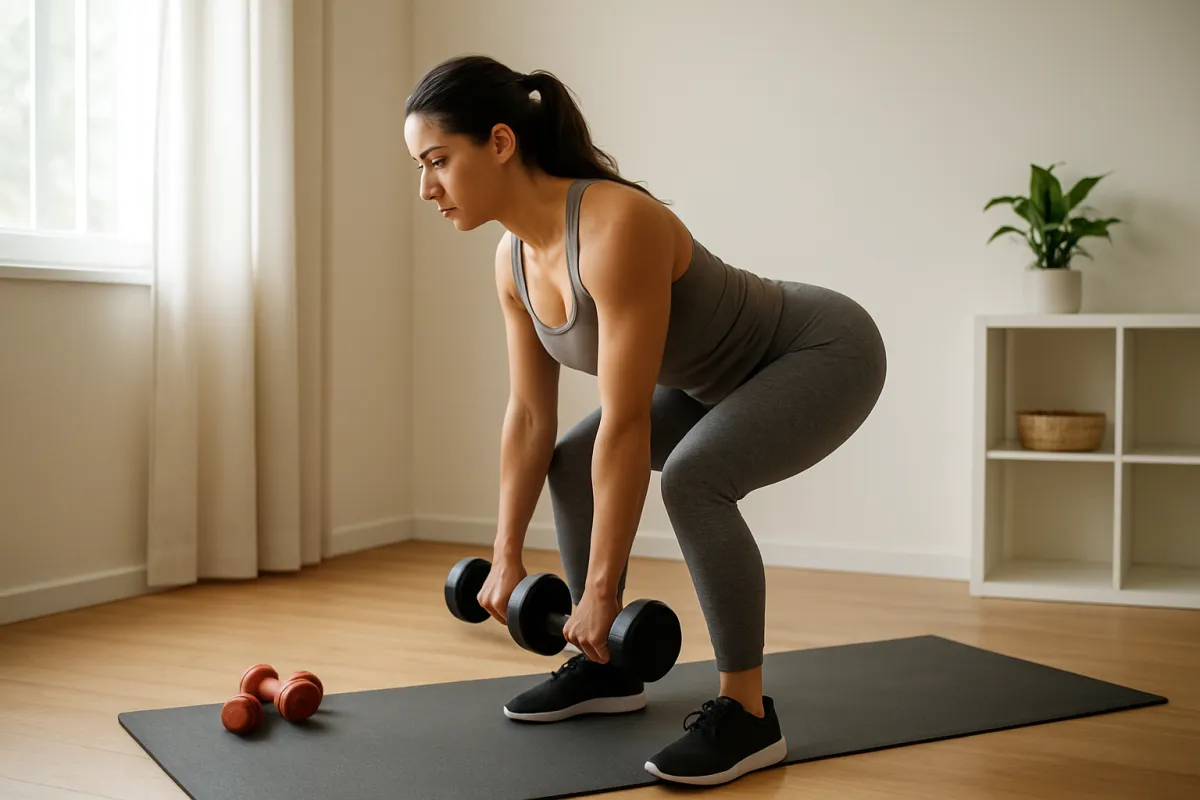
Best for: progressive posterior-chain strength. The Romanian deadlift trains the glutes through a controlled hip hinge and is one of the easiest home movements to progress with heavier dumbbells or a loaded backpack. Keep the weights close to your legs, soften your knees, push your hips backward, and stand by driving the hips forward.
Use 3 sets of 6–12 repetitions. Stop the descent when your back can no longer remain neutral or when you feel the movement shifting from your hips into your lower back. For a detailed technique breakdown, see our dumbbell Romanian deadlift form guide.
2. Bulgarian split squat
Best for: building strength one leg at a time. This demanding variation challenges the glutes, thighs, balance, and pelvic control without requiring heavy equipment. Place the rear foot on a low, stable surface, keep most of your weight over the front leg, and lower slowly.
Start with 2–3 sets of 6–10 repetitions per side. If balance is the limiting factor, hold a wall lightly or perform a regular split squat first. Avoid treating the exercise as a jump; control matters more than depth. See our Bulgarian split squat step-by-step guide for setup adjustments.
3. Hip thrust or glute bridge
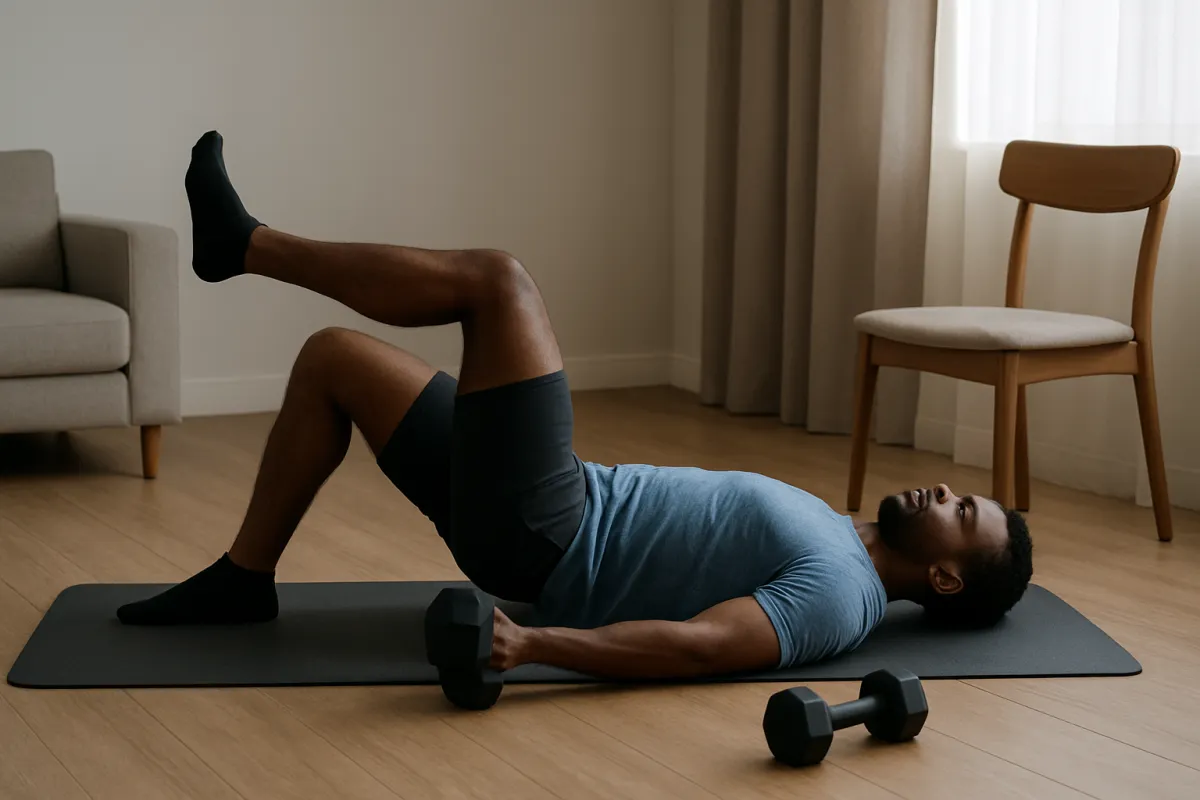
Best for: direct hip-extension practice. Glute bridges are accessible to beginners, while hip thrusts with your upper back supported on a firm sofa or bench allow a longer range of motion. Keep your ribs gently down, finish with your hips level, and avoid arching your lower back to create extra height.
Perform 3 sets of 8–15 repetitions. Once bodyweight work becomes easy, add a dumbbell or backpack across your hips and secure it with your hands. The American Council on Exercise recommends using a mixture of double-leg, single-leg, and power-focused movements rather than relying on one exercise alone. Its glute exercise library is useful for checking movement variations.
4. Goblet squat
Best for: a simple, full lower-body strength movement. Hold one weight close to your chest and squat between your hips. The goblet position provides a helpful counterbalance and often makes it easier to keep your torso controlled than a completely unloaded squat.
Use 3 sets of 8–15 repetitions. Choose a depth you can repeat consistently while keeping your feet planted and knees tracking in line with your toes. To emphasize the glutes slightly more, use a controlled descent and drive evenly through the whole foot rather than shifting onto your toes.
5. Reverse lunge
Best for: accessible single-leg training. Stepping backward usually makes it easier to control the landing than stepping forward. Keep your front foot stable, lower until both knees are comfortably bent, and return by pushing through the front leg.
Try 2–3 sets of 8–12 repetitions per side. Use a shorter range of motion or hold onto support if your balance is inconsistent. Add dumbbells only after the bodyweight version feels steady.
6. Step-up
Best for: practical leg drive and stair-related strength. Use a solid step that does not slide or wobble. Place the whole working foot on the platform, lean forward slightly from the hips, and stand without springing off the trailing leg.
Complete 2–3 sets of 6–10 repetitions per side. A lower step is often better than a high step that forces your pelvis to twist or your back to compensate. If you train in a small home office, keep equipment and loose cables away from the stepping area; safety matters more than height.
7. Side-lying leg raise
Best for: hip stability and low-fatigue accessory work. Lie on your side with your hips stacked. Raise the upper leg slightly behind your body while keeping the toes pointed forward, then lower slowly without rolling your torso backward.
Use 2–3 sets of 12–20 controlled repetitions per side. This is not usually the main strength builder in a home program, but it can complement squats, hinges, and lunges when you want additional lateral hip work without heavy loading.
3. Build a simple home glute workout
You do not need all seven exercises in one session. A practical beginner workout can use one exercise from each major pattern:
- Goblet squat: 3 sets of 8–12
- Dumbbell Romanian deadlift: 3 sets of 8–12
- Reverse lunge: 2 sets of 8–10 per side
- Glute bridge: 2–3 sets of 12–15
Train this routine twice weekly with at least one rest day between sessions. Leave roughly one to three controlled repetitions in reserve on most sets rather than forcing every set to complete failure. The latest ACSM resistance-training guidance emphasizes regular participation and sustainable progression over unnecessarily complicated programming.
4. Progress without a full home gym
When an exercise becomes easy, change one variable at a time. Add a small amount of weight, perform another repetition, slow the lowering phase, pause at the hardest point, or move from two legs to one leg. If you cannot add weight safely, increasing range of motion or improving control can still make the set more demanding.
Keep a basic record of the exercise, sets, repetitions, and resistance used. Progress is easier to judge when you compare similar sessions rather than relying only on soreness. Muscle soreness is not required for a productive workout.
5. Common selection mistakes
- Choosing only “burn” exercises: High-repetition pulses can be useful accessories, but they should not replace progressively harder squats, hinges, or split-leg work.
- Using unstable furniture: A chair that shifts can turn a normal exercise into a fall risk.
- Adding weight before learning the pattern: Practice unloaded repetitions first, especially for deadlifts, lunges, and step-ups.
- Ignoring the weaker side: Start unilateral exercises with the less confident side and match its repetitions on the stronger side.
- Changing workouts too often: Keep the same core movements long enough to evaluate progress.
6. What if an exercise does not feel right?
If you feel sharp pain, numbness, unusual joint instability, or symptoms that worsen during the session, stop the movement rather than trying to push through it. Reduce the range, lower the load, or choose an easier variation only if the movement becomes comfortable and controlled.
Persistent pain, a recent injury, or a condition affecting your hips, knees, back, or balance is a reason to seek individualized advice from a qualified healthcare professional. Exercise guidance online cannot assess your movement or medical history.
7. Final checklist and recommendation by scenario
- Choose one squat or lunge pattern.
- Include one hip hinge.
- Add direct hip extension such as a bridge or thrust.
- Use single-leg work when your balance allows it.
- Train consistently twice per week before adding more complexity.
- Progress gradually by changing load, repetitions, tempo, or range.
For beginners: Start with glute bridges, goblet squats, and reverse lunges. For maximum strength with limited equipment: prioritize dumbbell Romanian deadlifts, Bulgarian split squats, and weighted hip thrusts. For small spaces: use bridges, squats, hinges, and side-lying leg raises. For a balanced lower-body plan: combine a squat, hinge, single-leg exercise, and direct glute movement.
The best glute exercises for building strength at home are the ones you can perform safely, repeat consistently, and make gradually more challenging. Start with the four-movement routine above, record your work, and add difficulty only when your technique remains reliable.