To do dumbbell Romanian deadlifts correctly, keep a soft bend in your knees, push your hips backward, lower the dumbbells close to your legs, and stop when your hamstrings are well stretched without rounding your back. Stand by driving your feet into the floor and squeezing your glutes rather than leaning backward.
The dumbbell Romanian deadlift is a controlled hip-hinge exercise for the hamstrings, glutes, and supporting muscles around the trunk. The goal is not to reach the floor or use the heaviest dumbbells available. This guide will help you set up safely, recognize good form, choose a useful range of motion, and adjust the exercise when something feels wrong.
1. Prepare your space, equipment, and starting position
You need two dumbbells, a stable and reasonably clear floor, and enough room to lower the weights without hitting furniture or your knees. Wear shoes that give you a stable base; very soft or highly cushioned footwear can make balance and foot pressure harder to judge.
Choose a weight that allows you to perform every repetition smoothly. For your first practice set, use a load that feels easy enough to control while you learn the hinge. You can increase the weight later if your back position, balance, and tempo remain consistent.
Use a short warm-up
A warm-up does not need to exhaust your legs. Try five minutes of easy movement, followed by several unloaded hip hinges and a few slow bodyweight squats. The purpose is to rehearse the pattern and notice whether your hips, hamstrings, or back already feel restricted.
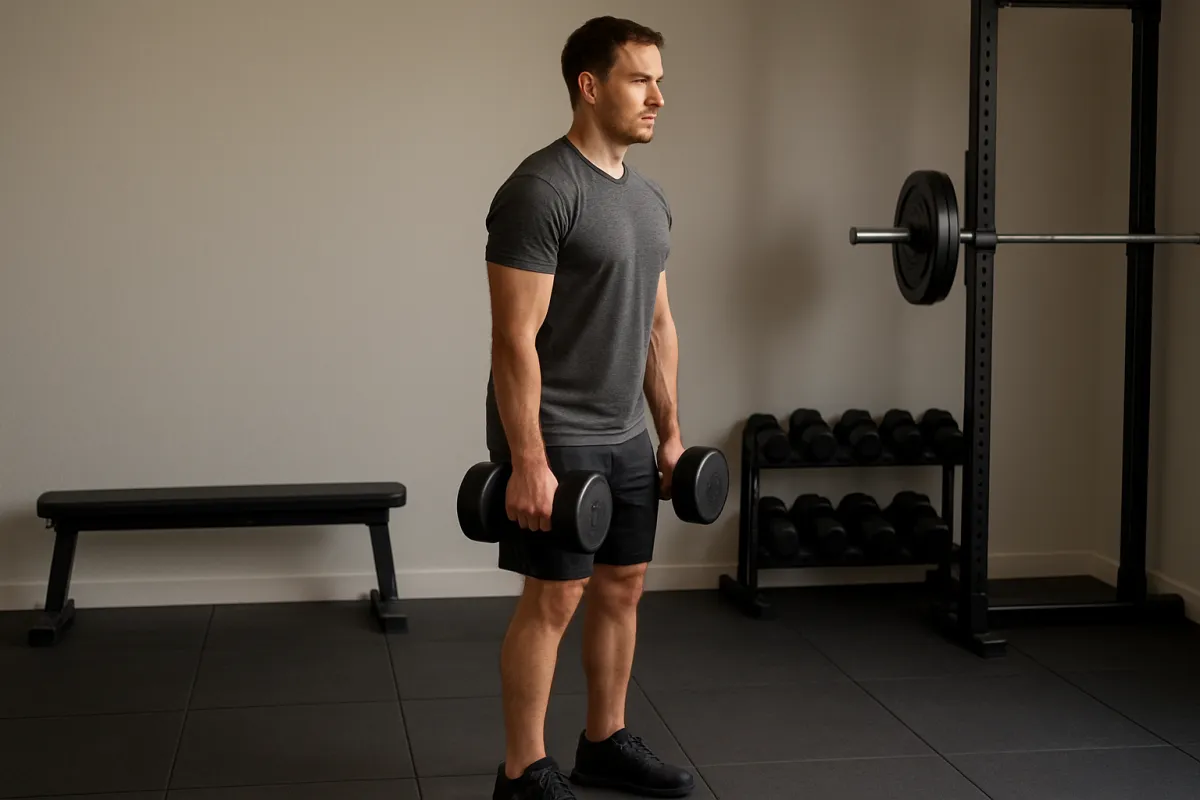
- Place your feet about hip-width apart.
- Keep your toes pointing mostly forward or slightly outward.
- Hold the dumbbells at your sides with your palms facing inward.
- Keep your chest relaxed, ribs stacked over your pelvis, and neck in line with your spine.
Checkpoint: Before the first repetition, you should feel balanced across your whole foot, not tipped toward your toes or heels. The dumbbells should be close enough to brush your legs during the movement.
2. Learn the hip hinge before lowering the dumbbells
A Romanian deadlift is primarily a hip hinge, not a squat. Your hips travel backward while your knees stay slightly bent. A useful practice drill is to stand a few inches in front of a wall, then push your hips back until they touch it while keeping your spine controlled.
Think about closing a car door with your hips. This cue encourages the backward movement needed to load the hamstrings without asking your knees to do most of the work.
How much should your knees bend?
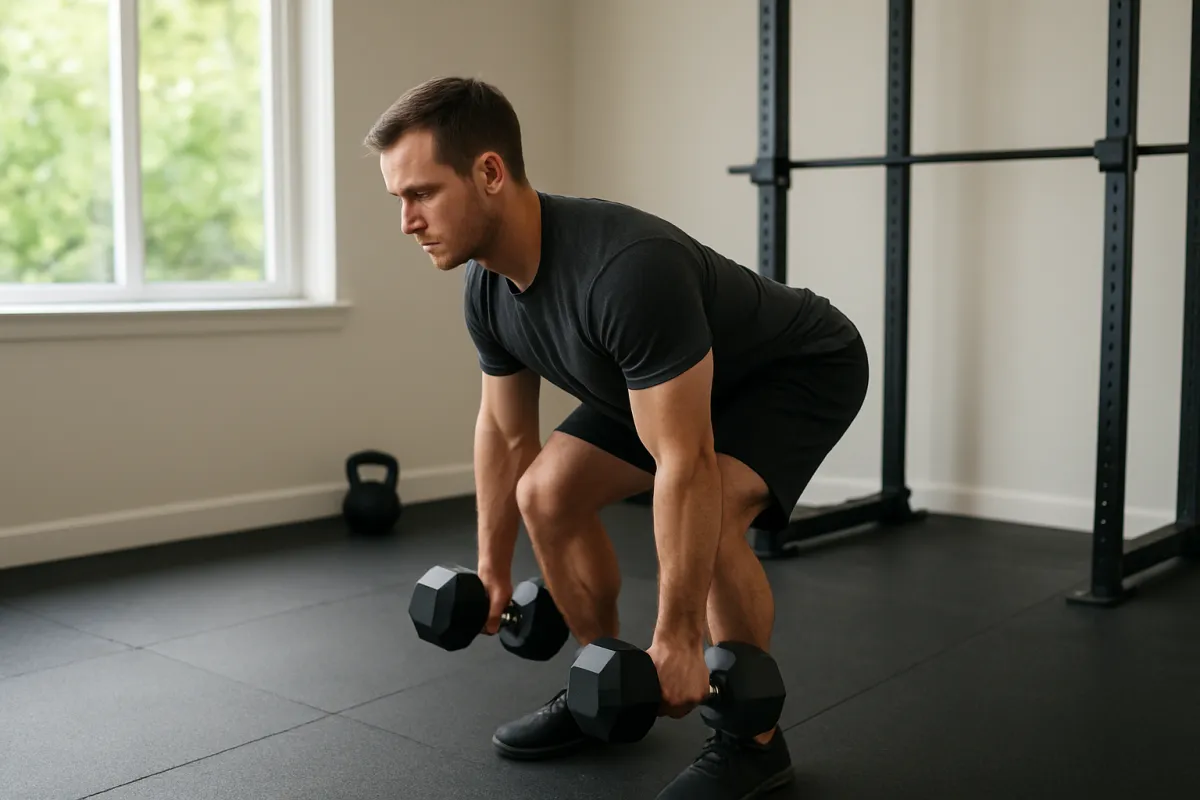
Start with a small knee bend and keep roughly the same angle as you hinge. Your knees may move slightly, but they should not continue bending significantly as you descend. Too much knee flexion turns the exercise toward a squat or conventional deadlift pattern and changes where you feel the effort.
Do not lock your knees rigidly. A soft bend helps you keep the movement controlled and reduces unnecessary stress from trying to hold the legs perfectly straight.
Checkpoint: From the side, your hips should move backward more than they move downward. If your knees travel far forward and your torso drops between your thighs, reset and practice a smaller hinge.
3. Perform the dumbbell Romanian deadlift correctly
Use the following sequence for each repetition:
- Stand tall. Hold one dumbbell in each hand, arms long, shoulders relaxed, and feet hip-width apart.
- Brace gently. Take a controlled breath and tighten your midsection as if preparing for a light tap to the stomach. Avoid forcing your ribs upward or holding your breath longer than necessary.
- Unlock your knees. Keep a slight bend in both knees without initiating a squat.
- Push your hips back. Hinge from the hips while keeping the dumbbells close to your thighs. Allow the weights to travel downward because your torso is tilting forward.
- Lower under control. Continue until you feel a clear but manageable stretch in the hamstrings and can still keep your back position stable.
- Pause briefly. You do not need to touch the floor. A short pause can help you confirm that the dumbbells are close and your balance is steady.
- Stand by extending your hips. Press through the floor and bring your hips forward. Keep the dumbbells close as you return to a tall standing position.
- Finish neutrally. Squeeze your glutes at the top without leaning backward or thrusting your ribs forward.
The downward phase is often where people lose control. Use a deliberate tempo, such as lowering for two or three seconds, then stand smoothly. The range of motion should be determined by your hamstring flexibility and your ability to maintain a neutral, controlled trunk—not by how close the dumbbells get to the floor.
NASM describes the Romanian deadlift as a hip-hinge exercise with relatively limited knee bend, while ACE gives similar guidance to keep the back straight, push the hips backward, and descend until you feel tension along the back of the legs. See the NASM exercise library and ACE Romanian deadlift instructions for additional movement references. ([nasm.org](https://www.nasm.org/resource-center/exercise-library/romanian-deadlift-barbell?utm_source=openai))
4. Use these form checks to judge each repetition
Good form is observable. You do not need to guess whether the exercise is working; look for consistent positions and sensations throughout the set.
Use this comparison table while practicing:
| Part of the movement | What to look for | Warning sign | Useful adjustment |
|---|---|---|---|
| Feet | Whole foot stays connected to the floor | Weight shifts onto the toes | Reduce the load and slow the descent |
| Knees | Soft bend stays fairly consistent | Knees keep bending as you descend | Push the hips farther back before lowering |
| Dumbbells | Weights remain close to the legs | Dumbbells drift forward | Keep the armpits gently engaged and shorten the range |
| Back | Spine remains controlled and stable | Lower or upper back rounds under load | Use lighter dumbbells and stop earlier |
| Bottom position | Hamstring stretch without strain | Stretch becomes sharp or balance is lost | Raise the stopping point |
| Top position | Hips and ribs finish stacked | You lean backward to “lock out” | Finish with glute tension, not spinal extension |
A mirror can help you check general alignment, but do not twist your head to watch yourself during the set. A side-view video recorded from a safe distance can be more useful. Review whether the dumbbells stay close and whether your hips move backward before deciding to add weight.
5. Choose the right depth, reps, and weight
Find your stopping point
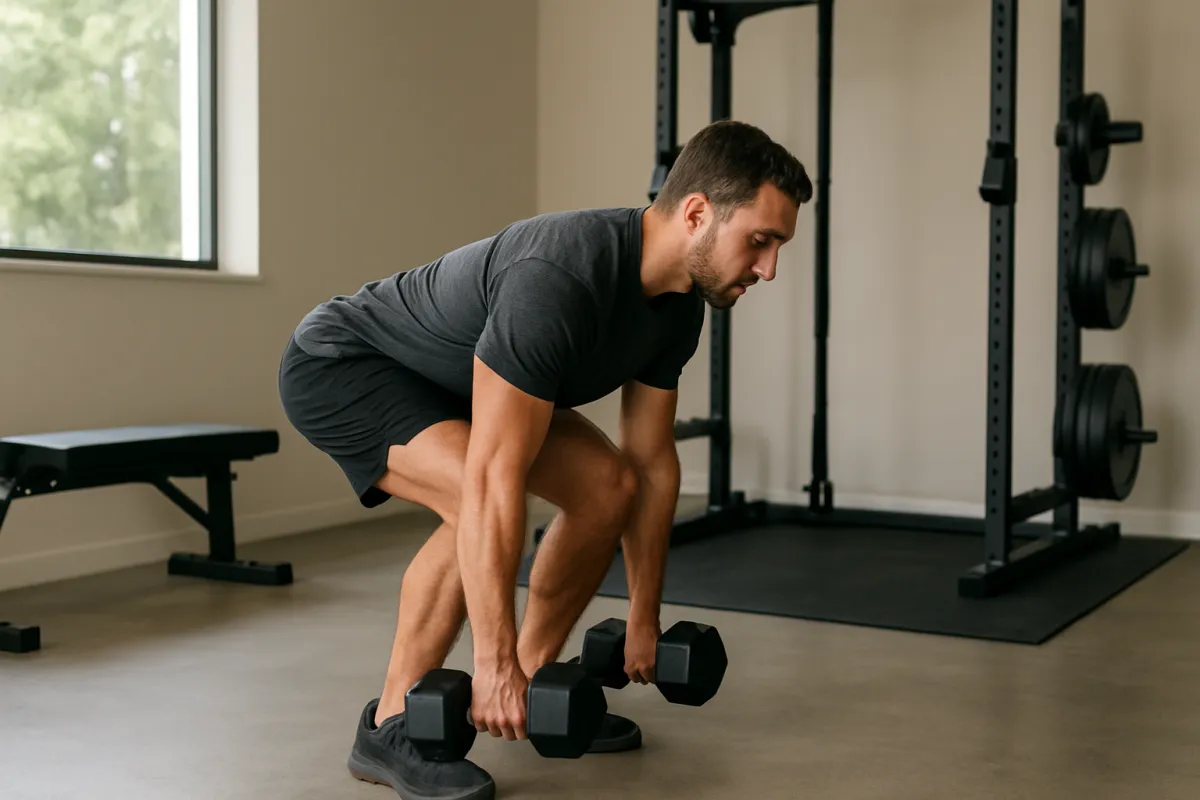
For many people, the dumbbells finish around the upper or middle shin, but that is only a rough reference. Your correct depth may be higher or lower. Stop when one of these conditions appears:
- Your hamstrings feel sufficiently stretched.
- Your spine is about to lose its controlled position.
- The dumbbells begin moving away from your legs.
- Your pelvis starts tucking strongly because you are forcing extra depth.
More depth is not automatically better. A shorter range performed with stable control is more useful than a deeper repetition that shifts stress into your lower back.
Start with manageable training volume
Beginners can start with two or three sets of about eight to twelve controlled repetitions, using a weight that leaves several technically sound repetitions available. Rest long enough to regain control of your breathing and grip before the next set.
When your technique is consistent, progress one variable at a time. You might add a small amount of weight, perform an additional repetition, or add one set. Do not increase all three at once.
Use a slower lowering phase if you want to improve awareness without immediately adding load. If your grip fails before your hamstrings and glutes feel adequately challenged, reduce the weight, use lifting straps only if appropriate for your training, or choose a variation that lets you practice the hinge without grip becoming the limiting factor.
6. Fix the most common dumbbell RDL mistakes
Rounding the back to reach lower
This usually means the range of motion is too ambitious for your current mobility or load. Raise the dumbbells back up, reduce the weight, and stop at the point where your trunk remains controlled.
Turning the movement into a squat
If your knees bend deeply and your hips drop, you may be thinking “lower the weights” instead of “send the hips backward.” Practice wall hinges or place a light object behind you as a target for your hips.
Letting the dumbbells drift away
Weights that move forward increase the demand on your back and make the hinge less efficient. Keep your arms long, shoulders relaxed, and dumbbells close to your thighs and shins. Shorten the range if you cannot maintain that path.
Moving too quickly
Fast repetitions can hide loss of balance and make it difficult to feel the hamstrings loading. Slow the descent, pause briefly near your personal bottom position, and stand without swinging the weights.
Overextending at the top
You only need to return to a tall, neutral standing position. Squeezing the glutes is useful; leaning backward is not a sign of a stronger repetition.
7. Troubleshoot discomfort and exercise substitutions
What if I feel the exercise mostly in my lower back?
First, reduce the weight and range of motion. Check that the dumbbells stay close, your knees are not locked, and your hips are moving backward. If the sensation remains uncomfortable, stop the loaded version and practice unloaded hinges or seek individualized instruction.
What if I cannot feel my hamstrings?
Use a slower descent and think about pulling your hips away from the dumbbells. Keep the knees softly bent but avoid squatting. A light load is often easier for learning the intended pattern than a heavy one.
What if balance is the problem?
Widen your stance slightly, lower the weight, or perform the movement beside a stable support without leaning on it. Keep both feet planted. A single-leg variation is more demanding and should come later, after the two-leg version feels dependable.
When should you stop?
Stop if you experience sharp, sudden, or radiating pain, numbness, unusual weakness, dizziness, or a loss of control. Exercise-related muscle effort and a mild stretch are different from pain that changes your movement.
If back pain is worsening, persists, follows a significant injury, or interferes with sleep and daily activities, consult a qualified healthcare professional. The NHS back-pain guidance provides general warning signs and emphasizes seeking medical advice when symptoms are severe, persistent, or accompanied by concerning changes. ([nhs.uk](https://www.nhs.uk/conditions/back-pain/?src=conditionswidget&utm_source=openai))
8. Apply advanced tips once your basic form is reliable
- Use a consistent stance: Mark your foot position mentally so each set begins the same way.
- Track the bottom position: Record whether the dumbbells stop at the same height without forcing depth.
- Use a 1-second pause: Pause where the hamstrings are loaded, then stand without bouncing.
- Try a suitcase variation carefully: Holding one dumbbell at a time increases the demand on your side-to-side stability. Use a lighter weight and resist leaning.
- Pair it with a knee-dominant exercise: A workout may combine RDLs with movements such as split squats, provided total fatigue does not damage your technique. For a separate lower-body option, see this guide to Bulgarian split squats at home.
Advanced techniques should make the movement clearer or more purposeful, not simply harder. If a variation makes it difficult to maintain the dumbbells’ path or your trunk position, return to the standard two-dumbbell version.
9. Complete your pre-set checklist
- My training area is clear and stable.
- I chose a weight I can control through the full planned set.
- My feet are balanced and about hip-width apart.
- My knees are softly bent, not locked or deeply flexed.
- I will push my hips backward before lowering farther.
- The dumbbells will stay close to my legs.
- I will stop at the deepest position I can control.
- I will stand tall without leaning backward.
10. Take these next actions
- Practice five to eight unloaded hip hinges in front of a mirror or with a side-view video.
- Perform one light dumbbell set and check your balance, knee angle, dumbbell path, and back position.
- Adjust only one issue at a time, such as reducing depth or slowing the descent.
- Complete two or three controlled working sets rather than chasing fatigue.
- Write down the weight, repetitions, and stopping point so your next session has a clear starting reference.
Learning how to do dumbbell Romanian deadlifts correctly comes down to controlling a hip hinge: soft knees, hips moving backward, weights close to your body, and a range of motion you can own. When those standards remain consistent, gradually increase the challenge; when they do not, reduce the load or depth before progressing.
Frequently asked questions
Should dumbbell Romanian deadlifts touch the floor?
No. Touching the floor is not required and may force you to round your back or lose hamstring tension. Stop when you reach your controlled range of motion.
Are dumbbell RDLs better than barbell RDLs?
Neither is universally better. Dumbbells can be convenient for home workouts and allow each hand to work independently, while a barbell may make heavier loading more practical. Choose the version that lets you maintain consistent form.
Where should I feel dumbbell Romanian deadlifts?
You should generally feel controlled tension in the hamstrings and glutes, with the trunk muscles working to maintain position. If the movement causes sharp pain or persistent discomfort in your back, stop and reassess your technique or seek professional guidance.