The best leg exercises for knee-friendly workouts are controlled movements that strengthen the hips, glutes, hamstrings, and quadriceps without forcing painful knee angles. For most people, a practical starting list includes glute bridges, Romanian deadlifts, supported sit-to-stands, low step-ups, hamstring curls, calf raises, and easy cycling.
Knee-friendly does not mean completely removing the knees from lower-body training. It means choosing a manageable range of motion, controlling the load, and progressing only when the movement feels stable. This guide ranks seven useful options, explains who each exercise suits, and shows how to combine them into a sensible routine.
1. Choose exercises by knee tolerance, not by reputation
There is no single exercise that is safe for every knee. A movement that feels comfortable for one person may irritate another because of differences in injury history, mobility, strength, footwear, or training volume.
Use these criteria when selecting your starting exercises:
- Load: Begin with body weight, a wall, or a sturdy support before adding dumbbells or machines.
- Range of motion: Work through the deepest position you can control without increasing symptoms.
- Stability: Favor slow, predictable movements before jumping, running, or fast changes of direction.
- Next-day response: Mild effort or muscle fatigue may be acceptable, but increasing swelling or persistent pain suggests that the session was too demanding.
The American Academy of Orthopaedic Surgeons exercise guidance and NHS knee exercise recommendations both emphasize gradual strengthening and movement control rather than rushing into high-impact work.
2. Compare the best leg exercises for knee-friendly workouts
The table below gives you a quick way to match each exercise with your current needs.
| Exercise | Best for | What to look for | Warning sign |
|---|---|---|---|
| Glute bridge | Low-load hip and glute strength | Hips lift smoothly without back arching | Hamstring cramping or back discomfort |
| Romanian deadlift | Hamstrings and hip hinge strength | Hips move backward while the spine stays neutral | Rounding the back or losing balance |
| Supported sit-to-stand | Building squat confidence | Weight stays balanced through the whole foot | Knees collapse inward or pain rises sharply |
| Low step-up | Single-leg strength and daily function | Use a low platform and control the lowering phase | Knee twisting or dropping inward |
| Hamstring curl | Direct hamstring work | Move slowly and avoid swinging | Cramping or discomfort behind the knee |
| Calf raise | Ankle and lower-leg strength | Rise evenly through both feet | Loss of balance or painful ankle motion |
| Easy cycling | Low-impact conditioning | Light resistance and smooth pedaling | Increasing knee pain or excessive resistance |
3. Ranked exercise picks and how to perform them
1. Glute bridge
Best for: Beginners, home workouts, and people who want to train the hips with limited knee movement.
Lie on your back with your knees bent and feet flat. Brace your midsection, press through your feet, and lift your hips until your body forms a comfortable line from shoulders to knees. Pause briefly, then lower with control.
Begin with 2–3 sets of 8–15 repetitions. Move your feet slightly farther away if your hamstrings dominate, or reduce the range if your back feels strained.
2. Romanian deadlift
Best for: Strengthening the hamstrings and glutes while keeping the exercise centered on the hips.
Stand with feet about hip-width apart and hold light dumbbells if appropriate. Soften your knees, push your hips backward, and lower the weights along your thighs until you feel a controlled stretch. Drive the hips forward to stand without leaning backward.
Use 2–4 sets of 6–12 repetitions. This is a strong progression when regular bridges become easy, but technique matters more than load. Practice the hip hinge with no weight first.
3. Supported sit-to-stand
Best for: Improving the strength needed for chairs, stairs, and everyday movement.
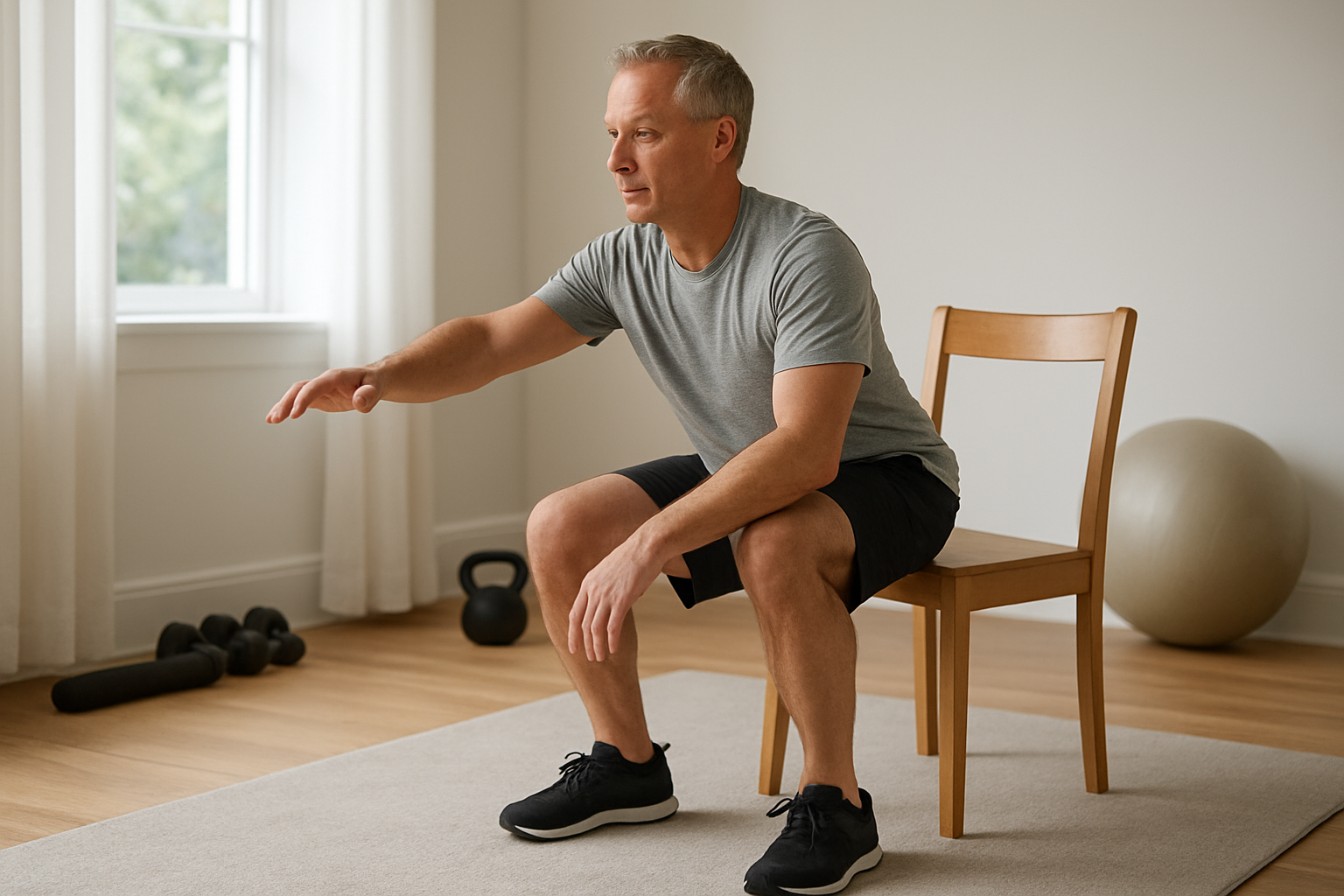
Place a chair behind you and stand with your feet in a comfortable position. Reach your hips back, lightly touch the seat, and stand again. Keep the movement slow and use your hands on the chair or a nearby support if necessary.
Try 2–3 sets of 6–12 repetitions. Raise the seat height, shorten the range, or use more hand support if a deeper squat is uncomfortable. The goal is a steady movement, not a test of depth.
4. Low step-up
Best for: Single-leg strength and controlled practice for stair climbing.
Use a stable, low step. Place one foot fully on the platform, press through that foot, and bring the other foot up without pushing aggressively from the floor. Step down slowly and repeat before switching sides.
Start with 1–3 sets of 5–10 repetitions per leg. A lower step is usually the better choice when balance or knee confidence is limited. Hold a rail or wall for stability.
5. Standing or lying hamstring curl
Best for: Adding direct hamstring work with little equipment.
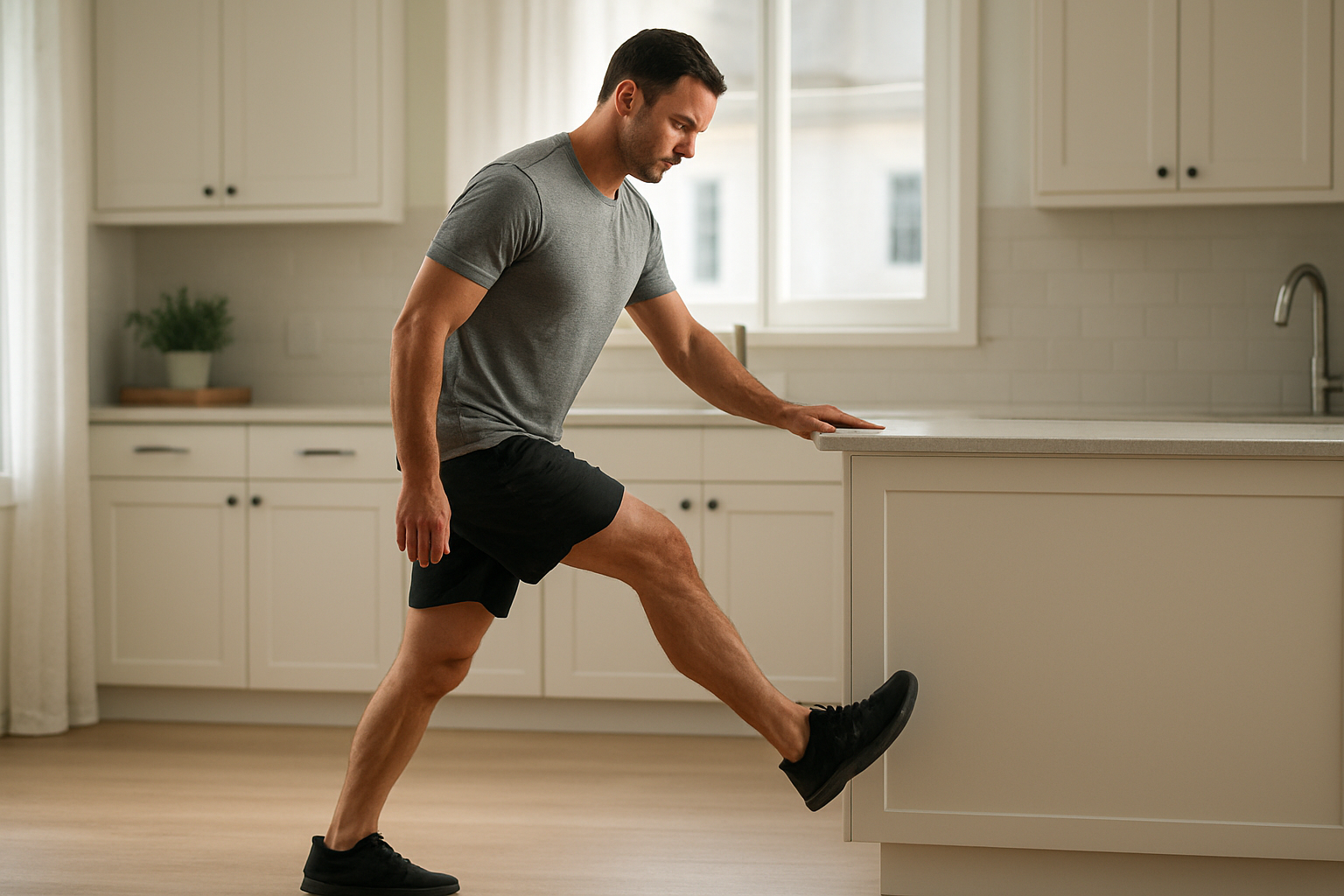
For a standing version, hold a sturdy surface and bend one knee, bringing the heel toward the back of the thigh. Lower the foot slowly without swinging. You can also perform the movement lying on your stomach if that position is comfortable.
Complete 2–3 sets of 10–15 repetitions per side. Keep the thigh mostly still and avoid forcing the heel higher than your comfortable range.
6. Calf raise
Best for: Building lower-leg strength and improving ankle control that supports walking and stepping.
Stand near a wall or countertop. Rise onto the balls of your feet, pause at the top, and lower your heels slowly. Keep your weight distributed evenly rather than rolling to the outside edges of your feet.
Use 2–4 sets of 8–20 repetitions. Progress from two legs to one leg only when you can maintain balance and a smooth range of motion.
7. Easy cycling
Best for: Low-impact conditioning and warm-ups when pedaling feels comfortable.
Set the bike so your knee remains slightly bent at the bottom of the pedal stroke. Begin with light resistance and a relaxed pace for 5–15 minutes. Increase duration before adding heavy resistance.
Cycling can be a useful alternative to repeated jumping or running, but it is not automatically pain-free. If symptoms increase as you pedal, reduce resistance, adjust the seat, or choose another conditioning option.
4. Build a simple knee-friendly leg workout
For a beginner session, warm up with five minutes of easy walking or cycling if tolerated. Then complete the following circuit for two rounds:
- Glute bridge: 10–15 repetitions
- Supported sit-to-stand: 6–10 repetitions
- Romanian deadlift: 8–12 repetitions
- Low step-up: 5–8 repetitions per side
- Calf raise: 12–15 repetitions
Rest about 60–90 seconds between exercises as needed. Train two nonconsecutive days per week at first, leaving enough time to assess how your knees respond. For progression ideas, see our guide to creating a progressive overload plan.
5. Adjust the workout when your knees are sensitive
If a movement is uncomfortable, change one variable rather than abandoning all lower-body training. Reduce the depth, slow the tempo, use more support, lower the step, or remove external weight.
Do not treat pain as a competition. Seek medical advice promptly if the knee is severely swollen, locks, repeatedly gives way, cannot bear weight, or became painful after a significant injury. A physical therapist or qualified clinician can help identify whether the issue is related to the knee itself or to the hips, ankles, or movement pattern.
The American Council on Exercise joint-friendly exercise guide is also useful for seeing how lower-body stability involves the hips, knees, and ankles together.
6. Common mistakes that make workouts less knee-friendly
- Starting too deep: A full-depth squat is not a requirement. Begin with the range you can control.
- Adding weight too soon: First make the movement repeatable, then increase resistance gradually.
- Ignoring the lowering phase: Many exercises become harder on the knees when you drop quickly.
- Training through escalating symptoms: Continuing while pain or swelling builds can make it harder to judge your tolerance.
- Only training the quadriceps: Glutes, hamstrings, calves, and trunk control also contribute to lower-body movement.
- Using unstable equipment unnecessarily: Balance challenges are not automatically better. Establish control on a stable surface first.
7. Action checklist and final recommendation
Before your next session, check the following:
- Choose two bilateral exercises and one single-leg or conditioning exercise.
- Keep one or two repetitions in reserve rather than forcing fatigue.
- Use a chair, wall, or rail when it improves control.
- Record which movements feel comfortable during training and the following day.
- Progress only one factor at a time: repetitions, range, resistance, or duration.
For most beginners, start with glute bridges, supported sit-to-stands, and calf raises. Add Romanian deadlifts when you can hinge confidently, then introduce low step-ups or cycling according to your goals and tolerance. If your main aim is strength, prioritize controlled resistance exercises; if you want conditioning, use easy cycling or walking; and if you have persistent or unexplained knee symptoms, get individualized guidance before progressing.
For related home-training ideas, explore LaokFitness, our guide to mobility exercises for tight hips, and our comparison of cycling versus running for weight loss.