The best dumbbell exercises for a full body workout are movements that cover the squat, hinge, push, pull, carry, and core patterns. For most people, a routine built around goblet squats, Romanian deadlifts, rows, presses, lunges, and carries is more useful than a long list of isolated exercises.
This guide ranks 10 practical dumbbell exercises by muscle coverage, usefulness, learning curve, and how easily they fit into a home workout. You will also find a sample routine, selection criteria, common mistakes, and adjustments for different training goals.
1. Use movement patterns to build a balanced workout
A full-body session should not simply combine random exercises. It should train the major muscle groups through different movement patterns, including the legs, hips, back, chest, shoulders, arms, and abdomen. The CDC recommends muscle-strengthening activities on at least two days per week and advises working all major muscle groups.
Use this table to decide whether an exercise deserves a place in your routine.
| Movement pattern | What to look for | Warning sign | Good dumbbell options |
|---|---|---|---|
| Squat | Knees track in line with toes; torso stays controlled | Heels lift or lower back rounds | Goblet squat, front squat |
| Hinge | Hips move back while the spine stays neutral | Movement comes mainly from the lower back | Romanian deadlift, suitcase deadlift |
| Push | Weights move without shoulder shrugging | Ribs flare or elbows cause shoulder discomfort | Floor press, overhead press |
| Pull | Shoulder blades move under control | Momentum replaces the rowing motion | One-arm row, supported row |
| Carry or brace | Trunk remains steady while you breathe | Leaning, twisting, or holding your breath | Farmer carry, suitcase carry |
2. Choose the best dumbbell exercises for a full body workout
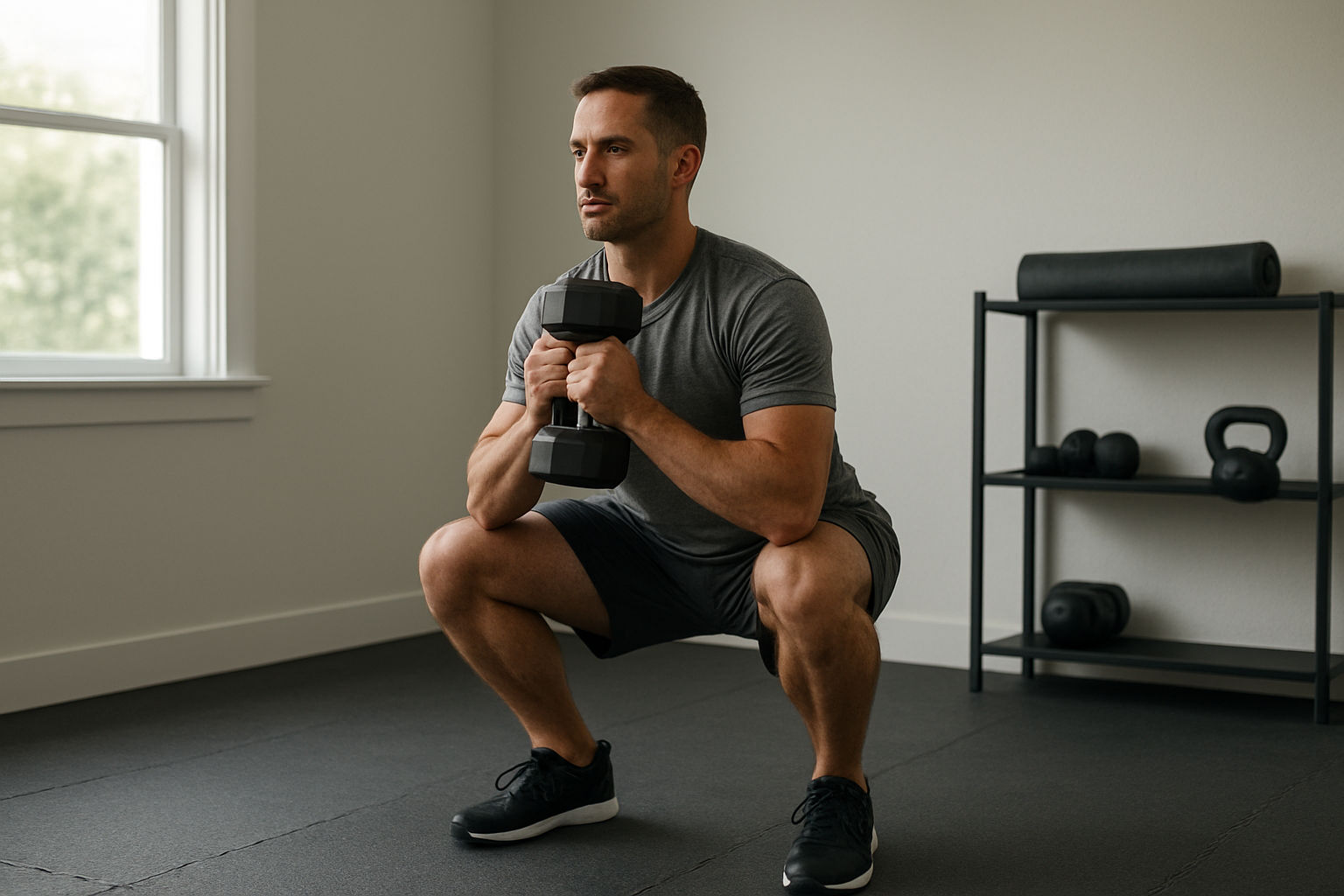
1. Goblet squat — best overall lower-body starting point
Hold one dumbbell close to your chest and squat as low as you can while maintaining control. The goblet position encourages an upright torso and makes it easier to learn the basic squat pattern than a heavily loaded bilateral variation.
Best for: Beginners, home workouts, and training the quadriceps, glutes, and trunk together.
Limitation: The amount of weight may eventually be limited by how comfortably you can hold the dumbbell.
2. Romanian deadlift — best for the posterior chain
Start with dumbbells in front of your thighs, soften your knees, and push your hips backward. Lower the weights until you feel tension in the hamstrings, then drive your hips forward without leaning backward at the top.
Best for: Hamstrings, glutes, and learning a safe hip hinge.
Limitation: Poor control or excessive range can shift work into the lower back.
3. One-arm dumbbell row — best upper-back exercise
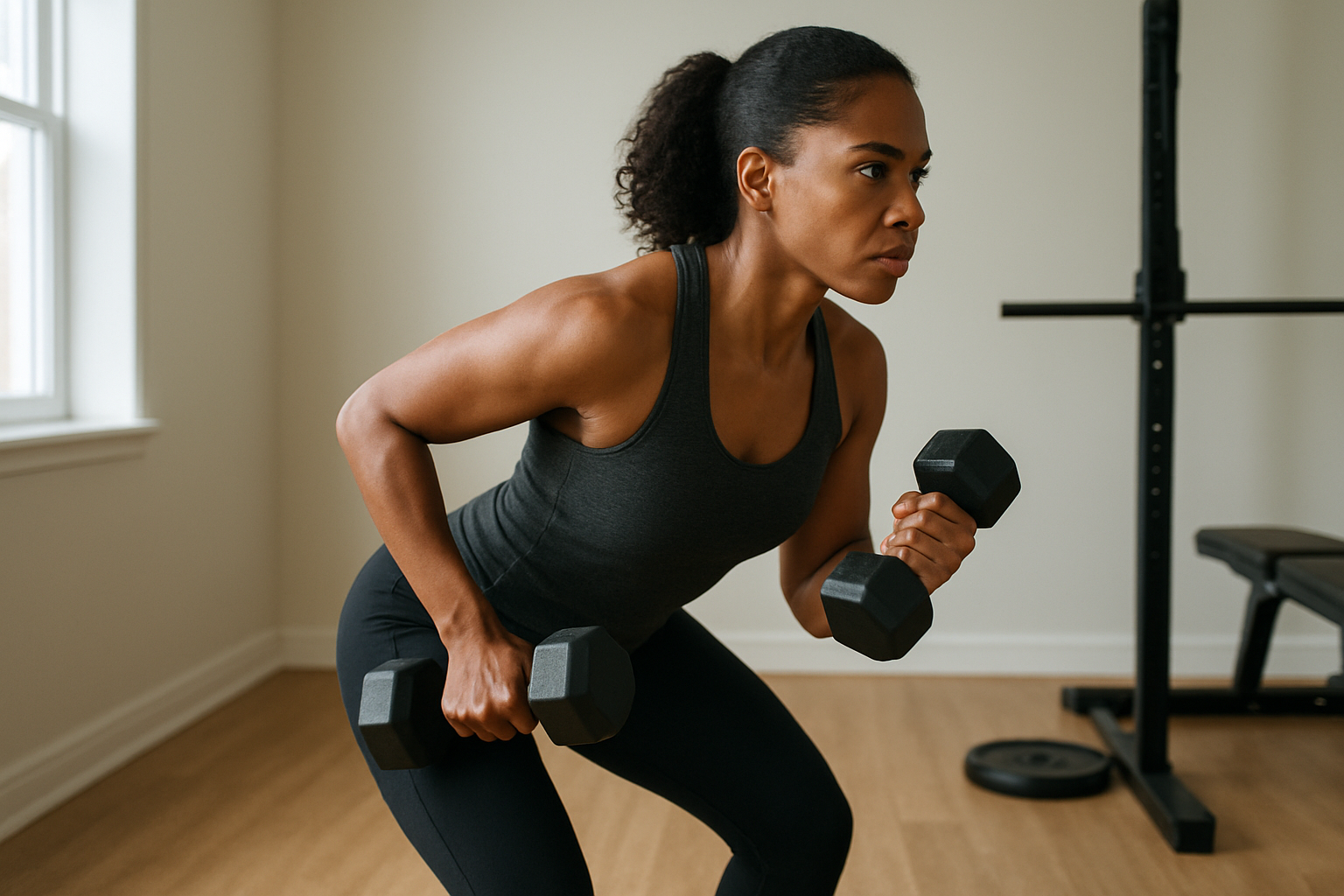
Support one hand on a bench, sturdy chair, or your thigh. Pull the dumbbell toward your hip while keeping your torso stable, then lower it slowly rather than dropping the shoulder forward.
Best for: The lats, upper back, rear shoulders, and grip.
Limitation: If you rotate your body to lift the weight, reduce the load or improve your support.
4. Dumbbell floor press — best home chest press
Lie on the floor with your knees bent and press the dumbbells upward. Your upper arms gently contact the floor at the bottom, which naturally limits shoulder extension and can make this a practical alternative when you do not have a bench.
Best for: Chest, triceps, and front shoulders.
Limitation: The floor restricts the range of motion compared with a bench press. For technique comparisons, see our guide to push-ups versus bench press.
5. Dumbbell reverse lunge — best single-leg option
Step backward and lower the rear knee toward the floor while keeping most of your pressure through the front foot. Reverse lunges are often easier to control than forward lunges because the backward step reduces the tendency to fall forward.
Best for: Glutes, thighs, balance, and identifying side-to-side differences.
Limitation: Hold onto support if balance is a limiting factor. Older adults or anyone with fall concerns can review these safe balance exercises.
6. Dumbbell overhead press — best shoulder push
Press the dumbbells from shoulder height while keeping your ribs stacked over your pelvis. You can perform the exercise seated for more support or standing to add a trunk-stability demand.
Best for: Shoulders, triceps, and upper-body pressing strength.
Limitation: Use a shorter range or a neutral grip if overhead movement causes discomfort. Pain is a reason to stop and seek appropriate professional advice rather than forcing repetitions.
7. Dumbbell step-up — best for practical leg strength
Place one foot on a stable, low platform and drive through that leg to stand. Keep the movement slow enough that you are not jumping off the floor leg or pushing excessively with your arms.
Best for: Glutes, thighs, balance, and activities that require climbing or stepping.
Limitation: The platform must be stable and low enough to maintain control.
8. Dumbbell clean to front squat — best conditioning combination
Move the dumbbells from a low position to your shoulders using a hip-driven motion, then perform a squat. Learn the clean and squat separately before combining them, and keep the load modest.
Best for: Time-efficient sessions and people who already have basic lifting coordination.
Limitation: It is more technical than the exercises above and is not the first choice for a complete beginner.
9. Farmer carry — best grip and trunk exercise
Hold a dumbbell in each hand and walk with tall posture. Keep your steps controlled, your shoulders level, and your breathing steady.
Best for: Grip, forearms, trunk bracing, posture, and simple conditioning.
Limitation: You need a clear walking path and enough space to put the weights down safely.
10. Dumbbell pullover — best optional chest-and-lat accessory
Lie on a bench or the floor, hold one dumbbell with both hands, and lower it slowly behind your head only as far as your shoulders can control. Return the weight without arching your lower back.
Best for: Adding variety after your main push and pull exercises.
Limitation: It is less essential for a full-body program than squats, hinges, rows, presses, and carries.
3. Build a simple full-body dumbbell workout
For a balanced beginner-to-intermediate session, use the following order. Start with exercises that require the most coordination, then finish with simpler movements.
- Goblet squat: 2–3 sets of 8–12 repetitions
- Romanian deadlift: 2–3 sets of 8–12 repetitions
- One-arm row: 2–3 sets of 8–12 repetitions per side
- Floor press: 2–3 sets of 8–12 repetitions
- Reverse lunge: 2 sets of 6–10 repetitions per side
- Farmer carry: 2–4 walks of 20–40 seconds
Rest long enough to repeat the next set with sound technique. The CDC notes that one set of 8–12 repetitions can be effective, while two or three sets may provide additional benefit. You can also review our guide on choosing the right dumbbell weight.
4. Adjust the routine to your goal and experience
For beginners
Start with four exercises: goblet squat, Romanian deadlift, one-arm row, and floor press. Train two nonconsecutive days per week, use a slow tempo, and stop each set when your technique begins to change.
For muscle growth
Keep most exercises in a moderate repetition range and add sets gradually. When you can complete the top end of your target range with consistent form, increase the weight slightly or add one repetition per set.
For general fitness
Use full-body circuits with controlled transitions, but do not rush technical exercises. Pair strength sessions with aerobic activity; federal guidance recommends both muscle-strengthening work and regular aerobic movement.
For additional planning ideas, compare this approach with our guides to yoga and Pilates or sprints and long-distance running.
5. Follow this safety and form checklist
- Warm up with several unloaded repetitions and easy movement.
- Keep the dumbbells close to your body during hinges and rows.
- Use a full range of motion only when you can control every part of it.
- Breathe continuously instead of holding your breath throughout a set.
- Place weights on a stable surface and keep the floor clear.
- Increase weight, repetitions, or sets gradually rather than changing everything at once.
The NHS also advises building up gradually and increasing repetitions over time. If you have a diagnosed condition, recent injury, chest symptoms, unexplained dizziness, or persistent joint pain, ask a qualified healthcare professional how to modify exercise before continuing.
Common mistakes when choosing dumbbell exercises
- Using only mirror-muscle exercises: Curls and lateral raises can be useful, but they should not replace leg, hip, back, and pressing movements.
- Choosing weight before choosing technique: A heavier dumbbell is not an improvement if it changes your range of motion or posture.
- Doing too many exercises: Six well-chosen movements are usually easier to progress than 15 loosely performed ones.
- Ignoring one-sided work: Lunges and one-arm rows can reveal control differences between sides.
- Training to failure on every set: Leave enough control to maintain safe technique, especially on hinges and overhead movements.
What if a movement does not feel right?
If an exercise causes sharp pain, numbness, unusual weakness, chest symptoms, or dizziness, stop rather than trying to work through it. For mild discomfort caused by position, test a lighter weight, shorter range, slower tempo, or a supported variation. If the problem persists, seek individual assessment from a qualified clinician or exercise professional.
Next actions for your first workout
- Choose one dumbbell weight that allows controlled practice.
- Clear a stable space and prepare a bench, chair, or wall for support if needed.
- Complete a brief warm-up and one easy practice set.
- Perform four to six exercises from the ranked list.
- Record repetitions, weight, and any form limitations.
- Repeat the session at least once before changing several variables.
Final recommendation: For most people, the best dumbbell exercises for a full body workout are goblet squats, Romanian deadlifts, one-arm rows, floor presses, reverse lunges, and farmer carries. Use that six-exercise foundation first, then add overhead presses or more technical combinations only when you can perform the basics consistently and without pain.
Sources: See the CDC guidance on muscle-strengthening activity, the NHS strength exercise guidance, and the American College of Sports Medicine resources.