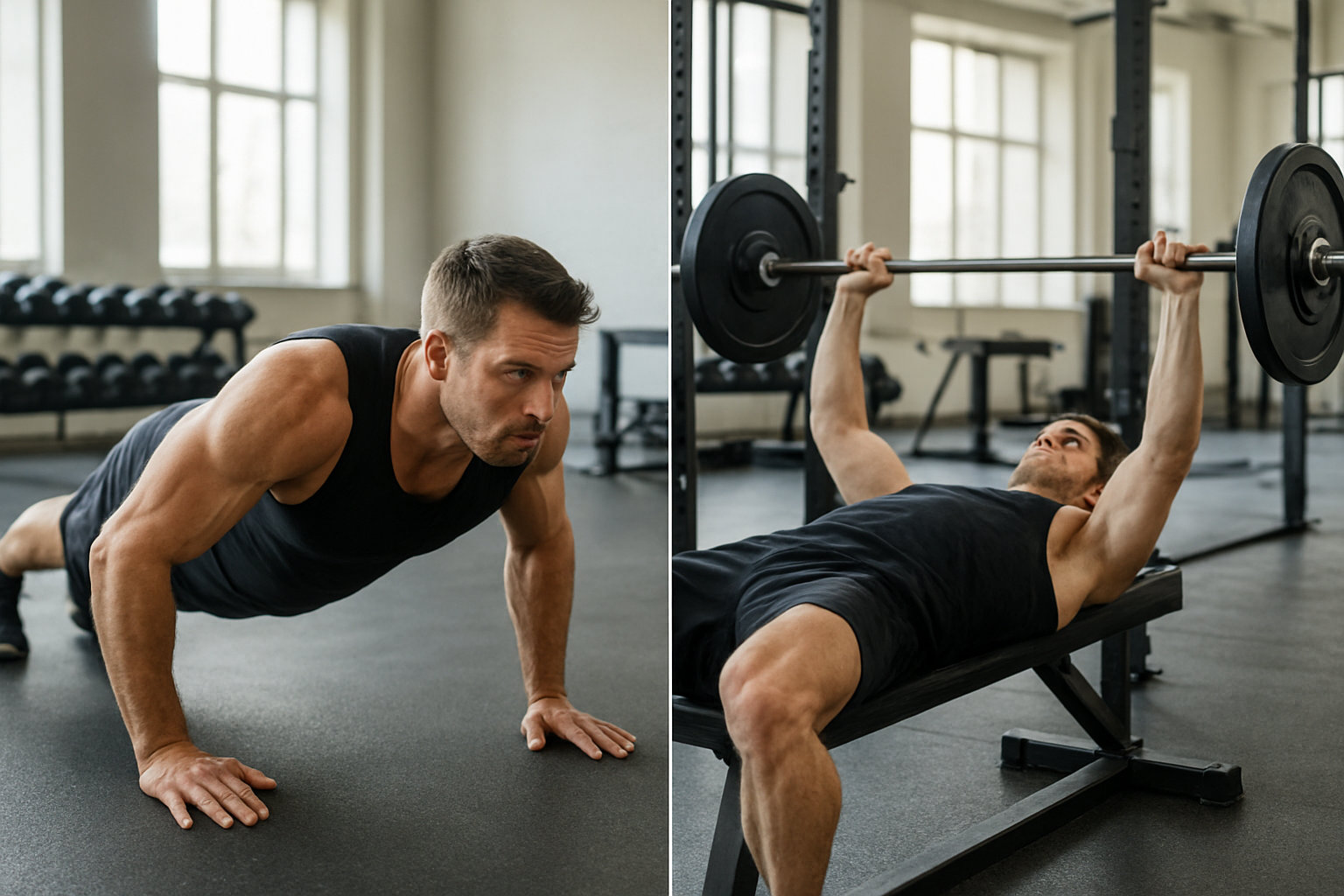
Quick verdict: Bench press is usually the better primary exercise for maximizing chest development because it makes progressive loading easier. Push-ups remain highly effective when you train them close to technical failure and progressively increase the challenge.
The better choice depends less on the exercise name and more on whether you can create a difficult, repeatable stimulus. This comparison explains how push-ups and bench presses differ, when each works best, and how to combine them without wasting training time.
1. Start with the real goal: muscle growth, strength, or convenience
Before comparing exercises, decide what “better” means for you. Chest development can include larger pectoral muscles, higher pressing strength, better muscular endurance, or simply having an exercise you can perform consistently.
- For chest hypertrophy: both can work if the sets are challenging, technique is controlled, and the workload progresses over time.
- For maximum barbell strength: the bench press is the more direct choice because it trains the exact movement with adjustable external resistance.
- For home training: push-ups are easier to start and require no rack, plates, or spotter.
- For general upper-body fitness: push-ups offer chest, triceps, shoulder, and trunk involvement in one movement.
Research comparing the two movements suggests that push-ups can produce similar muscle activation and training effects when the resistance is matched appropriately. That does not mean every version of a push-up equals every bench press. It means the difficulty and effort level matter greatly. ([pubmed.ncbi.nlm.nih.gov](https://pubmed.ncbi.nlm.nih.gov/31508485/))
2. Compare push-ups and bench press side by side
The table below focuses on practical training differences rather than declaring one exercise universally superior.
| Decision factor | Push-ups | Bench press |
|---|---|---|
| Resistance | Body weight, bands, a vest, plates, or harder variations | Barbell, dumbbells, or machine resistance with precise adjustments |
| Progression | Requires variations, added load, more repetitions, pauses, or slower tempo | Usually straightforward: add small amounts of weight or repetitions |
| Muscles involved | Chest, triceps, front shoulders, and core stabilizers | Chest, triceps, and front shoulders, with more support from the bench |
| Strength measurement | Repetitions and variation difficulty are useful but less standardized | Load and repetitions are easy to record and compare |
| Equipment | None for basic versions; a stable surface is helpful | Bench, weights, rack or machine, and ideally a safety setup |
| Technical demand | Requires whole-body alignment and shoulder-blade control | Requires setup, bar path, grip, wrist position, and controlled lowering |
| Best practical advantage | Accessible, portable, and easy to add to home workouts | Highly loadable and useful for systematic strength training |
3. Which exercise makes chest growth easier?
Why the bench press has an advantage for progressive overload
Muscle growth generally requires repeated hard sets and a gradually increasing training demand. With a bench press, you can adjust the load in small increments, keep the movement stable, and track your performance clearly. This makes it easier to identify whether your training is progressing.
The bench also supports your back and reduces the amount of whole-body stabilization required. That can allow you to focus more directly on pressing, although your shoulders, triceps, and upper back still contribute to the movement. For technique guidance, see our step-by-step bench press form guide.
Why push-ups can still build an impressive chest
A standard push-up becomes challenging when your available strength is close to the movement’s limit. You can increase difficulty with a weighted vest, resistance band, feet elevation, a deficit, a pause near the floor, or a slower lowering phase.
Push-ups also require you to maintain a rigid body position. That added demand is useful, but it can become the limiting factor before your chest receives enough stimulus. If your hips sag, your shoulders shift forward, or your range of motion becomes shorter, the set may feel difficult without providing a consistent chest-focused challenge.
For general exercise technique, the ACE push-up instructions emphasize maintaining body alignment and controlling the movement rather than rushing through repetitions. ([acefitness.org](https://www.acefitness.org/resources/everyone/exercise-library/41/push-up/))
4. Match the exercise to your training situation
Choose push-ups when you need simplicity
Push-ups are often the better option if you train in a small space, travel frequently, or do not yet have access to a reliable bench and rack. They are also useful for warm-up sets, conditioning circuits, and adding extra chest volume without needing another machine.
Beginners can start with hands on an elevated, stable surface, then progress to floor push-ups as strength improves. If standard push-ups are too easy, do not rely only on very high repetitions. Increase difficulty so that your target repetition range remains challenging with clean technique.
Choose bench press when you want measurable strength
The bench press is the more suitable main lift if you want to improve your one-repetition strength, practice a competition-style press, or build a structured upper-body program. It is also easier to balance training volume between sessions because the load can be recorded precisely.
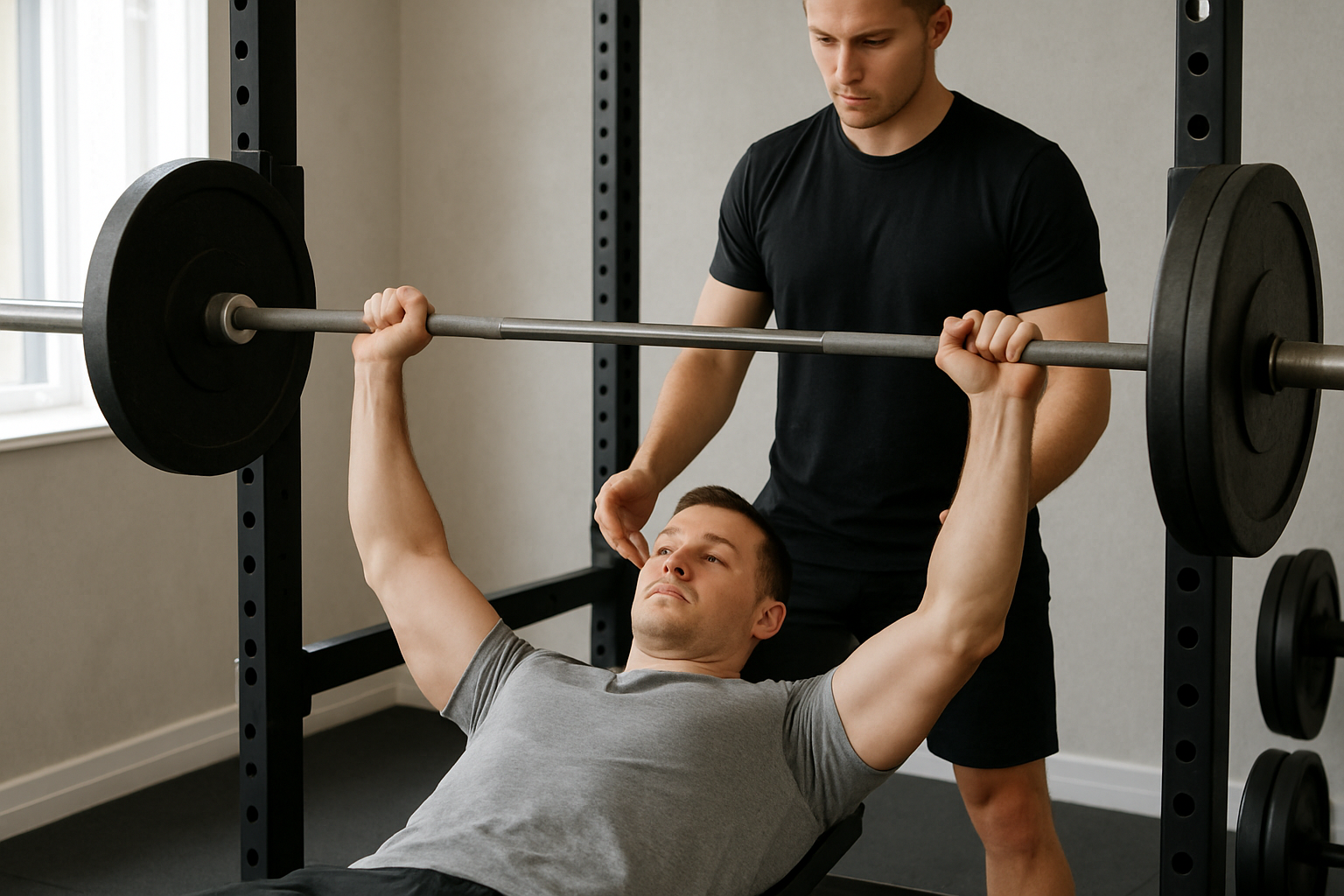
Use a rack with appropriate safety pins or a spotter when needed. Keep your feet stable, maintain a controlled bar path, and avoid turning every set into a test of maximum strength. The ACE chest press technique guide provides useful reminders about stable contact points and controlled positioning. ([acefitness.org](https://www.acefitness.org/resources/everyone/exercise-library/19/chest-press/))
5. Build a practical chest routine with either exercise
You do not need to choose one movement permanently. A simple approach is to make one exercise the primary strength movement and use the other as secondary volume.
- Home-focused routine: 3 to 5 challenging sets of push-ups, using an easier or harder variation as needed.
- Gym-focused routine: bench press first, followed by push-ups for controlled additional volume.
- Strength priority: use lower-repetition bench press sets with ample rest, then add moderate-repetition accessory work.
- Muscle-growth priority: use several hard sets in a moderate repetition range and stop when technique is close to breaking down.
- Limited equipment: use push-ups with a backpack only if the load is secure and does not shift during the movement.
Current resistance-training guidance from the American College of Sports Medicine emphasizes training major muscle groups regularly and building the workload gradually. The specific exercise is less important than following a plan you can perform consistently. ([acsm.org](https://www.acsm.org/effective-resistance-training-program-infographic/))
6. Common mistakes that distort the comparison
- Comparing an easy push-up with a hard bench press: match effort and difficulty before judging the movements.
- Chasing repetitions instead of progression: 40 easy repetitions may be less useful than 12 controlled, demanding repetitions.
- Using poor push-up alignment: keep your ribs, pelvis, and head controlled rather than allowing your lower back to collapse.
- Testing the bench press too often: frequent maximum attempts can reduce training quality and increase technical risk.
- Ignoring range of motion: use a repeatable depth that you can control without painful shoulder positions.
- Assuming soreness proves effectiveness: soreness is not a reliable measure of muscle growth or exercise quality.
7. What if one exercise causes discomfort?
Muscle effort and sharp or worsening joint pain are not the same thing. Reduce the range of motion, lower the load, try an easier variation, or stop the exercise if pain is sharp, persistent, or associated with weakness, numbness, swelling, or loss of normal movement.
For bench press, review your grip width, bar path, shoulder position, and setup. For push-ups, try an incline version, neutral hand handles, or a slightly narrower range that remains comfortable. If symptoms continue, seek assessment from a qualified healthcare professional rather than repeatedly testing the painful movement.
8. A quick decision checklist
- Can you train consistently with the equipment you have?
- Can you make the exercise gradually harder?
- Can you use a controlled, repeatable range of motion?
- Does the movement train your chest without distracting pain?
- Can you record sets, repetitions, variation, and effort?
- Does the exercise fit your main goal: strength, size, fitness, or convenience?
9. Best choice by scenario
- Best for maximum measurable pressing strength: bench press.
- Best for no-equipment home workouts: push-ups.
- Best for a beginner with limited strength: incline push-ups, then gradually lower the hand position.
- Best for an experienced lifter who needs more chest volume: bench press followed by a challenging push-up variation.
- Best for travel or short workouts: push-ups with planned progression.
- Best overall for flexibility: combine both and assign each a clear role.
10. Final verdict: push-ups vs bench press for chest development
For push ups vs bench press for chest development, the bench press usually wins as the easier tool for long-term, measurable loading. Push-ups are not merely a beginner substitute, however. When you increase their difficulty and train with consistent effort, they can contribute meaningfully to chest growth and upper-body strength.
Choose push-ups when convenience, portability, and whole-body control matter most. Choose the bench press when precise progression and maximum pressing strength are your priorities. If you have access to both, use the bench press for structured loading and push-ups for additional volume, variety, or home training days.