The right dumbbell weight is the heaviest load you can lift through your planned repetitions with controlled form and about one to three good repetitions still available. Start lighter than your estimate, test the movement, and increase gradually only when your technique remains consistent.
Choosing dumbbells this way helps you train the intended muscles without letting momentum, joint discomfort, or fatigue take over. This guide shows you how to select a starting weight, test it safely, adjust it for different exercises, and progress over time.
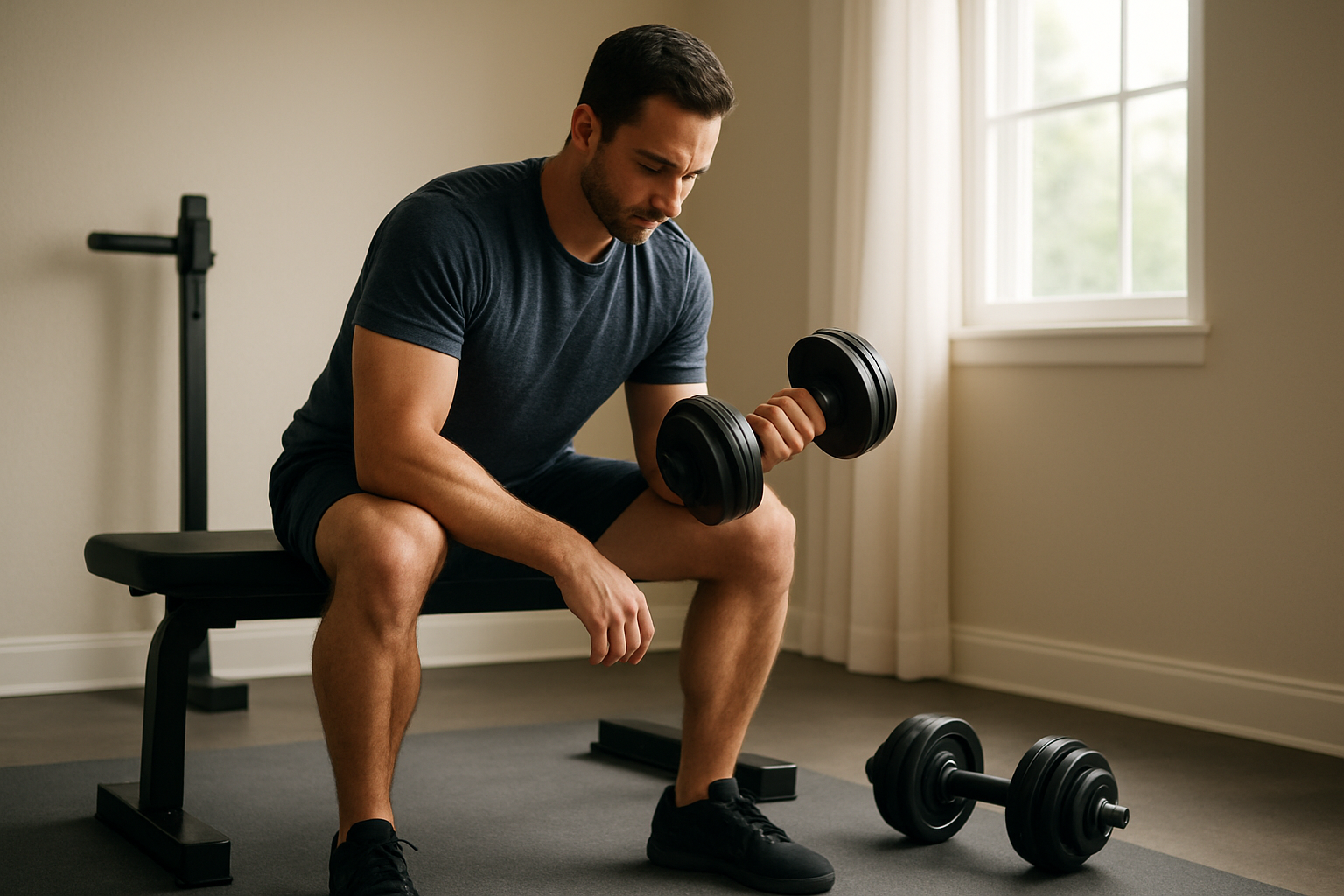
1. Define the exercise and your training goal
The correct dumbbell weight depends on the exercise, your experience, and what you are trying to improve. A weight suitable for a goblet squat may be far too heavy for a lateral raise because the exercises use different muscle groups and leverage.
Use your program’s repetition range as the starting point. General fitness sessions often use moderate sets such as 8 to 12 repetitions, while strength-focused work may use fewer repetitions with more rest. Muscle endurance work usually involves lighter weights and longer sets. The American College of Sports Medicine recommends matching load and training volume to the individual’s goal rather than treating one weight range as suitable for every exercise.
Before choosing a dumbbell, identify:
- The exercise and whether it is compound or isolation-based.
- Your target number of repetitions and sets.
- Whether the movement is unilateral, such as a one-arm row, or bilateral, such as a dumbbell bench press.
- Whether you are prioritizing strength, muscle growth, endurance, or movement practice.
If you are building a broader routine, this guide can complement our step-by-step bench press technique guide and our comparison of push-ups and bench press training.
2. Prepare the movement before testing the load
Do not use a heavy dumbbell to learn an unfamiliar exercise. First, review the movement, clear enough space, and perform several unloaded repetitions or use a very light pair. You should know where the exercise starts, where it ends, and which joints should remain stable.
Warm up with general movement and one or two easy practice sets. A warm-up should prepare you for the exercise without causing fatigue. For home training, check that the floor is level, the dumbbell handles are dry, and the weights can be placed down without rolling into your path.
For beginners, adjustable dumbbells or several light pairs can make small changes easier. A large jump between available weights may force you to change repetitions or choose a different exercise until your strength catches up.
3. Find your starting weight with a test set
Begin with a weight that feels conservative. You should be able to complete the first few repetitions while keeping the same range of motion, posture, and tempo. Do not select a load based only on what another person lifts.
- Perform five to eight controlled practice repetitions with a light dumbbell.
- Ask whether the movement feels stable and whether you can breathe normally.
- If the set is clearly easy, move up by the smallest available increment.
- Repeat until the final repetitions require effort but do not distort your technique.
- Stop the test if pain, sharp discomfort, unusual weakness, or loss of control appears.
A suitable starting weight usually makes the last few repetitions challenging without requiring swinging, bouncing, leaning, or holding your breath. The Centers for Disease Control and Prevention describes muscle-strengthening work as activity that makes it difficult to perform another repetition without help, but you do not need to train to complete failure in every set.
Use this practical comparison when adjusting your load:
Dumbbell weight selection checkpoints
| What to look for | What it usually means | What to do next | Warning sign |
|---|---|---|---|
| You complete the target reps with stable form | The load is probably appropriate | Keep it for the planned sets | Form deteriorates during later sets |
| You finish well below the minimum reps | The weight is too heavy | Reduce the load and retest | Joint pain or forced range of motion |
| You exceed the top of the range easily | The load is too light for that prescription | Increase slightly next set or session | You are using momentum to create difficulty |
| One side fails earlier | There may be a strength or control difference | Use the weaker side to set the repetitions | Persistent pain or marked asymmetry |
4. Adjust the weight for the exercise type
Large compound movements
Exercises such as goblet squats, dumbbell deadlifts, lunges, rows, and presses generally allow more load because several muscles work together. Even so, the correct weight is limited by the weakest part of the movement. For example, a dumbbell row may be limited by grip or shoulder control before your back muscles feel fully challenged.
Small isolation movements
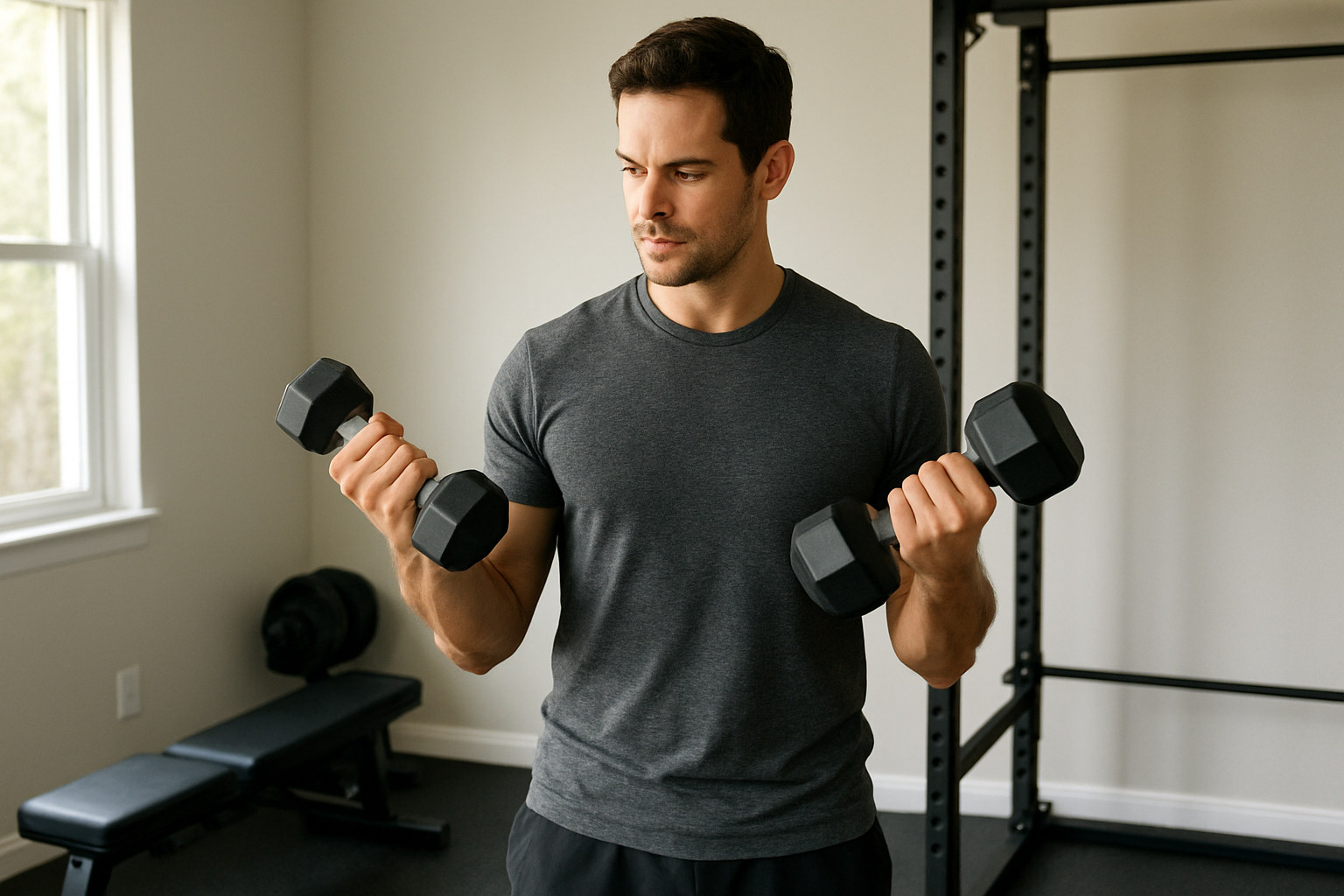
Lateral raises, rear-delt raises, curls, triceps extensions, and some shoulder exercises usually require lighter weights. These movements often expose poor control quickly. Choose a load that lets you pause briefly at the hardest point and lower the dumbbell without dropping it.
Unilateral exercises
Single-arm or single-leg exercises may feel harder because they demand balance and trunk control. Start with the weaker side, match its repetitions on the stronger side, and avoid using a heavier dumbbell simply because one side can manage it.
5. Use repetitions and effort to confirm the choice
Record the weight, repetitions, and how the set felt. A simple effort note such as “easy,” “moderate,” or “hard but controlled” is enough for most beginners. Over several sessions, this record is more useful than trying to find a perfect weight on the first attempt.
For many general-purpose sets, finish with roughly one to three repetitions left in reserve. This means you could probably complete one to three more clean repetitions, but doing so would require increasing effort. If every set ends with many repetitions still available, the load may be too light. If you regularly miss the target early, reduce it.
The NHS advises building up gradually and increasing repetitions over time. That approach is often more sustainable than making large weight jumps between workouts.
6. Progress without sacrificing technique
Use a progression rule instead of increasing weight whenever a workout feels good. For example, if your plan calls for 8 to 12 repetitions, keep the same weight until you can complete all sets near 12 repetitions with consistent form. Then increase the dumbbell by the smallest practical amount and return to the lower end of the range.
You can also progress by improving one variable at a time:
- Add one or two repetitions while keeping the same weight.
- Add a set only if your recovery and technique remain good.
- Use a slower lowering phase to increase control.
- Increase the dumbbell load by a small increment.
- Reduce rest only when endurance, rather than maximum strength, is the goal.
Do not increase load, repetitions, sets, and training frequency all at once. If your performance drops for several sessions, maintain or reduce the weight and review sleep, recovery, technique, and exercise order.
7. Avoid common weight-selection mistakes
- Choosing by ego: A heavier dumbbell is not better if it changes the movement.
- Using one weight for everything: Presses, rows, raises, curls, and leg exercises have different demands.
- Testing only the first set: A weight may feel manageable initially but become too heavy after fatigue accumulates.
- Ignoring range of motion: Shortening the movement can make an unsuitable load appear manageable.
- Training through pain: Muscle effort and burning are not the same as sharp pain, joint pain, or numbness.
- Changing too many variables: Keep the exercise and rep target stable while you learn how the weight affects performance.
8. Troubleshoot difficult situations
What if the available dumbbells are too light?
Increase repetitions, add a controlled pause, slow the lowering phase, or use a single-limb variation. These changes can make a light weight more challenging, but they should not turn a stable exercise into a rushed one.
What if the next dumbbell is too heavy?
Stay with the lighter weight and build more repetitions within your planned range. You can also add a set or use a shorter rest period if that matches your goal. Do not force the heavier weight simply because it is the next option.
What if your grip fails first?
Reduce the weight, rest longer, or use a different exercise variation. Persistent grip limitations, tingling, numbness, or unusual weakness should be assessed by a qualified healthcare professional.
What if you are returning after an injury?
Follow the guidance of your clinician or physical therapist. Start with a range of motion and load that has been cleared for you, and stop if symptoms worsen during or after training.
9. Use this checklist before your next dumbbell session
- Write down the exercise, target repetitions, and planned sets.
- Perform a light practice set before using your working weight.
- Choose a load that allows controlled range of motion.
- Check your breathing, posture, tempo, and joint position.
- Stop or reduce the load if technique changes noticeably.
- Record the result so your next adjustment is based on evidence.
- Progress one variable at a time.
10. Take your next action
Choose one dumbbell exercise you already know, select a conservative weight, and complete one test set within your programmed repetition range. Record whether you finished with stable form and one to three repetitions left in reserve. Use that result to set the weight for your next set, then reassess after the full workout rather than judging the load from a single repetition.
For a balanced routine, combine strength work with regular aerobic activity and recovery. Adults are generally advised to include muscle-strengthening activity on at least two days each week; you can also review the CDC’s adult activity guidelines, the NHS strength exercise guidance, and ACSM’s resistance-training recommendations.
The best answer to “how to choose the right weight for dumbbell exercises” is not a fixed number. It is the load that challenges the target muscles while allowing repeatable technique, appropriate effort, and gradual progress. Start conservatively, track your results, and increase the weight only when your form proves you are ready.