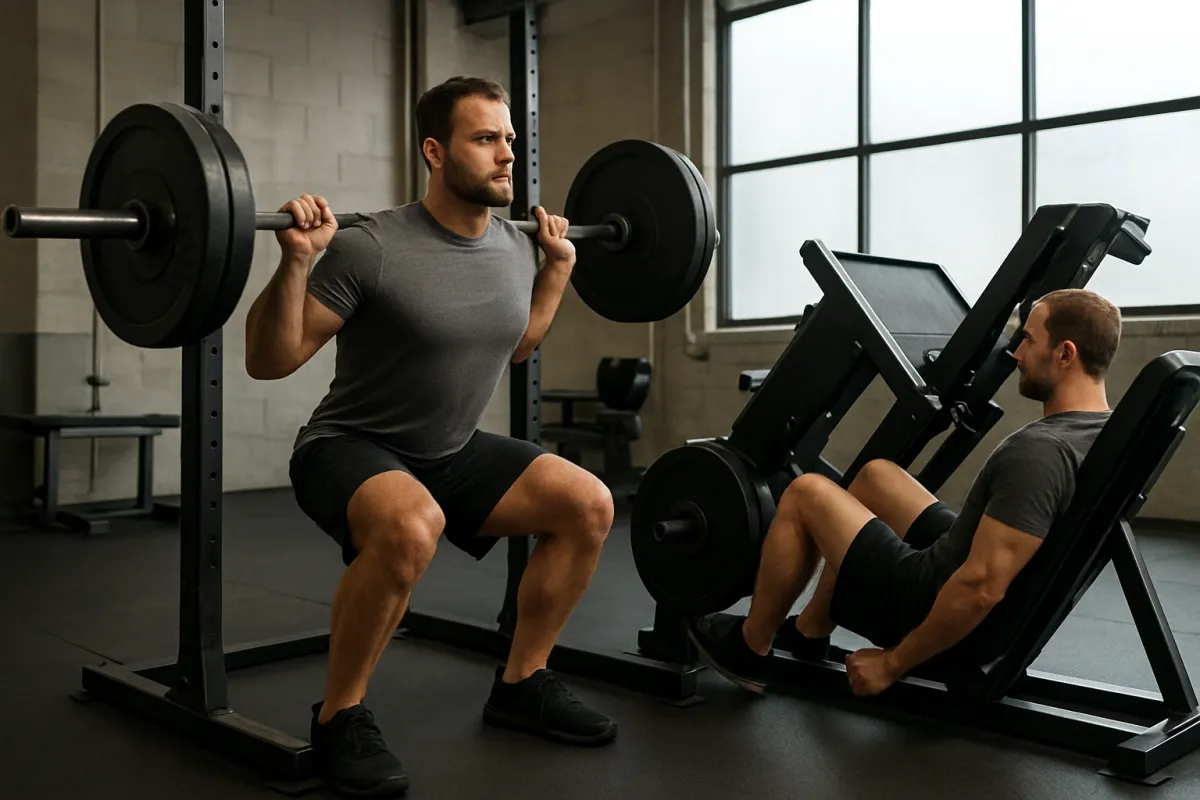
For most people, neither exercise is automatically best for muscle growth. Barbell squats offer more whole-body involvement and athletic carryover, while the leg press makes it easier to train the quads and glutes hard with less balance and bracing demand.
The better choice depends on your technique, joint tolerance, available equipment, recovery, and whether you want general strength or focused lower-body hypertrophy. This comparison will help you decide where each exercise belongs in a leg-training program.
1. Start with the real muscle-growth criteria
Muscle growth is driven less by the name of the exercise and more by whether you can train the target muscles consistently through a comfortable range of motion, use challenging loads, and progress over time. The American College of Sports Medicine’s current resistance-training guidance emphasizes matching the program to your goal, individualizing exercise selection, and prioritizing consistency over unnecessary complexity. Read the ACSM resistance-training overview.
When comparing squats and leg presses, evaluate these practical questions:
- Can you feel the intended muscles working without pain?
- Can you maintain reliable technique as the set becomes difficult?
- Can you add repetitions, load, or quality volume over several weeks?
- Does the exercise create more useful stimulus than fatigue for your current program?
- Can you perform it safely with the equipment and supervision available?
These criteria matter because a theoretically excellent exercise is not useful if you avoid it, perform it inconsistently, or cannot recover from it.
2. Compare barbell squats and leg presses side by side
The table below summarizes the main tradeoffs. It describes common tendencies, not fixed rules: stance, depth, machine design, body proportions, training experience, and load selection can all change the result.
Barbell squats vs leg press for muscle growth: practical comparison
| Training factor | Barbell squat | Leg press |
|---|---|---|
| Primary demand | Quads, glutes, adductors, trunk, and upper-back bracing | Mostly quads and glutes, with the machine providing stability |
| Balance and coordination | High; you must control the bar and body position | Low to moderate; the back pad and carriage provide support |
| Loading potential | High, but limited by technique and whole-body fatigue | High, with less balance-related limitation |
| Fatigue profile | Often more systemic fatigue and bracing demand | Usually easier to take the legs close to failure without losing balance |
| Progress tracking | Clear, but small technique changes can affect performance | Simple when seat position, stance, and depth remain consistent |
| Athletic transfer | Generally broader because it requires standing, bracing, and coordination | More exercise-specific; useful for leg strength but less demanding of stability |
| Best limitation workaround | Can be modified with stance, bar position, or depth | Reduces balance and spinal-loading demands, but machine setup still matters |
| Main warning sign | Depth or torso position changes sharply as fatigue rises | Hips tuck under, knees collapse, or the lower back loses contact with the pad |
3. Understand what each exercise is likely to emphasize
Barbell squats: a compound strength option
A barbell squat asks you to coordinate the hips, knees, ankles, trunk, and upper body at the same time. That makes it useful when you want lower-body muscle development alongside standing strength, bracing ability, and movement practice.
However, the limiting factor may not always be your legs. A tired back, weak brace, poor balance, or discomfort under the bar can stop the set before the quads or glutes are fully challenged. This does not make squats ineffective; it means the exercise has a larger skill and fatigue cost.
Squat mechanics are also adjustable. A deeper, controlled range may increase the training demand on different muscles, but depth should be selected according to your mobility, comfort, and ability to maintain position. Research on squat range of motion suggests that changing depth can affect training adaptations, so avoid treating one depth as universally correct. Review the range-of-motion squat study.
Leg presses: stable, focused lower-body volume
The leg press supports your torso and removes much of the balance requirement. That can let you concentrate on knee and hip extension, accumulate hard sets, and train close to muscular failure with less concern about a bar becoming unstable.
It is often a practical choice after squats, Romanian deadlifts, or split squats, when your stabilizing muscles are already tired. It can also be useful for beginners who are still learning free-weight technique, although machine setup and controlled range of motion still require instruction.
A leg press is not automatically safer in every situation. Using excessive load, allowing the pelvis to roll off the pad, or lowering the carriage beyond the range your hips can control may create unnecessary stress. Stop the descent before your lower back rounds or your hips lose a stable position.

4. Match the exercise to your training scenario
Choose barbell squats when…
- You want to develop general lower-body and whole-body strength.
- You enjoy practicing a free-weight movement and can maintain consistent technique.
- You participate in sports where standing force production and coordination matter.
- You have suitable rack, safeties, footwear, and—when needed—a reliable spotter.
Squats should not be selected simply because they are considered more “functional.” If they cause persistent pain or prevent you from getting enough productive leg volume, another squat variation or machine-based movement may be a better fit.
Choose the leg press when…
- You want additional quad or glute volume after a demanding compound lift.
- Balance, confidence, or bar positioning limits your squat performance.
- You are managing training fatigue and want a more supported movement.
- You can adjust the seat and foot position to achieve a controlled, pain-free range.
For more single-leg work, compare this option with our guide to Bulgarian split squats at home. Unilateral exercises add a different balance and coordination challenge, so they are not direct replacements for every set of leg presses.
5. Build a program instead of choosing a winner
A useful approach is to give each exercise a distinct job. You might place barbell squats first when strength and technical practice are priorities, then use the leg press for controlled hypertrophy volume. Alternatively, you could use the leg press as your primary movement during a phase when fatigue management or joint comfort is more important.
Keep the comparison fair by standardizing the variables that matter:
- Use a repeatable stance, depth, and tempo.
- Record sets, repetitions, load, and meaningful technique notes.
- Progress gradually rather than adding weight whenever form deteriorates.
- Leave enough recovery between hard lower-body sessions.
- Judge progress by performance, measurements, photos, and how well you recover—not by soreness alone.
General resistance-training guidance supports using a range of loads and repetitions when sets are sufficiently challenging, rather than assuming that one narrow repetition range is required. See the ACSM training-plan takeaways.
6. Avoid common decision mistakes
- Comparing numbers from different machines: Leg-press loads are not standardized across machines, so do not compare the stack or sled number directly with your squat.
- Chasing depth without control: A deeper repetition is not automatically better if your pelvis, knees, or spine lose position.
- Using soreness as proof: Soreness can occur after either exercise, but it does not reliably measure muscle growth.
- Ignoring setup: Seat angle, foot placement, bar position, and stance width can change which muscles limit the set.
- Changing exercises too often: Frequent variation makes it harder to identify whether your program is actually progressing.
- Taking every set to failure: Near-failure work can be productive, but technical lifts often benefit from stopping before form breaks down.
7. What if one exercise bothers your joints or back?
First, reduce the load and check whether your range, stance, and setup are appropriate. A temporary modification—such as a lighter squat, a shorter controlled range, or a leg press with a different foot position—may help you identify whether the problem is technique or exercise tolerance.
Do not force painful repetitions or assume discomfort is something you must “push through.” Seek assessment from a qualified healthcare professional if pain is sharp, worsening, associated with numbness or weakness, follows an injury, or persists despite sensible modifications.
8. Your lower-body decision checklist
- Define whether your priority is hypertrophy, general strength, athletic transfer, or convenience.
- Choose the movement that lets you train the target muscles consistently.
- Use a controlled range that your joints and technique can tolerate.
- Keep setup and execution consistent enough to track progress.
- Use the second exercise if it adds useful volume without overwhelming recovery.
- Review progress after several weeks, not after one unusually difficult workout.
If you are building a broader lower-body routine, our guides to dumbbell Romanian deadlifts and glute exercises for home training can help you cover hip-dominant work as well as knee-dominant work.
Final verdict: barbell squats vs leg press for muscle growth
For barbell squats vs leg press for muscle growth, the conditional answer is simple: use barbell squats when their free-weight demands support your goals, and use the leg press when stability lets you train your legs harder and more consistently. If both are comfortable and recoverable, squats can provide the main compound stimulus while leg presses add focused volume.
The best exercise is the one you can perform well, progress patiently, and recover from. Choose based on your actual training response—not on the idea that one movement must win every category.