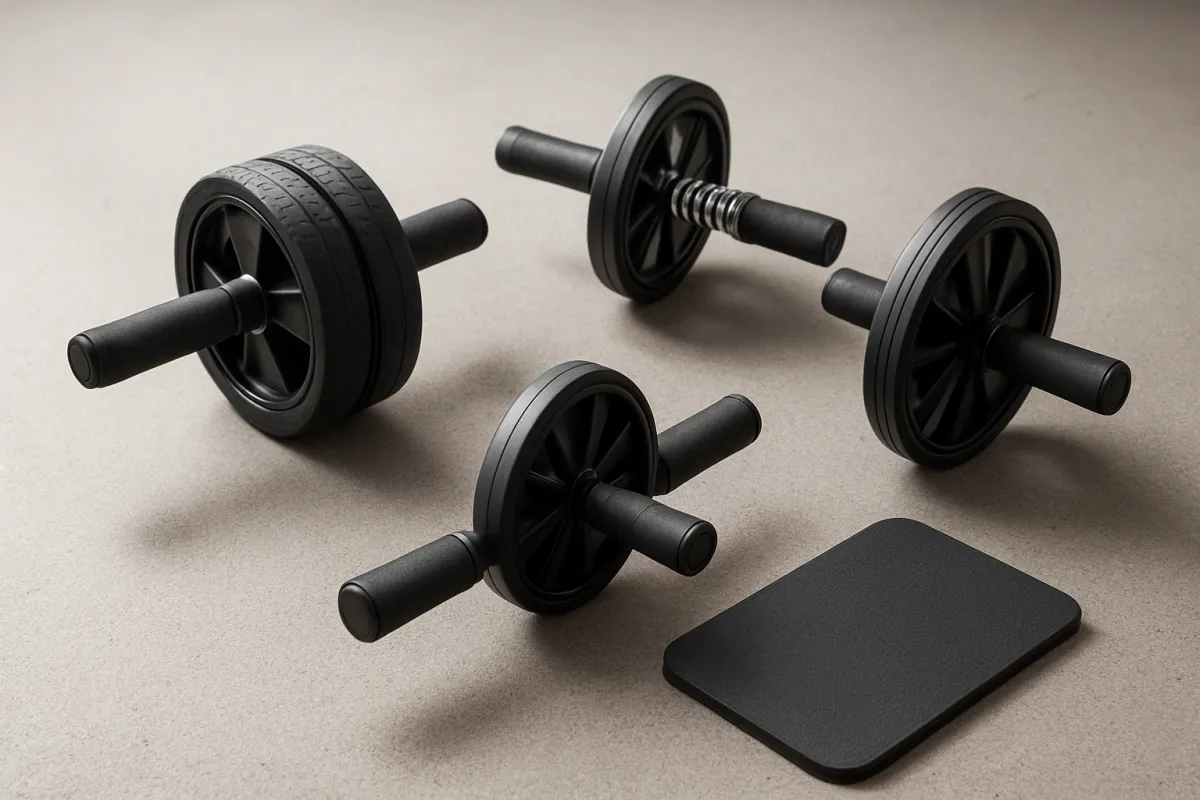
For most beginners, the best ab roller is a stable dual-wheel model with grippy handles and a usable knee pad. If you already have solid plank control, a single-wheel roller with smooth bearings can offer a better long-term challenge.
An ab roller is compact, inexpensive compared with many home-gym machines, and capable of making a short core session demanding. It is also easy to use poorly: rolling too far, letting the lower back sag, or choosing an unstable wheel can turn a controlled exercise into an uncomfortable one.
This guide compares five practical options for different starting points. The rankings focus on stability, control, construction, comfort, storage, and how easily you can progress from short kneeling rollouts to a fuller range of motion. Product availability and prices can change, so check the current specifications before buying.
1. Decide whether an ab roller is the right starting point
The kneeling ab rollout is not simply a moving crunch. Your shoulders, arms, hips, and trunk work together to resist extension as the wheel travels away from your knees. That makes the movement useful, but it also means the exercise can exceed a beginner’s current control.
NASM lists the plank as a beginner exercise and describes it as a movement requiring a straight body line, which is a useful basic prerequisite for learning to brace. A rollout does not require you to pass a formal fitness test, but you should be able to hold a controlled plank without pain or obvious sagging before practicing very short wheel movements. ([nasm.org](https://www.nasm.org/workout-exercise-guidance/default?slug=plank&utm_source=openai))
- Start with a plank, dead bug, or bird dog if you cannot brace without holding your breath.
- Use a thick mat or separate knee pad; hard floors can distract you from your form.
- Begin from your knees, not your feet. Standing rollouts are an advanced progression.
- Stop if you feel sharp pain, numbness, or pain that persists after the session.
A wheel will strengthen your trunk, but it will not selectively remove belly fat or guarantee visible abdominal definition. Treat it as one resistance exercise within a broader routine that includes strength work, regular activity, recovery, and nutrition.
2. Compare the best ab rollers for beginners
The following picks are ranked by beginner suitability rather than by maximum difficulty. A more advanced wheel is not automatically a better choice if it makes you lose position after one or two repetitions.
Comparison table: beginner-focused ab roller features
| Product | Best for | Design strengths | Main limitation |
|---|---|---|---|
| GoFit Super Ab Wheel | Most first-time users | Dual wide wheels, grippy tread, soft rubber handles | No built-in assistance or braking system |
| Perfect Fitness Ab Carver Pro | Users who want assisted return | Spring-resistance concept and directional control | More moving parts and a less minimal design |
| VINSGUIR adjustable resistance roller | Progressive home training | Assistance band can reduce the initial challenge | More accessories to set up and inspect |
| Sports Research Ab Wheel Roller | Comfort-conscious beginners | Wide wheel format and included knee-pad style package on some listings | Verify the exact package and current availability |
| Rogue Ab Wheel | Beginners with a strong base | Rubber tread, sealed bearings, robust shaft and handles | Single wheel demands more steering control and costs more |
1. GoFit Super Ab Wheel — Best overall for beginners
Best for: New users who want a simple, stable wheel without a complicated setup.
The GoFit Super Ab Wheel uses dual wheels with wide treads and a traction surface. It also has soft rubber handles and urethane wheel hubs. That combination makes it a sensible first pick when balance and hand comfort matter more than advanced features. The manufacturer lists a 7-inch diameter and 13-inch total width, along with a training manual. ([gofit.net](https://gofit.net/products/super-ab-wheel?utm_source=openai))
Its limitation is also its simplicity. There is no built-in spring assistance, so you must control both the rollout and the return. Begin with a short range and increase distance only when your ribs, hips, and lower back remain in the same controlled position.
2. Perfect Fitness Ab Carver Pro — Best for assisted return control
Best for: Beginners who find the return phase difficult and prefer a more guided-feeling design.
The Ab Carver Pro is built around a spring-assisted roller concept. In practical terms, the assistance is intended to help you steer back toward the starting position, which can make short kneeling repetitions feel more manageable. Perfect Fitness describes the product as suitable for people at different fitness levels and positions it as an alternative to conventional sit-up training. ([perfectfitness.com](https://www.perfectfitness.com/about/?utm_source=openai))
Do not treat assistance as permission to rush. The spring does not replace bracing, and you still need to control the wheel rather than allowing it to pull you forward or snap you back. Check the mechanism periodically and avoid buying an older or incomplete unit without confirming its condition.
3. VINSGUIR adjustable resistance ab roller — Best for gradual progression
Best for: Users who want to begin with assistance and reduce it as their control improves.
Adjustable resistance-band rollers are designed around a useful beginner idea: shorten the effective challenge first, then work toward unassisted repetitions. The band can help you practice the movement pattern while limiting how much bodyweight you must control at the far end of the rollout.
The trade-off is setup and inspection. You need to confirm that the band is attached correctly, does not rub against sharp edges, and is not cracked or overstretched. Because listings can vary, check whether the current package includes the band, knee pad, and the specific wheel configuration shown in the listing before ordering.
4. Sports Research Ab Wheel Roller — Best for a comfort-oriented setup
Best for: Beginners who want a conventional wheel with extra attention to grip and knee comfort.
A basic roller can be entirely adequate if it tracks straight, has handles that do not flex noticeably, and rolls smoothly on the floor you use. Sports Research models are commonly sold as a wide-wheel roller package with a knee-pad accessory, but package contents can change by retailer or product version.
This is a practical category rather than a reason to chase a particular feature count. Verify the wheel width, handle attachment, included pad, user-weight guidance, and return policy. If the roller feels loose before you begin, do not assume it will settle during exercise.
5. Rogue Ab Wheel — Best durable single-wheel option
Best for: Beginners who already have dependable plank and kneeling-rollout control and want a long-lasting, more demanding tool.
The Rogue Ab Wheel has an 8-inch rubber wheel, sealed bearings, a nickel-plated steel shaft, and rubber handles. Its slightly rounded wheel edges are intended to make the user control the wheel’s line rather than relying on a broad dual-wheel base. ([roguefitness.com](https://www.roguefitness.com/rogue-ab-wheel?utm_source=openai))
That precision is valuable for experienced trainees, but it is not the easiest introduction. The single wheel can wobble or turn if your hands are uneven or your shoulders shift. It also does not solve knee comfort by itself, so plan to use a mat or separate pad.
3. Match the roller design to your needs
Stability comes before difficulty
Dual-wheel models usually provide a broader base of support. This can make the first few short rollouts easier to steer, especially if you are still learning how to keep your shoulders and hips aligned.
A single wheel can be excellent, but it exposes side-to-side errors more clearly. Choose it when you want a precise challenge and are prepared to reduce your range of motion whenever the wheel starts drifting.
Assistance is useful, but only if you can reduce it
Resistance bands and spring-assisted systems may help you learn the movement. The best progression is not to depend on assistance permanently; it is to use enough help to maintain control, then gradually increase range or reduce support.
Look closely at contact points
- Handles: Look for a firm attachment, a non-slip surface, and enough length for a natural hand position.
- Wheel tread: Rubber or textured material is generally more suitable than a slick plastic surface on smooth floors.
- Bearings: Smooth rotation can help you focus on bracing instead of fighting a jerky axle.
- Knee support: A small included pad is convenient, but thickness and firmness matter more than its inclusion alone.
- Storage: Removable handles or a compact frame can be useful if you train in a shared room.
4. Learn the beginner rollout before chasing more repetitions
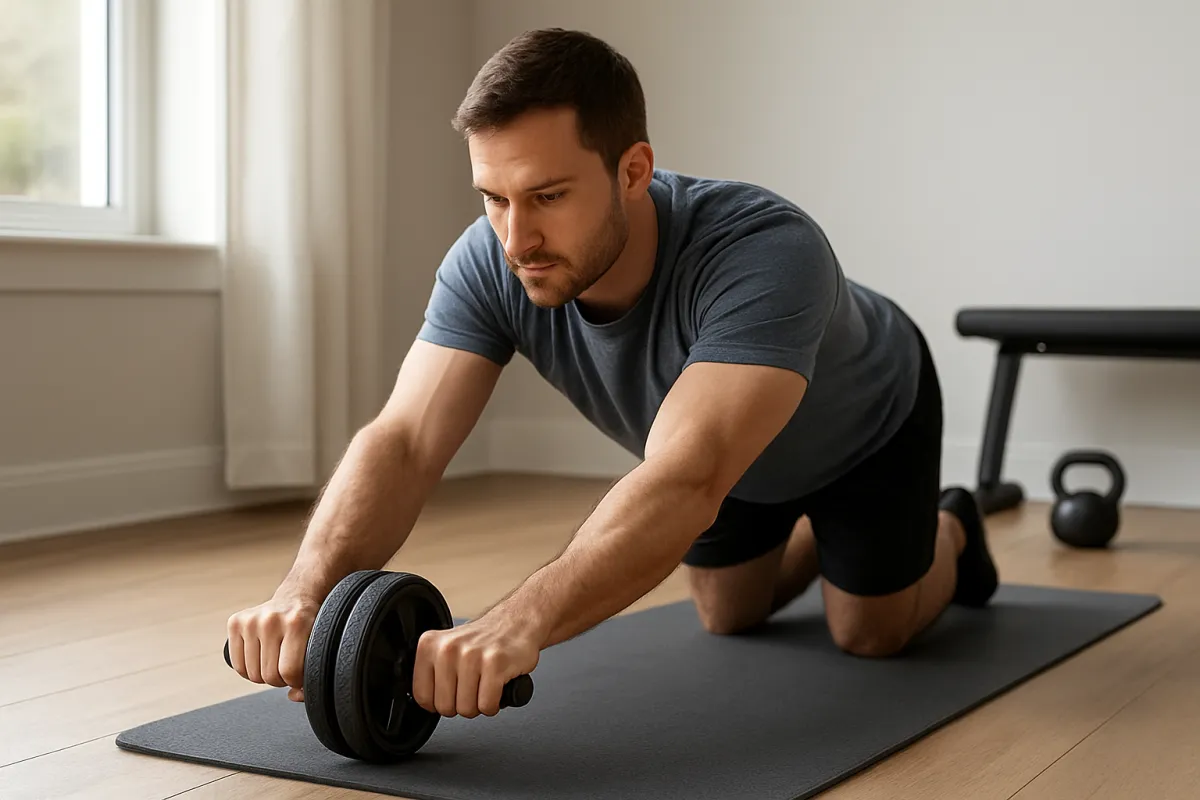
Place the wheel under your shoulders and kneel on a mat. Grip the handles, brace as if preparing for a light punch, gently tuck your pelvis, and keep your ribs from flaring upward.
Roll forward only as far as you can maintain that position. Pause briefly, then pull the wheel back by bringing your hips and ribcage together rather than bending sharply at the waist. Keep the movement slow enough that the wheel does not shoot away.
Start with two or three controlled sets of a few repetitions, leaving several good repetitions in reserve. The exact number depends on your current strength; quality and repeatable positioning matter more than reaching a preset count. For additional form guidance, compare this movement with the stabilization principles used in correct dumbbell Romanian deadlift technique, especially the emphasis on maintaining a controlled trunk.
Useful progressions
- Plank holds and dead bugs.
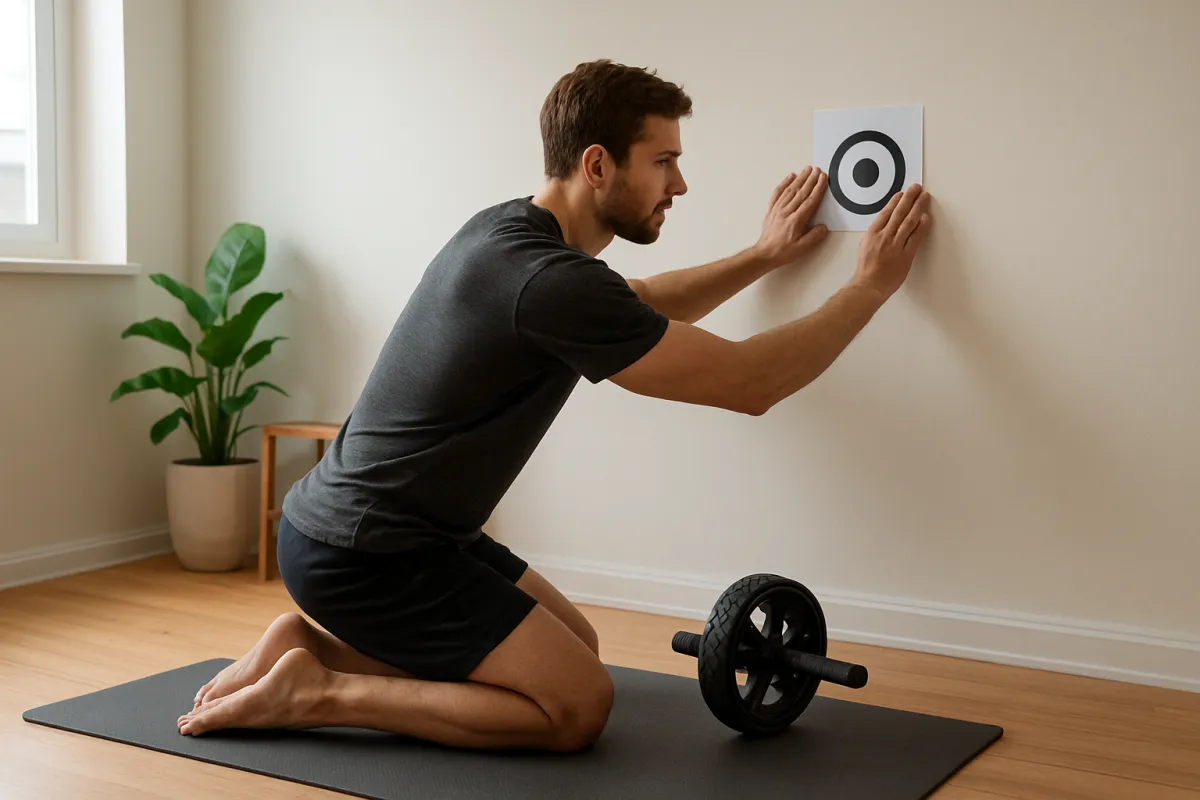
- Short kneeling rollouts toward a wall or other physical stopping point.
- Longer kneeling rollouts with a controlled return.
- More repetitions or an additional set, but not both at once.
- Full-range kneeling rollouts.
- Only later, advanced variations such as standing rollouts.
A wall target is useful because it limits distance while you learn control. Move the target farther away in small increments rather than testing your maximum range on every set.
5. Avoid these common buying and training mistakes
Common selection mistakes
- Choosing the cheapest wheel without checking whether the handles flex or the axle feels loose.
- Assuming a wider wheel automatically makes the exercise easy.
- Buying a spring-assisted model without confirming that replacement parts or maintenance information are available.
- Ignoring floor compatibility. A hard, slippery surface may make a stable wheel feel unstable.
- Focusing on included accessories while overlooking wheel tracking and handle security.
- Purchasing a single-wheel model when you have not yet built basic plank control.
Common technique mistakes
- Rolling from the hips while the lower back arches.
- Allowing the shoulders to shrug toward the ears.
- Holding the breath through every repetition.
- Trying to reach the floor instead of stopping at the farthest controlled point.
- Training the movement hard every day without allowing recovery.
6. What if the ab roller causes discomfort?
Mild muscular fatigue in the abdominals, shoulders, or upper back can be expected when the exercise is new. Sharp pain, tingling, joint pain, or symptoms that worsen as you continue are reasons to stop rather than adjust the wheel blindly.
If your lower back repeatedly feels strained, shorten the rollout, use a wall target, and practice planks or dead bugs for several sessions. If pain persists, follows an injury, or affects normal activities, consult a qualified healthcare professional before returning to rollouts.
For a broader home-training plan, you can pair short core sessions with lower-body movements such as Bulgarian split squats at home and choose cardio based on your schedule using the HIIT versus steady-state cardio guide.
7. Beginner ab roller checklist
- Choose dual wheels if balance and steering are new concerns.
- Choose assistance only when it helps you control the full movement.
- Confirm wheel tread and handle security before every session.
- Use a firm mat for your knees and a surface where the wheel tracks consistently.
- Set a distance limit before you begin.
- Keep your ribs, hips, and shoulders controlled throughout each repetition.
- Progress one variable at a time: range, repetitions, sets, or less assistance.
8. Final recommendations by scenario
Choose the GoFit Super Ab Wheel if you want the clearest, most stable introduction to kneeling rollouts. Its dual-wheel layout and grippy contact points make it the most straightforward choice for many first-time users.
Choose the Perfect Fitness Ab Carver Pro if returning the wheel is your main obstacle and you prefer assisted control. Use the assistance as a bridge, not as a substitute for gradually building strength.
Choose an adjustable resistance-band roller if you want a progression system built into the equipment and are willing to inspect the band and setup regularly.
Choose the Rogue Ab Wheel if durability and a precise single-wheel challenge matter more than beginner stability. It is best suited to someone who can already perform short kneeling rollouts without losing position.
The best ab rollers for beginners are not the most advanced-looking models. They are the ones that let you start with a short, controlled range, protect your knees and hands, and progress without forcing your lower back to compensate. For most new users, buy the stable dual-wheel option, set a conservative distance, and earn more range through consistent technique.