The best balance exercises for older adults are supported single-leg stands, heel-to-toe walking, sit-to-stands, heel raises, side-stepping, tai chi, and controlled leg movements. Start with an exercise that matches your current stability, use a sturdy support, and progress gradually rather than testing your balance with difficult movements too soon.
Balance practice can help you move more confidently during everyday activities such as standing from a chair, turning, stepping over obstacles, and walking on uneven ground. This guide compares practical options, explains what each exercise develops, and shows how to build a simple routine at home.
1. How to choose the right balance exercise
A useful balance routine should challenge you without making you feel unsafe. Look for exercises that improve one or more of these abilities: staying steady while standing, shifting weight, controlling your hips and ankles, stepping in different directions, and recovering from small changes in position.
The CDC guidelines for older adults recommend including balance activities alongside aerobic and muscle-strengthening exercise. If you have a chronic condition, recent surgery, repeated falls, severe dizziness, or a diagnosed neurological or vestibular problem, ask a health professional how to adapt exercise for you.
Use a kitchen counter, heavy table, or stable chair for support. Avoid lightweight chairs, wheeled furniture, slippery rugs, and exercises performed close to stairs.
2. Best balance exercises for older adults ranked
| Rank | Exercise | Best for | What to look for | Warning sign |
|---|---|---|---|---|
| 1 | Supported single-leg stand | Improving static balance | Small, controlled weight shifts | Gripping hard or leaning heavily |
| 2 | Heel-to-toe walking | Walking stability | Slow steps along a clear path | Feet crossing or rushed steps |
| 3 | Sit-to-stand | Leg strength and transitions | Controlled rise and lowering | Knees collapsing inward |
| 4 | Side-stepping | Hip control and lateral movement | Small steps with toes facing forward | Dragging or crossing the feet |
| 5 | Heel raises | Ankle strength and stability | Even pressure through both feet | Rocking or bouncing |
| 6 | Tai chi | Gentle whole-body practice | Slow weight transfers and relaxed breathing | Unsupervised difficult positions |
| 7 | Standing leg movements | Weight shifting and hip control | Upright posture with light support | Twisting the trunk to compensate |
1. Supported single-leg stand
Best for: Building basic standing balance.
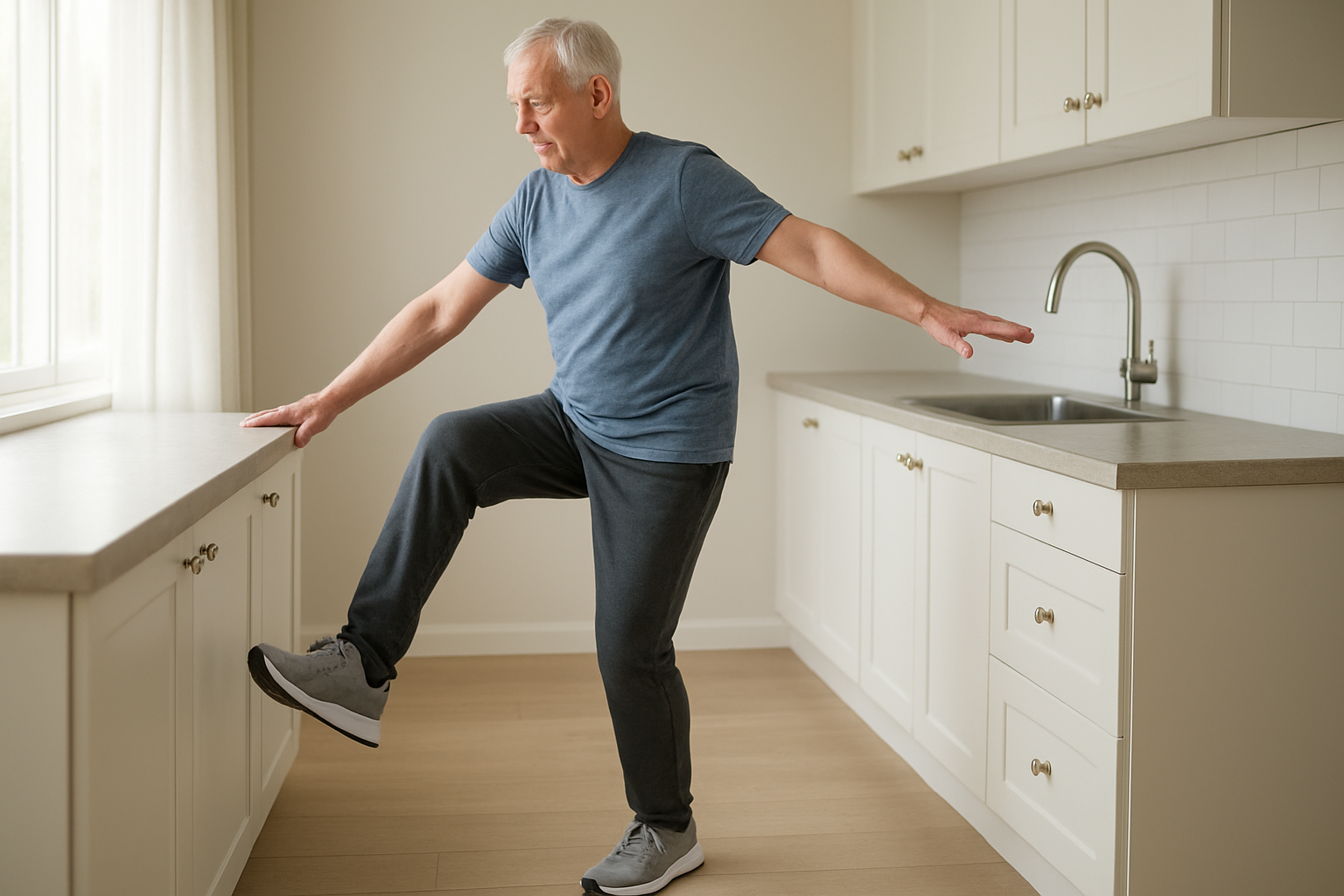
Stand beside a sturdy support and place one or two fingertips on it. Lift one foot slightly from the floor, hold briefly, then lower it with control. Keep your standing knee soft rather than locked. Begin with very short holds and switch sides.
This is a useful progression because you can adjust the challenge easily: use both hands, one hand, fingertips, or less support as your control improves. Do not close your eyes unless a qualified professional specifically instructs you to do so.
2. Heel-to-toe walking
Best for: Improving control while walking in a straight line.
Walk beside a counter or wall, placing the heel of one foot close to the toes of the other. Take slow steps and look forward rather than constantly watching your feet. Use a shorter distance at first and turn around carefully.
This movement is more demanding than ordinary walking because it narrows your base of support. Practice only in a clear area, and use a helper or physical therapist if you regularly feel unsteady.
3. Sit-to-stand
Best for: Improving leg strength and balance during a common daily movement.
Sit near the front of a firm chair with your feet under your knees. Lean forward slightly, stand without pulling on the chair, pause, and lower yourself slowly. Use your hands on the armrests or a stable surface if needed.
Although sit-to-stands are usually described as strength exercises, they also train forward weight transfer, foot placement, and control when changing levels. Choose a chair height that allows good form instead of forcing a deep squat.
4. Side-stepping
Best for: Moving safely sideways and strengthening the hips.
Stand near a counter and take several small steps to one side, then return. Keep your chest facing forward and avoid crossing one foot over the other. You can make the exercise easier by holding the support with both hands.
Side-stepping is especially practical because many everyday situations require you to move around furniture, turn in a narrow space, or regain position after a sideways shift.
5. Heel raises
Best for: Ankle strength and controlled weight transfer.
Hold a stable surface, stand tall, and slowly rise onto the balls of your feet. Pause briefly, then lower your heels. Keep your weight evenly distributed rather than rolling toward the outside of your feet.
Start with both legs. Later, a qualified trainer or physical therapist may suggest a more challenging variation, but single-leg heel raises are not necessary for everyone.
6. Tai chi
Best for: Gentle, coordinated movement that combines balance, mobility, and attention.
Tai chi uses slow transitions between positions and can be a useful group or home-based activity. Choose a class designed for older adults or beginners, especially if you have arthritis, limited mobility, or a history of falls.
Tai chi should complement, not replace, basic strength work. If standing for a full class is difficult, look for seated or adapted instruction.
7. Standing leg movements
Best for: Practicing controlled weight shifts.
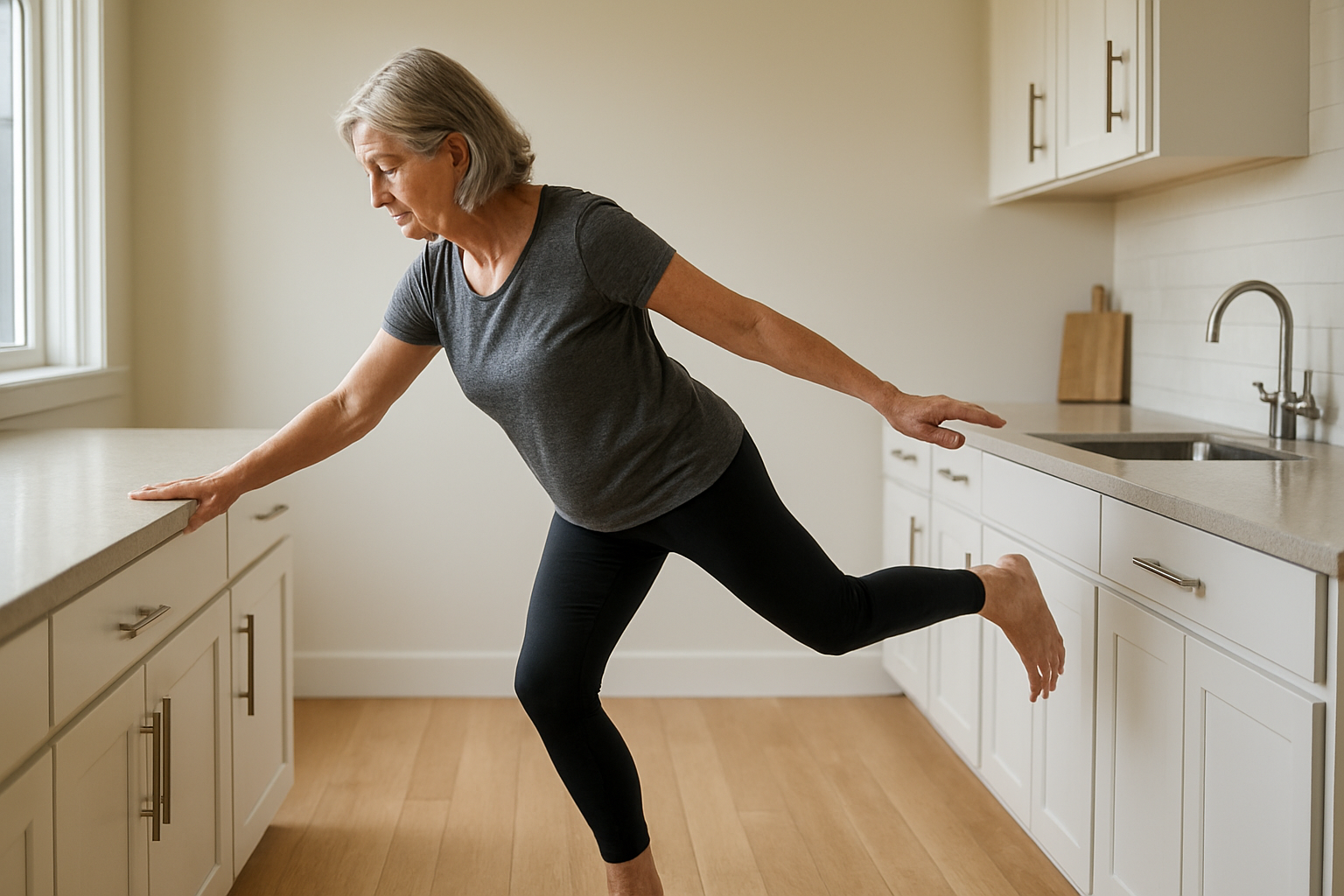
While holding a sturdy support, slowly move one leg forward, backward, or out to the side without leaning your upper body. Return the foot to the starting position before changing direction. Keep the movement small and deliberate.
The goal is not to lift the leg high. It is to maintain control while your body shifts over the supporting foot.
3. How to build a safe weekly routine
Start with three exercises rather than trying to complete every option in one session. For example, perform sit-to-stands, heel raises, and supported side-stepping on two or three nonconsecutive days each week. Add one balance-specific exercise, such as heel-to-toe walking, when the basic movements feel controlled.
- Warm up with several minutes of easy walking or gentle marching.
- Perform one or two comfortable sets of each exercise.
- Rest when your legs become tired or your form changes.
- Increase repetitions or reduce hand support gradually, not both at once.
- Keep the practice area well lit and free of pets, cords, and loose rugs.
The NHS balance exercise guidance also emphasizes using appropriate support and building up slowly. Consistency matters more than making every session difficult.
4. Safety checks before you begin
Balance exercises should feel challenging but controlled. Stop and sit down if you develop chest pain, unusual shortness of breath, faintness, sudden weakness, or new confusion. Seek medical advice for repeated dizziness, vertigo, unexplained falls, or balance problems that appear suddenly.
The National Institute on Aging explains that balance problems can be related to medications or medical conditions. Review concerning symptoms with a clinician instead of trying to solve them by adding harder exercises.
5. Common mistakes when practicing balance
- Using an unstable support: A light chair can slide or tip when you need it most.
- Progressing too quickly: Removing support before you can control the movement increases risk.
- Holding your breath: Breathe normally and avoid straining.
- Practicing when exhausted: Fatigue can reduce foot control and reaction speed.
- Training only one direction: Include forward, backward, and sideways control as appropriate.
- Ignoring footwear: Wear secure, well-fitting shoes with adequate traction.
6. What if balance exercises feel too difficult?
Make the movement smaller, sit down, or use more support. You can begin with seated marching, ankle movements, and repeated sit-to-stands from a higher chair. A physical therapist can assess gait, strength, vision, footwear, and the home environment when falls or significant instability are involved.
If you feel confident with the exercises but remain worried about falling, combine balance work with practical fall-prevention changes. The NIA recommends reviewing medications, improving lighting, securing rugs, checking vision and hearing, and using a cane or walker when appropriate.
7. Quick checklist and final recommendations
- Choose a stable support and clear the floor.
- Start with exercises you can complete without rushing.
- Practice two or three times weekly.
- Combine balance work with walking and muscle-strengthening activity.
- Progress by adding control before adding complexity.
- Ask a professional about repeated falls, dizziness, pain, or major mobility limitations.
Final recommendation by scenario: Choose sit-to-stands if getting out of a chair is difficult; choose supported single-leg stands if standing stability is your priority; choose heel-to-toe walking for walking control; choose side-stepping for sideways movement; choose tai chi for a gentle class-based option; and begin with seated or heavily supported movements if you feel unsteady. The best balance exercises for older adults are the ones you can perform regularly, safely, and with gradual progress.
For broader home exercise planning, visit the LaokFitness homepage and consider related guidance on choosing a home exercise mat.