The best adjustable kettlebell for home workouts is one with a secure locking system, a comfortable handle, useful weight increments, and enough range for your current training and likely progress. It can replace several fixed kettlebells, but not every adjustable design is equally suitable for fast swings, cleans, or overhead movements.
This guide evaluates the features that matter most rather than treating one product as universally best. You will learn how adjustable kettlebells work, where they are strongest, what limitations to expect, and when fixed kettlebells, dumbbells, or another adjustable tool may be a better choice.
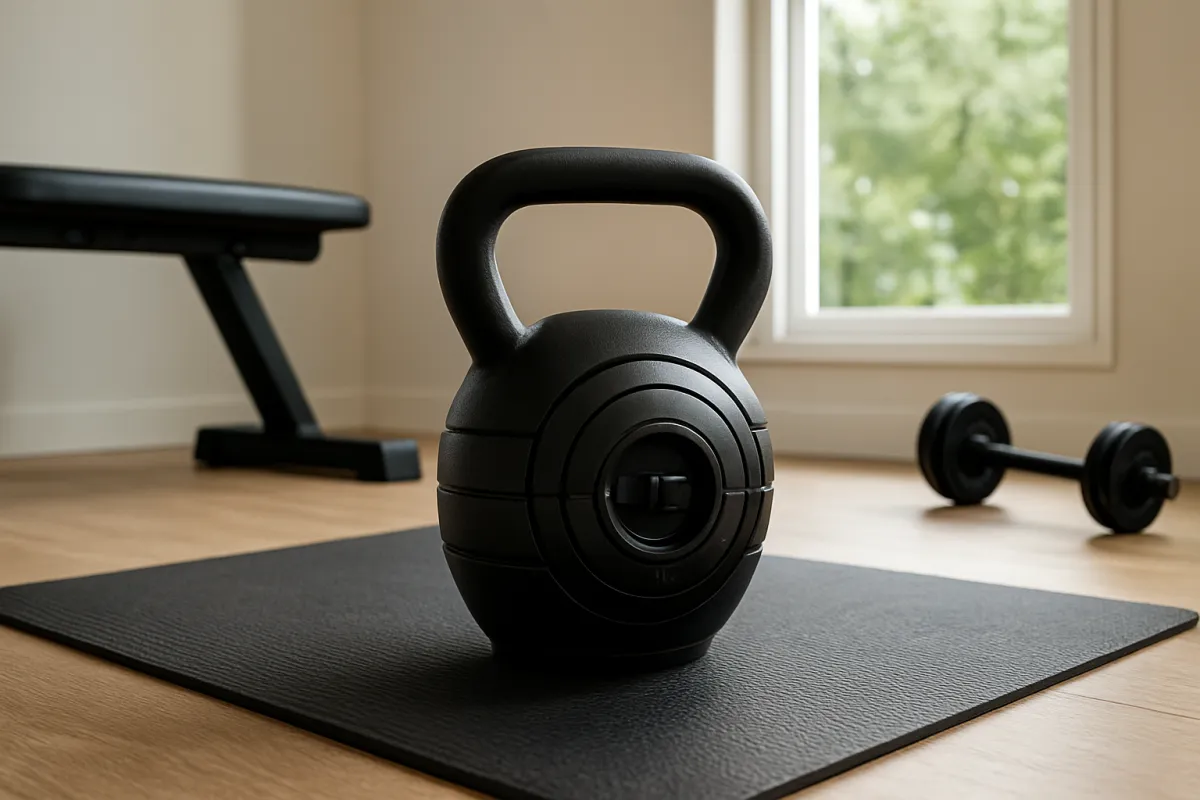
1. Decide whether an adjustable kettlebell fits your home workouts
Adjustable kettlebells usually use one of three designs: a selector mechanism inside a shell, removable plates secured to a handle or sleeve, or a soft container filled with sand or another material. Each approach trades off convenience, compactness, durability, and movement freedom.
For a small home gym, the main benefit is straightforward: one implement can cover several training loads. The American College of Sports Medicine lists kettlebells as useful equipment for total-body strength and resistance training, while its 2026 resistance-training guidance emphasizes that consistent home-based training can be effective without a traditional gym. ACSM’s home-gym guidance and its updated resistance-training recommendations provide useful context. ([acsm.org](https://acsm.org/home-gym-essentials/?utm_source=openai))
- Good fit: You have limited storage, want to progress gradually, and perform mostly controlled strength exercises.
- Less suitable: You regularly train high-repetition ballistic movements and need a traditional, unobstructed bell.
- Potentially unnecessary: You only need one light or medium weight and can buy a durable fixed kettlebell at a lower total cost.
2. Check the usable weight range and increments
The advertised range is only useful if it matches your exercises. A kettlebell that starts too heavy may be unsuitable for pressing, halos, or technique practice. One that tops out too early may stop challenging your lower-body exercises and carries.
Look at the actual selectable settings, not only the minimum and maximum numbers. Four large jumps may be adequate for swings and squats but awkward for presses or single-arm rows. Smaller increments make it easier to increase resistance while maintaining form.
For comparison, the current PowerBlock Adjustable Kettlebell is offered in separate regular and heavy versions, each with four listed weight settings rather than one continuous range. The Rogue KettlePod uses a plate-loaded format and accepts compatible standard or Olympic plates. These examples show why “adjustable” does not describe one standardized design. ([roguefitness.com](https://www.roguefitness.com/powerblock-adjustable-kettlebell?utm_source=openai))
Use this simple test:
- Identify your lightest planned movement, such as a press or Turkish get-up.
- Identify your heaviest planned movement, such as a deadlift, squat, or swing.
- Make sure the bell offers at least two or three useful steps between those extremes.
- Check whether additional plates, filler, or accessories are required to reach the claimed maximum.
3. Inspect the handle and center of mass
Handle shape matters because the kettlebell sits outside your hand rather than directly around it. A handle that is too thick, sharply edged, slippery, or crowded by adjustment hardware can make cleans, carries, and presses less comfortable.
Pay attention to handle diameter, usable grip width, surface finish, and clearance between the handle and the body. The best dimensions depend on your hand size and the exercises you use. A compact handle may feel efficient for presses but restrictive during two-handed swings.
Also consider whether the adjustable components change the bell’s balance. A conventional cast-iron kettlebell has a predictable center of mass. A selector bell or plate-loaded model may feel different as the load changes, especially if the weight is distributed along a sleeve or housed in a tall shell.
For dynamic movements, prioritize a stable, centered feel over a maximum number of settings. The ACE guidance on two-handed kettlebell swings stresses that the movement requires proper technique and control; equipment that distracts from those basics is a poor bargain. ([acefitness.org](https://www.acefitness.org/continuing-education/certified/january-2025/8788/the-ace-do-it-better-series-the-two-handed-kettlebell-swing/?authorScope=58&utm_source=openai))
Use the table below when comparing models.
| What to look for | Why it matters | Warning sign |
|---|---|---|
| Rounded, smooth handle | Reduces pressure points during repeated gripping | Sharp seams or rough adjustment parts where your hand rests |
| Enough grip width | Allows two-handed swings and comfortable cleans | Hands overlap or touch the mechanism |
| Secure weight lock | Keeps the load stable during movement | Visible play, rattling, or unclear locking feedback |
| Stable base | Makes floor exercises and storage easier | Bell rocks, tips, or rests on a narrow point |
| Balanced loading | Creates more predictable handling | Weight shifts noticeably between settings |
4. Evaluate the locking mechanism and construction
The adjustment system is the most important safety feature. Selector models should provide a clear locked position, and plate-loaded models should use hardware that cannot loosen during normal use. Read the owner’s manual before assuming a product is designed for swings, snatches, or drops.
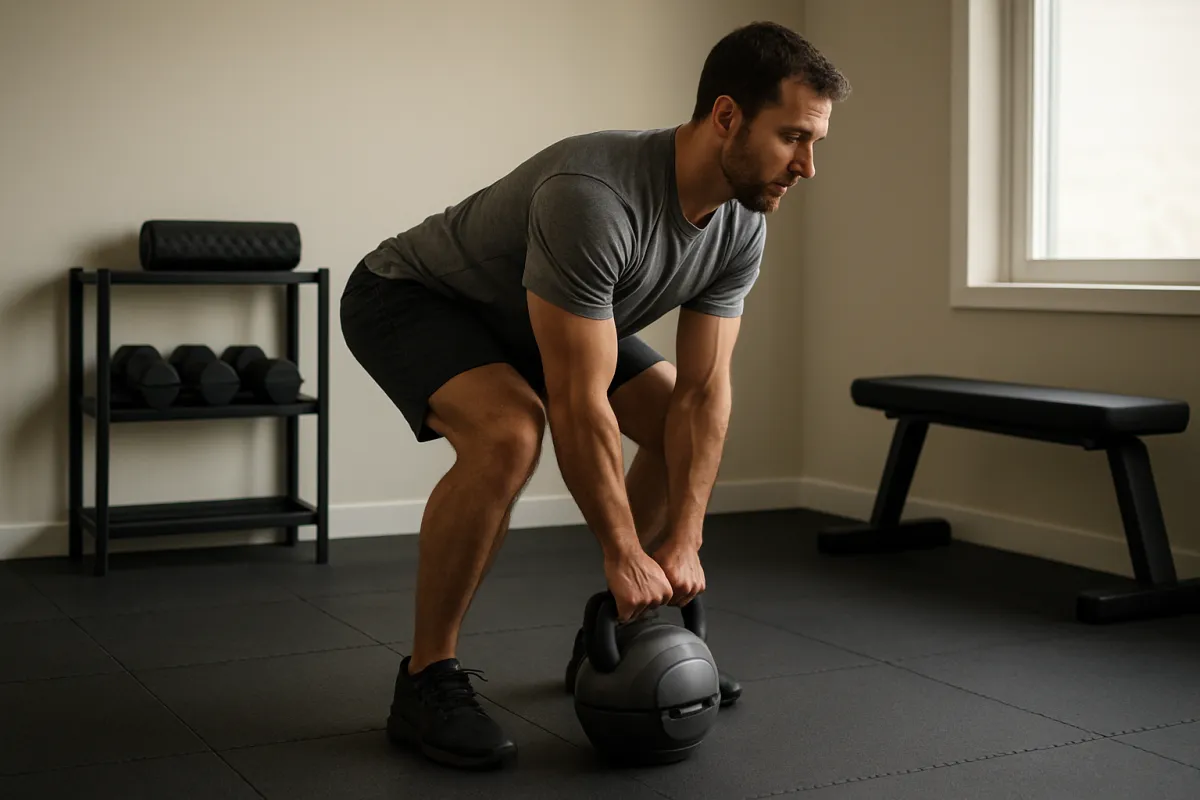
Inspect the mechanism each time you change the load. Confirm that the handle is fully seated, the selector is in its intended position, and no plate, pin, collar, or latch is visibly damaged. Do not use the kettlebell if the load moves independently of the handle.
Some manufacturers publish specific instructions about adjustment and inspection. For example, the BowFlex SelectTech 840 manual states that its adjustment control operates only when the handle is properly inserted into the base. That kind of interlock is useful, but it does not remove the need to check the unit before training. ([download.bowflex.com](https://download.bowflex.com/supportdocs/OM/Bowflex/BFX.STK.840.OM.Costco.EN.pdf?utm_source=openai))
5. Match the design to your exercise selection
Best for controlled strength exercises
Adjustable kettlebells are often most convenient for goblet squats, split squats, rows, deadlifts, carries, floor presses, and strict presses. These exercises allow you to pause and confirm that the implement is secure.
Use more caution with ballistic movements
Swings, cleans, snatches, and high-repetition circuits place greater demands on the handle, locking system, and your ability to control the bell. If the manufacturer excludes ballistic use, follow that limitation. For swing technique, see this step-by-step kettlebell swing guide before increasing load or speed.
A soft sand-filled option may be useful for travel or outdoor training, but it will not feel identical to a compact iron bell. Rogue describes its sand kettlebells as portable and fillable, while noting that final weight depends on the material used. That variability is an important consideration when programming precise resistance. ([roguefitness.com](https://www.roguefitness.com/rogue-sand-kettlebells?utm_source=openai))
6. Compare value, storage, and alternatives
Do not compare only the purchase price. Include compatible plates, filler material, shipping, replacement parts, and the cost of buying a second unit if you need symmetrical loading. An adjustable model may save space while costing more than two fixed bells that cover your actual training needs.
Consider these alternatives:
- Fixed cast-iron kettlebells: Usually simpler and easier to inspect, with a consistent feel for dynamic work.
- Adjustable dumbbells: Often better for bilateral pressing, rows, and bodybuilding-style exercises, although they do not replicate every kettlebell movement.
- Plate-loaded kettlebell handles: Useful if you already own compatible plates, but the balance and adjustment process may be less convenient.
- Resistance bands: A lower-storage option for many exercises, though resistance changes through the range of motion and does not feel like a free weight.
If your goal includes lower-body strength, combine the kettlebell with movements such as those in this guide to effective glute exercises at home. A single tool is more valuable when it supports a complete, repeatable routine rather than a few novelty movements.
7. Avoid these common buying mistakes
- Choosing the heaviest advertised model without considering your lightest exercise.
- Assuming every adjustable kettlebell is safe for swings or overhead work.
- Ignoring handle clearance and discovering that two-handed movements are uncomfortable.
- Buying a product with large weight jumps when gradual progression is important.
- Failing to measure storage height, especially for tall selector designs.
- Overlooking the return policy, warranty terms, or availability of replacement pins and parts.
8. What if the kettlebell does not feel right?
If the bell rattles, shifts, or feels uneven, stop using it and inspect the locking system. If the issue remains after following the manual, contact the manufacturer rather than improvising a repair.
If your wrists or forearms become uncomfortable, reduce the load and review your grip and technique. Persistent pain, numbness, swelling, or loss of strength warrants evaluation by a qualified healthcare professional.
If you cannot perform a movement with control, regress to a lighter setting or a simpler exercise. Strength training does not require forcing a difficult variation before you have established stable mechanics.
9. Adjustable kettlebell buying checklist
- Write down your intended exercises and realistic starting weight.
- Confirm the minimum, maximum, and every selectable increment.
- Measure the handle diameter, grip width, and total storage height.
- Check whether the product is approved for ballistic movements.
- Test the adjustment mechanism before each session.
- Verify compatibility with any plates, collars, filler, or accessories.
- Read warranty, return, and replacement-part information.
- Leave clear floor space around you for swings and carries.
10. Next actions before you buy
First, decide whether you need one compact tool or several fixed weights. Next, shortlist models whose usable range covers both your lightest and heaviest exercises. Finally, compare the handle, balance, locking system, and manufacturer instructions before considering price.
For a broader home-training setup, you can also compare equipment choices through LaokFitness resources on squat and leg-press training, dumbbell Romanian deadlifts, and HIIT versus steady-state cardio.
Verdict: An adjustable kettlebell can be an excellent space-saving choice for home workouts when you value progressive loading and versatility. It is worth buying if the range, handle, balance, and locking system suit your exercises. Choose fixed kettlebells instead when simplicity, a traditional feel, and frequent ballistic training are more important than storage efficiency.