The best cardio workouts for small apartments are low-impact routines that raise your heart rate without requiring much floor space or creating heavy landing noise. For most people, brisk indoor walking, step-ups, shadow boxing, and quiet interval circuits offer the best balance of effectiveness, convenience, and neighbor-friendly training.
Limited space does not prevent you from building a consistent cardio habit. This guide ranks practical apartment workouts by noise, space, impact, equipment needs, and ease of progression so you can choose a routine you will actually use.
1. Evaluate your apartment before choosing a workout
The right routine depends less on the name of the exercise than on your surroundings. A workout that feels quiet in a detached home may transmit impact through a ceiling or floor in an apartment building.
- Available floor space: Measure whether you have room to extend your arms, take two or three steps, and move safely around furniture.
- Floor surface: A stable exercise mat can improve comfort, but it will not eliminate all impact or vibration.
- Noise tolerance: Favor stepping, marching, cycling, and controlled strength-cardio combinations over jumping.
- Your joints and training history: Beginners and people returning after a break usually benefit from gradual, low-impact progression.
For general health, federal guidance recommends at least 150 minutes of moderate-intensity aerobic activity each week, or 75 minutes of vigorous activity, plus muscle-strengthening work on at least two days. You can divide that total into shorter sessions; consistency matters more than forcing every workout to be intense. See the CDC’s adult activity guidelines and the U.S. Physical Activity Guidelines explanation for the full framework.
2. Compare the best cardio workouts for small apartments
The table below focuses on practical apartment concerns rather than which workout sounds most demanding. “Quiet” means relatively low noise when performed with control; no indoor workout is completely soundless.
Apartment cardio comparison:
| Workout | Space needed | Noise level | Impact | Best use | Warning sign |
|---|---|---|---|---|---|
| Indoor walking | One clear path | Very low | Low | Steady cardio and beginners | Turning too quickly around furniture |
| Step-ups | A stable step | Low to moderate | Low to moderate | Short, efficient intervals | Wobbly or overly high platform |
| Shadow boxing | About one arm span | Low | Low | Intervals and upper-body movement | Locking the elbows or twisting sharply |
| Low-impact cardio circuit | Yoga-mat area | Low | Low to moderate | Full-body conditioning | Rushing through poor form |
| Stationary cycling | Bike footprint | Low to moderate | Low | Longer sessions | Loose setup or poor seat position |
| Dance cardio without jumps | Yoga-mat area | Low to moderate | Low to moderate | Enjoyable moderate cardio | Uncontrolled pivots on a slippery floor |
| Jump-rope alternatives | Small clear area | Moderate | Moderate to high | Brief conditioning intervals | Repeated hard landings or ceiling clearance issues |
3. The seven best apartment-friendly cardio options
1. Indoor walking and marching
Best for: Beginners, low-impact training, and quiet daily movement.
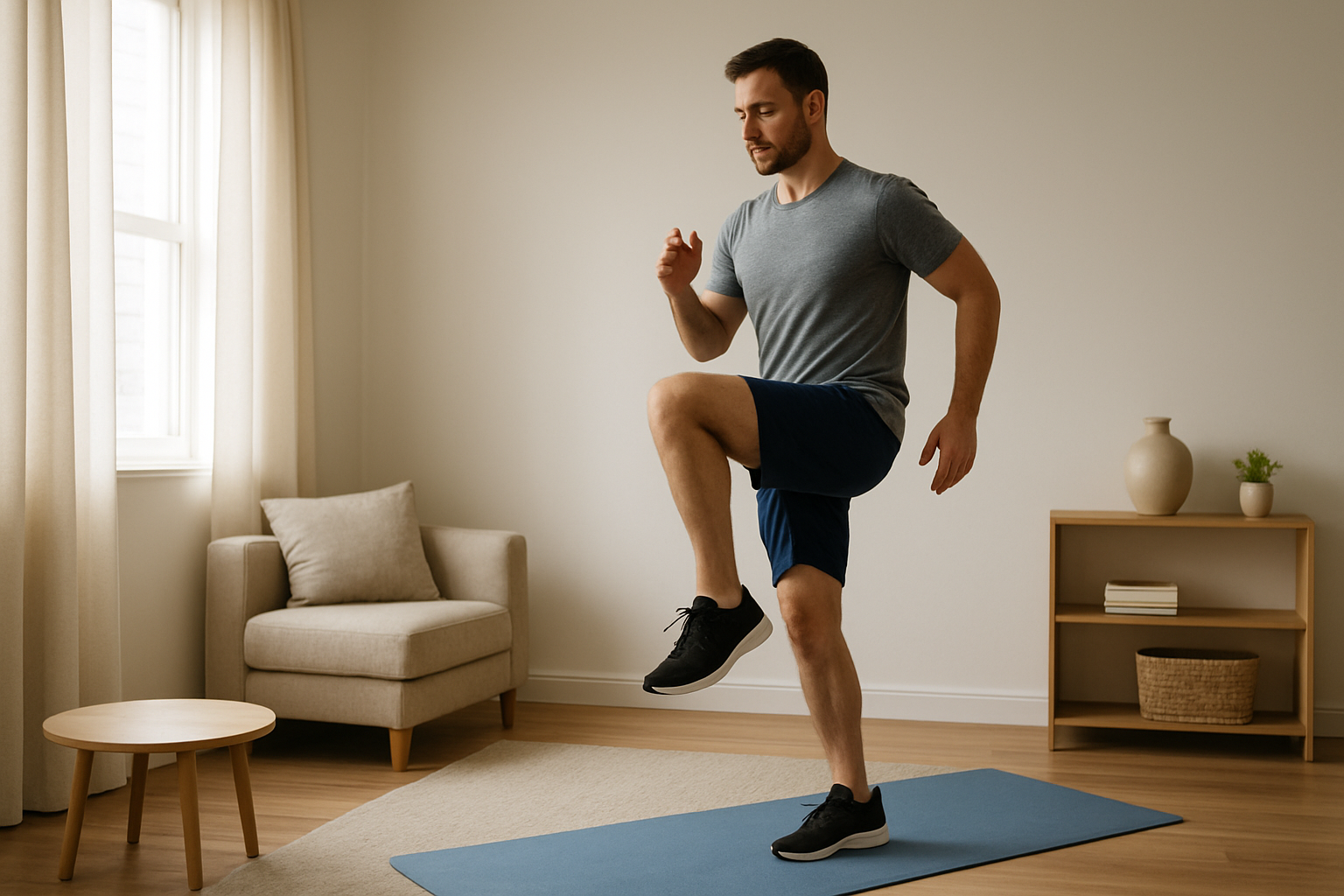
Walk back and forth along a clear path, march in place, or combine forward steps with side steps. Swing your arms naturally and gradually increase pace until talking requires more effort but remains possible in short sentences.
This is the easiest option to scale. Start with 10 to 20 minutes, then add time before adding speed. If you need more challenge, use faster marching intervals, higher but controlled knee lifts, or a longer continuous session.
2. Step-ups on a stable platform
Best for: A compact workout with a clear intensity increase.
Use a purpose-built aerobic step or another platform designed to support your body weight. Step up and down slowly at first, alternating the lead leg, and keep your whole foot supported on the platform.
Step-ups can become demanding quickly, so use short rounds such as 30 seconds of work followed by 30 to 60 seconds of easy movement. Stop if the platform shifts, your knee collapses inward, or you cannot control the descent.
3. Shadow boxing
Best for: Quiet intervals that involve the upper body as well as the legs.
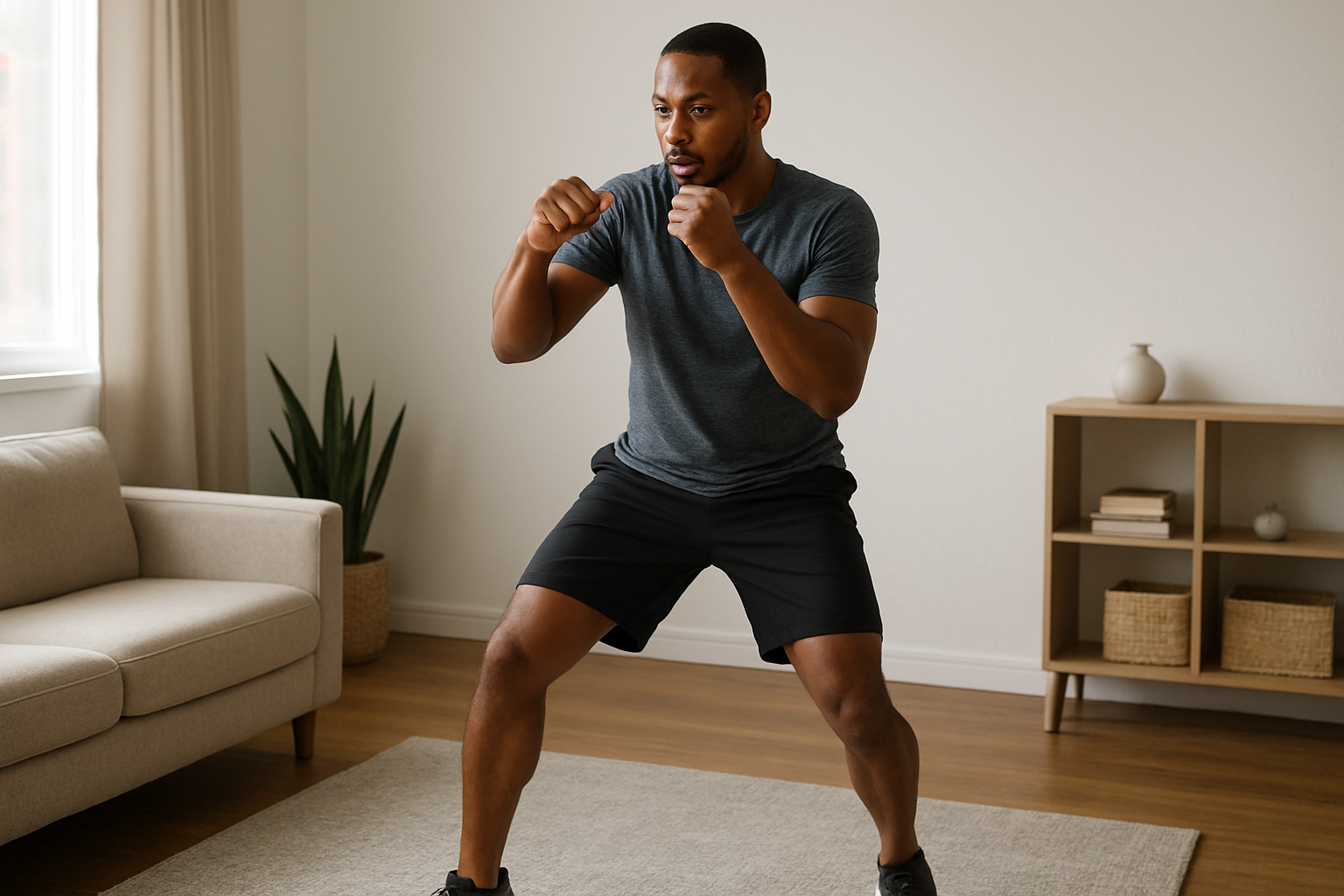
Stand with a comfortable staggered stance and throw relaxed punches into the air while lightly stepping or shifting your weight. Keep your shoulders down, avoid snapping the elbows straight, and rotate through the hips rather than twisting aggressively through the knees.
Try three to six rounds of one minute with one minute of easy marching between rounds. Shadow boxing is also useful when furniture leaves little room for traveling movements.
4. Low-impact cardio circuits
Best for: Full-body conditioning without jumping.
Build a circuit from movements such as marching, bodyweight squats, alternating reverse lunges, incline mountain climbers against a sturdy surface, and standing knee drives. Perform each exercise for 30 to 45 seconds, then rest or move gently for the same amount of time.
Keep the circuit quiet by placing your feet down deliberately and avoiding fast transitions. For strength-focused exercises, the home shoulder exercise guide and front squat versus back squat comparison can help you understand how to complement cardio with resistance training.
5. Stationary cycling
Best for: Longer, steady sessions when you have room for one piece of equipment.
A stationary bike can provide consistent cardio with little landing impact. Begin with an easy resistance and adjust the seat so your knee remains slightly bent at the bottom of the pedal stroke.
The main limitation is storage, not exercise variety. If you are considering a larger cardio machine, compare its folded dimensions, operating noise, and storage position before buying; the foldable treadmill apartment workout guide covers similar space and setup questions.
6. No-jump dance cardio
Best for: People who need variety to stay consistent.
Use side steps, grapevine patterns, heel digs, step touches, knee lifts, and controlled arm movements. Keep the rhythm comfortable and replace any jump with a step-out version.
Dance-based sessions can be moderate or vigorous depending on pace, but choreography should never take priority over safe foot placement. Clear cords, rugs, and furniture before starting.
7. Jump-rope alternatives and quiet intervals
Best for: Experienced exercisers who want brief, intense bursts without swinging a rope indoors.
Try simulated rope turns with alternating toe taps, fast marching, low pogo steps only if your floor and joints tolerate them, or quick step patterns. These options are quieter than using a rope but may still transmit impact.
Use short work periods and focus on soft, controlled foot contacts. If neighbors can hear the landing or you feel discomfort in the knees, ankles, hips, or back, switch to boxing, cycling, or marching intervals.
4. Build a quiet apartment cardio session
A simple session can be effective without being complicated. Warm up for five minutes with easy marching and shoulder movements, then choose one of these formats:
- Beginner: 20 minutes of indoor walking, alternating two minutes easy with one minute brisk.
- Moderate: Five rounds of two minutes shadow boxing and two minutes marching.
- Mixed circuit: Six exercises performed for 40 seconds each, followed by 20 seconds of easy movement.
- Time-efficient: Eight rounds of 30 seconds of step-ups or fast marching followed by 60 seconds of recovery.
Increase only one variable at a time: total minutes, number of rounds, pace, or resistance. The ACSM overview of interval training is useful background if you plan to add harder work.
5. Checklist before you start
- Clear a space large enough for your arms and a few steps.
- Wear supportive shoes if the floor is hard or your feet need extra cushioning.
- Check that steps, bikes, and other equipment are stable before use.
- Keep water nearby and avoid exercising beside sharp furniture edges.
- Use the talk test: moderate work should feel challenging but controlled.
- Finish with a few minutes of easy movement rather than stopping abruptly after hard intervals.
6. Common mistakes with apartment cardio
- Choosing intensity over repeatability: A quiet 20-minute session you repeat is usually more useful than an exhausting routine you avoid.
- Ignoring impact: A mat may improve comfort, but it does not make repeated jumping noiseless.
- Using unstable furniture: A chair or table is not automatically a safe step or support.
- Skipping progression: Add volume gradually instead of doubling workout length after one good session.
- Doing only cardio: Add at least two weekly strength sessions when appropriate, using bodyweight exercises or equipment.
7. What if a workout causes problems?
If your knees, ankles, hips, or back become painful, reduce impact and range of motion first. Replace jumping and fast lunges with walking, cycling, or controlled marching. Persistent pain, chest pain, unusual shortness of breath, faintness, or symptoms that worsen during exercise warrant stopping and seeking appropriate medical advice.
If noise is the issue, move to grounded exercises: marching, shadow boxing, cycling, and standing circuits. If space is the issue, keep your routine in one place and use tempo, arm movement, and intervals rather than traveling farther.
Final recommendation by scenario
- Best overall: Indoor walking combined with short shadow-boxing intervals.
- Best for beginners: Marching in place or walking for 10 to 20 minutes.
- Best for a harder compact workout: Controlled step-ups, provided the platform is stable.
- Best for the quietest routine: Indoor walking, marching, and low-impact standing circuits.
- Best for longer sessions: Stationary cycling.
- Best for variety: No-jump dance cardio mixed with boxing and walking.
The best cardio workouts for small apartments are the ones that match your floor space, noise constraints, fitness level, and schedule. Start with the quietest option you can perform comfortably, build regular weekly volume, and add intensity only when your technique and recovery support it.
For more home-training ideas, visit the LaokFitness homepage, or explore the guide to walking versus jogging for fat loss when deciding how to progress beyond indoor workouts.