The best shoulder exercises for building muscle at home are overhead presses, pike push-ups, lateral raises, rear-delt rows, and controlled fly variations. Choose movements that train all three deltoid regions, use a load you can control, and make the exercise gradually harder over time.
Home shoulder training works, but it requires more than repeating one pressing movement. This guide ranks seven useful options, explains what each exercise is best for, and shows how to combine them into a simple routine with limited equipment.

1. Decide what your home setup can support
Before choosing exercises, identify the equipment and space available. A pair of adjustable dumbbells gives you the widest range of options, but resistance bands, a sturdy backpack, or body weight can also provide useful training.
- No equipment: pike push-ups, wall-supported handstand holds, and prone rear-delt raises.
- Resistance bands: overhead presses, lateral raises, face pulls, and rear-delt pulls.
- Dumbbells or kettlebells: presses, lateral raises, rows, and fly variations.
- Small space: prioritize exercises that can be performed standing, kneeling, or lying on a mat.
Resistance training does not need to rely on a particular type of equipment. The American College of Sports Medicine’s resistance-training guidance emphasizes consistency, gradual progression, and training the major muscle groups regularly rather than chasing a complicated setup. ([acsm.org](https://www.acsm.org/effective-resistance-training-program-infographic/))
2. Use these criteria to rank shoulder exercises
The ranking below is based on practical muscle-building value, how easily you can progress the movement at home, how much of the shoulder it trains, and how simple it is to perform with controlled technique.
One exercise cannot perfectly isolate every part of the shoulder. Presses usually emphasize the front delts and triceps, lateral raises target the side delts, and rear-delt raises or rows help cover the back of the shoulder. A balanced session uses more than one movement pattern.
For exercise demonstrations and additional shoulder variations, the ACE shoulder exercise library is a useful reference. ([acefitness.org](https://www.acefitness.org/resources/everyone/exercise-library/body-part/shoulders/))
Comparison table: the best home shoulder exercises at a glance
| Exercise | Equipment | Primary emphasis | Best for | Warning sign |
|---|---|---|---|---|
| Seated dumbbell shoulder press | Dumbbells | Front and side delts | Overall shoulder strength and size | Lower back arching or painful overhead motion |
| Pike push-up | None | Front delts and triceps | No-equipment pressing | Head dropping abruptly or elbows flaring widely |
| Dumbbell lateral raise | Dumbbells or bands | Side delts | Building shoulder width | Swinging the torso to lift the weight |
| Rear-delt fly | Dumbbells or bands | Rear delts and upper back | Balancing pressing-heavy routines | Using momentum instead of a controlled arc |
| One-arm overhead press | Dumbbell or kettlebell | Delts, triceps, and trunk | Unilateral strength and stability | Leaning away from the weight |
| Band face pull | Resistance band | Rear delts and upper back | Light pulling volume and posture support | Pulling to the chest with shrugged shoulders |
| Prone Y-raise | None or light weights | Rear shoulder and upper back | Low-load control work | Raising the arms higher by arching the spine |
3. The seven best shoulder exercises for building muscle at home
1. Seated dumbbell shoulder press
Best for: overall shoulder muscle and strength. Sit tall on a stable bench or firm chair, hold the dumbbells just outside your shoulders, and press them upward without forcing your elbows into a locked-out position. Lower slowly until the weights return to a comfortable starting point.
Use a moderate load for three to four sets of six to twelve controlled repetitions. Keep your ribs down and avoid turning the movement into a standing backbend.
2. Pike push-up
Best for: building pressing strength without weights. Start in a high plank, then lift your hips into an inverted-V position. Bend your elbows and lower the crown of your head toward the floor, then press back up while keeping your hands firmly planted.
Make it easier by reducing the hip angle or placing your hands on an elevated surface. Make it harder by elevating your feet. Aim for three sets of six to fifteen repetitions.
3. Dumbbell or band lateral raise
Best for: emphasizing the side delts. Stand with a slight bend in your elbows and raise your hands out to the sides until your upper arms are near shoulder height. Lower under control and keep the movement smooth.
This exercise is usually more effective with lighter resistance than a press. Try two to four sets of ten to twenty repetitions, stopping before you need to swing the weights.
4. Bent-over rear-delt fly
Best for: rear-delt development. Hinge at the hips with a neutral spine, let the weights hang below your chest, and move your arms outward in a wide arc. Think about moving from the back of the shoulder rather than pulling with the hands.
Use light dumbbells and perform two to four sets of twelve to twenty repetitions. If your neck tightens or your torso rocks, reduce the load.
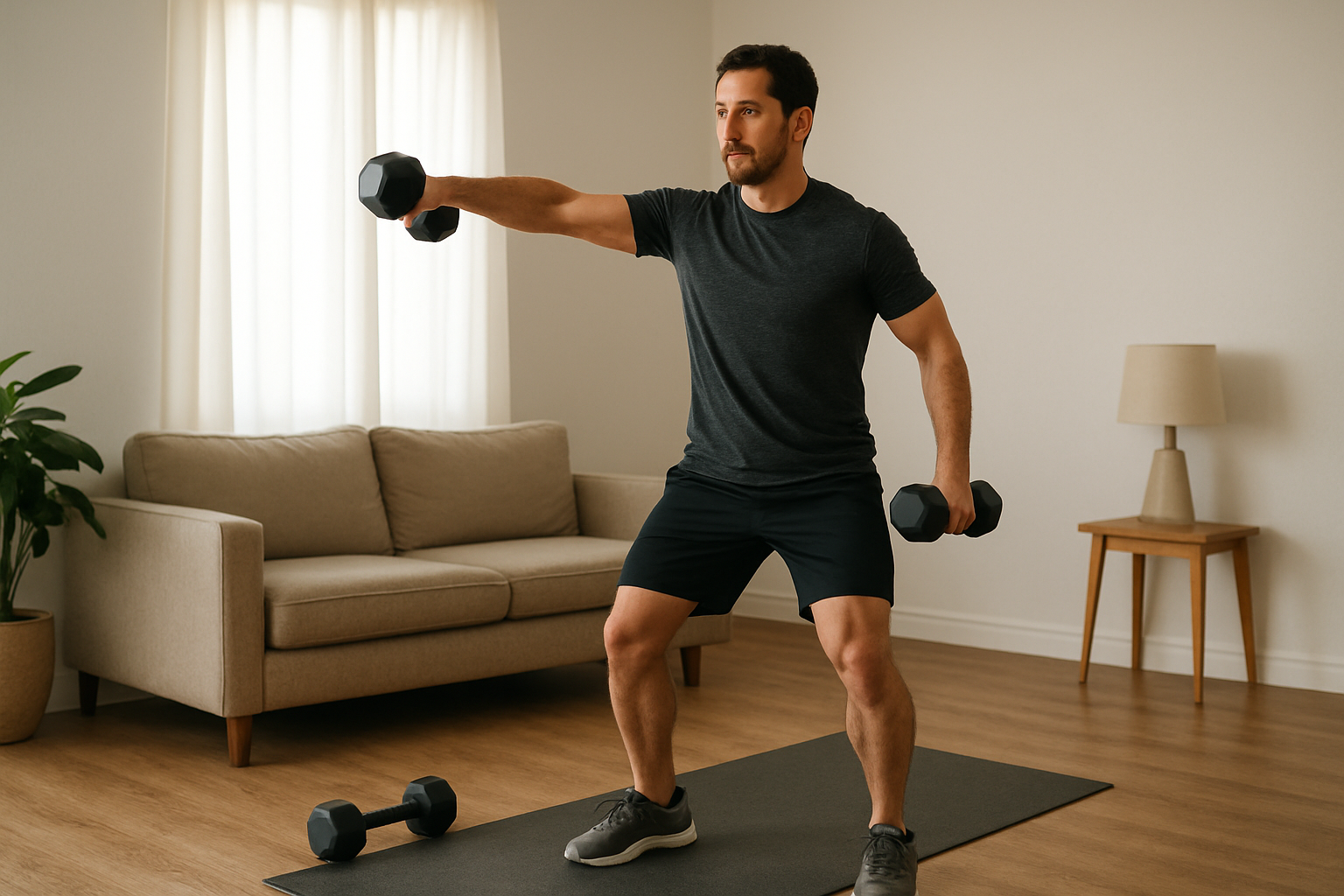
5. One-arm overhead press
Best for: unilateral strength and trunk control. Hold one dumbbell or kettlebell at shoulder height and press it overhead while keeping your torso tall. Lower it slowly, complete the repetitions on one side, and then switch.
The one-sided load can expose differences between your arms, but do not compensate by leaning. Two to three sets of six to twelve repetitions per side is a practical starting point. ACE provides a step-by-step single-arm overhead press reference. ([acefitness.org](https://www.acefitness.org/resources/everyone/exercise-library/395/single-arm-overhead-press/))
6. Resistance-band face pull
Best for: rear shoulders and upper-back pulling volume. Anchor a band around face height, pull the handles toward your forehead, and finish with your hands beside your ears. Keep your shoulders away from your ears and return the band slowly.
Perform two to four sets of twelve to twenty repetitions. The band should provide tension throughout the movement without forcing you to jerk the handles.
7. Prone Y-raise
Best for: low-load shoulder control. Lie face down with your arms extended in a Y shape. Lift your hands only as high as you can without shrugging or arching your lower back, pause briefly, and lower them.
This is not a maximal-load exercise. Use body weight or very light weights for two to three sets of eight to fifteen repetitions, focusing on steady motion.
4. Build a simple home shoulder workout
Train shoulders after a brief warm-up and leave at least one day between demanding shoulder sessions. The U.S. Department of Health and Human Services recommends muscle-strengthening activity on at least two days per week for adults, while your exact schedule should account for your full-body training and recovery. ([odphp.health.gov](https://odphp.health.gov/our-work/nutrition-physical-activity/physical-activity-guidelines/about-physical-activity-guidelines/questions-answers))
- Seated dumbbell shoulder press: 3 sets of 6–12
- Lateral raise: 3 sets of 10–20
- Rear-delt fly: 3 sets of 12–20
- Band face pull: 2 sets of 12–20
Rest roughly one to two minutes between smaller isolation sets and longer when needed after pressing. Finish most sets with one to three good repetitions still available. Over time, add a repetition, increase resistance slightly, slow the lowering phase, or move to a harder variation.
For a broader training plan, see our guide to calisthenics versus weight training for beginners. Shoulder work should complement—not replace—training for the legs, back, chest, and trunk.
5. Common mistakes that limit progress
- Only doing presses: pressing alone can leave the side and rear delts undertrained.
- Using excessive weight: momentum shifts work away from the target muscles and makes joint position harder to control.
- Skipping progression: the same easy workout may maintain capacity but is less likely to keep building muscle.
- Training through sharp pain: muscle fatigue is expected; sharp, catching, or worsening joint pain is not.
- Ignoring recovery: shoulders also work during chest, back, and arm exercises, so count total weekly stress.
6. What if a shoulder exercise hurts?
Stop the painful variation and check whether the range of motion, load, grip, or setup is the problem. You can try a lighter resistance, a neutral-grip press, a shorter range, or a floor-based exercise, but do not use modifications to hide persistent pain.
Seek assessment from a qualified healthcare professional if pain follows an injury, causes notable weakness, limits normal daily movement, produces numbness, or does not improve with rest and sensible modification. This article is general fitness information, not a diagnosis or rehabilitation plan.
7. Action checklist for your next session
- Choose one press, one side-delt exercise, and one rear-delt exercise.
- Warm up with easy shoulder circles, light band pulls, and several practice repetitions.
- Use a range of motion you can control without pain.
- Record sets, repetitions, resistance, and the variation used.
- Progress only when your technique remains consistent.
- Review your full weekly program so pressing volume is not excessive.
Final recommendation by scenario
For the best all-around home setup: use the seated dumbbell shoulder press, lateral raise, rear-delt fly, and band face pull.
For body-weight training: prioritize pike push-ups, progress them by elevating your feet, and add prone Y-raises for controlled rear-shoulder work.
For beginners: start with two sessions per week, two or three exercises per session, and conservative resistance. For experienced trainees: use unilateral presses, slower eccentrics, harder pressing angles, and planned progression rather than simply adding more exercises.
The best shoulder exercises for building muscle at home are the ones you can perform consistently, progress gradually, and recover from. Cover the front, side, and rear delts, keep technique strict, and let your equipment determine the variation—not the quality of your training.