A small home does not have to mean a limited workout. With the right choices, an apartment, bedroom, or corner of a living room can support strength training, cardio, mobility work, and general fitness. The key is to buy equipment that covers several movement patterns, stores easily, and can be used safely in the space you have.
This guide focuses on durable equipment categories rather than specific products. It explains what each category does well, where it falls short, and how to decide what belongs in your home gym. It also includes quick picks by need, a comparison table, space-planning advice, budget priorities, and safety guidance.
Quick picks for a small home gym
- Best all-around strength option: Adjustable dumbbells. They provide several loading levels without requiring a full rack of fixed weights.
- Best low-cost starting point: Resistance bands. A useful set can support pressing, pulling, squatting, hinging, and mobility work.
- Best for bodyweight training: A suspension trainer. It adds adjustable resistance to rows, presses, split squats, and core exercises, but it requires a reliable anchor.
- Best for floor-based workouts: A quality exercise mat with sliders. This combination supports strength, stretching, mobility, and controlled core work.
- Best compact conditioning choice: A jump rope, step platform, or compact cardio machine, depending on noise, ceiling height, neighbors, and storage.
- Best for renters: Portable equipment such as bands, adjustable dumbbells, sliders, a mat, and a freestanding pull-up option that does not require drilling.
- Best for absolute beginners: A mat, light-to-moderate resistance bands, and one adjustable loading option added gradually as technique improves.
How to choose the best home gym equipment for small spaces
Small-space equipment should solve more than one problem. A product that supports only one exercise may not justify the floor area unless that exercise is a central goal. Before shopping, use these selection criteria.
1. Movement coverage
Look for equipment that helps you train the major movement patterns: squat, hinge, push, pull, carry, brace, and locomotion. You do not need a separate tool for every pattern. For example, adjustable dumbbells can support squats, deadlifts, presses, rows, and carries. Bands can add pulling and pressing work while taking up very little room.
2. Storage footprint
Measure the equipment when it is stored, not only when it is in use. Consider whether it can slide under a bed, stand in a closet, fit on a shelf, or sit inside a storage bench. Also measure doorways, stairways, and elevators if a larger item must be delivered to an apartment.
3. Setup and changeover time
Equipment that takes several minutes to assemble every time may discourage regular use. Favor tools that can be put away quickly and adjusted without complicated steps. If you work out in a shared room, a fast setup helps you return the space to normal.
4. Stability and build quality
Compact does not automatically mean durable. Check that handles are comfortable, seams are secure, adjustment mechanisms are clear, and support surfaces do not rock under normal use. For load-bearing equipment, follow the maker’s instructions and stated limits. Do not assume that a product is safe simply because it fits in a small room.
5. Noise and floor impact
Apartment users should consider neighbors and flooring. Dropping weights, jumping, and running on a hard surface can create noise and vibration. A mat may protect the floor, but it will not make every activity quiet. Low-impact cardio, controlled strength work, and a soft landing surface are usually better choices in shared buildings.
6. Adjustability
Adjustable equipment can replace several fixed items, but it should be simple enough to use correctly. Confirm that changes lock securely and that the equipment remains balanced at different settings. Adjustability is useful only when it does not create confusing or unsafe transitions.
7. Your actual training goal
A person focused on strength needs different priorities from someone who wants daily movement or low-impact cardio. Start with the activity you are most likely to perform consistently. The best compact gym is not the one with the most categories. It is the one that supports your routine.
Comparison of compact home gym equipment
| Equipment category | Best uses | Space and storage | Main limitations |
|---|---|---|---|
| Adjustable dumbbells | Strength, carries, presses, rows, squats | Moderate stored footprint; often replaces several pairs | Can be awkward to set down or change between exercises |
| Resistance bands | Full-body strength, warm-ups, mobility, travel | Very small and light | Resistance changes with stretch and may feel different from weights |
| Suspension trainer | Rows, presses, split squats, core training | Small when packed | Needs a secure anchor and enough clear space |
| Compact bench | Presses, step-ups, supported rows, seated exercises | Moderate; choose a foldable or upright-storing design | Needs stable support and adds furniture-like bulk |
| Kettlebell | Hinges, squats, carries, presses, conditioning | Small floor footprint but fixed weight | One weight may not suit every exercise or user |
| Doorframe pull-up option | Pull-ups, hangs, assisted pulling | Small when removed | Fit, doorframe strength, clearance, and installation matter |
| Sliders | Core work, hamstring curls, lunges, mobility | Very small | Surface-dependent and less useful for heavy loading |
| Exercise mat | Floor strength, stretching, mobility, comfort | Rolls or folds for storage | Does not replace a stable lifting surface |
| Compact cardio equipment | Walking, cycling, rowing, stepping, or jumping | Varies widely by category | Noise, storage, ceiling height, and cost can be significant |
The most useful equipment categories
Adjustable dumbbells
Adjustable dumbbells are often the most versatile choice for a small strength-focused gym. One pair can support presses, rows, squats, lunges, deadlift variations, carries, and many accessory exercises. They also make it easier to progress than a single fixed weight.
Compare the adjustment method, grip comfort, balance, and storage base. Some designs change quickly but can feel bulky. Others are more compact in the hand but take longer to adjust. Either can work if the mechanism is clear and secure. Keep the dumbbells on a stable surface and avoid dropping them, especially on apartment flooring.
Resistance bands
Resistance bands are among the easiest tools to store. Loop bands can support warm-ups, lateral work, assisted exercises, and lower-body training. Longer tube or flat bands can be used for rows, presses, pulldowns, and anti-rotation exercises when attached to a suitable anchor.
Band resistance increases as the band stretches, so the hardest part of an exercise may occur near the end of the movement. Inspect bands for cuts, cracks, thinning, or damage before use. Keep them away from sharp edges and do not anchor them to an untested object. A range of resistances is generally more useful than relying on one very heavy band.
Suspension trainers
A suspension trainer uses body position and leverage to change difficulty. It can provide rows, chest presses, split squats, hamstring curls, planks, and other movements while packing into a small bag. It is especially useful when floor space is available but storage is limited.
The anchor is the important safety issue. Use a purpose-built door anchor or another approved attachment point according to the equipment instructions. Check that the door closes and locks in the correct direction, and confirm that the anchor cannot pull free. Allow enough space for the straps and your body. A suspension trainer is not a good choice if you cannot create a reliable setup.
Compact benches
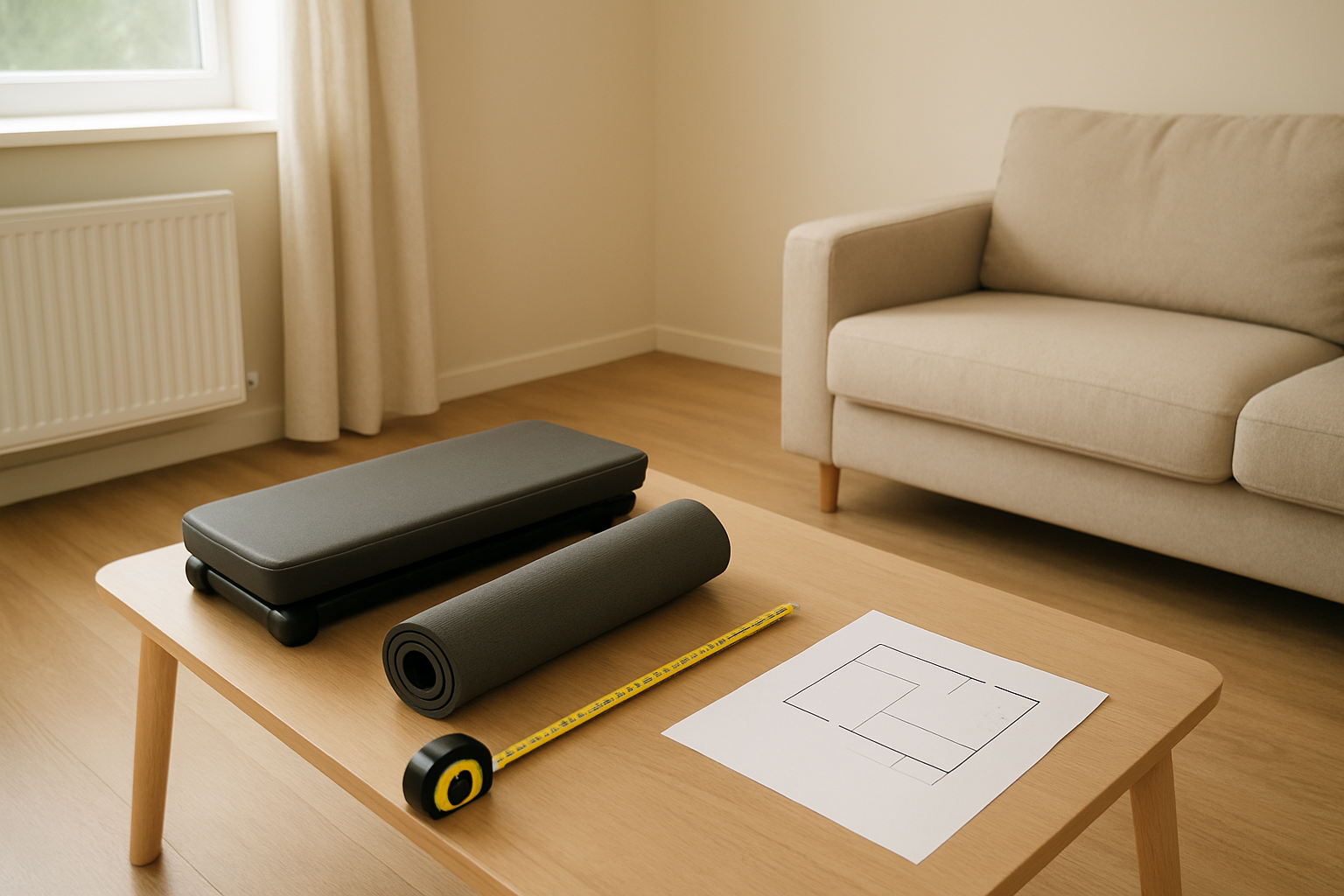
A bench can make dumbbell training more comfortable and can support presses, seated exercises, step-ups, and supported rows. In a small home, choose a bench that folds, stands upright, or serves another storage purpose. Check the base for wobble and make sure the surface is long and wide enough for the exercises you intend to perform.
A bench is not essential for a capable beginner setup. Floor presses, split squats, rows, push-ups, and standing presses can cover a great deal of training. Consider a bench after you already use your other equipment consistently or when supported training is central to your plan.
Kettlebells
A kettlebell is compact and useful for swings, deadlift patterns, goblet squats, carries, presses, and controlled conditioning circuits. Its handle allows exercises that feel different from dumbbell training, especially during carries and hinge-based movements.
A fixed kettlebell is simple and durable, but each weight serves a narrower purpose. If you choose one, select a load that you can control for basic strength exercises rather than chasing the heaviest possible option. Kettlebell swings require instruction, a clear area, and a confident hip-hinge pattern. They are not a substitute for learning technique.
Doorframe pull-up options
A doorframe pull-up bar can add vertical pulling to a small gym. It may also support hangs or assisted variations, depending on the design and the user’s ability. Removable options are attractive to renters, but compatibility matters.
Measure the frame and follow the installation instructions. Do not use a bar on a weak, damaged, unusually shaped, or unsuitable frame. Check the bar before every session and keep the area below it clear. If a full pull-up is not yet possible, use rows, band pulldowns, or controlled assisted work instead of forcing a repetition.
Sliders
Sliders take almost no storage space and can make familiar exercises more demanding. They work well for hamstring curls, mountain-climber variations, reverse lunges, body saws, and controlled mobility drills. Some work best on carpet, while others are designed for hard floors. Dual-sided options can be useful in homes with mixed flooring.
Sliders are most valuable when you already have basic strength and control. Start with short ranges of motion and slow repetitions. A slippery surface can make an exercise much harder than expected.
Exercise mats
A mat improves comfort for floor exercises, stretching, mobility work, and kneeling positions. Choose a size that fits the movements you perform and a thickness that balances cushioning with stability. A very soft mat may feel comfortable but can make balance-based exercises less steady.
Allow the mat to dry after cleaning and store it where it will not remain tightly compressed for long periods unless the maker permits that. A mat is helpful, but it should not be used to conceal an uneven or unsafe floor.
Compact cardio categories
Cardio equipment requires more careful space planning than most strength tools. A jump rope is inexpensive to store but needs ceiling height, floor clearance, and tolerance for impact and noise. A step platform can support low-space conditioning, but it still needs a stable surface and enough room to step safely.
Compact bikes, under-desk cycles, folding treadmills, and smaller rowing machines can provide structured cardio, but their usefulness depends on the exact room and storage plan. Consider noise, ventilation, machine weight, transport into the home, and whether the equipment can be used without blocking a doorway or heating vent. For many apartments, walking outdoors, stair walking where appropriate, or low-impact bodyweight circuits may be more practical than adding a large machine.
Build your setup by training goal
For strength
Start with adjustable dumbbells or a suitable kettlebell, then add bands and a mat. A compact bench is a later upgrade if you want more pressing and supported-row options. A suspension trainer can fill gaps in pulling and core work. Progress by adding controlled repetitions, range of motion, training volume, or load while maintaining good technique.
For cardio
Choose the least intrusive option you will use regularly. A jump rope suits people with enough clearance and good tolerance for impact. A step platform supports short intervals but needs a stable base. A compact bike or other machine may be preferable when low-impact exercise, predictable pacing, or indoor privacy matters. Do not buy a machine solely because it folds; verify that you have a practical place to use and store it.
For mobility and general movement
A mat, light bands, and sliders can support a broad routine. Add a suspension trainer if you want adjustable assisted positions, or a light kettlebell if loaded carries and controlled strength work appeal to you. Mobility work should be comfortable and controlled rather than forced.
For renters
Prioritize removable equipment and avoid drilling unless your lease and landlord allow it. Bands, dumbbells, kettlebells, sliders, and a mat are straightforward choices. A doorframe pull-up option can work only when the frame is compatible and the setup is approved by the instructions. Protect floors, manage noise, and store equipment so it does not block exits.
For absolute beginners
Keep the first setup simple: a mat, manageable resistance bands, and one adjustable loading option. Learn basic squat, hinge, push, pull, carry, and bracing patterns before adding complex tools. A few consistent sessions with simple equipment are more useful than a crowded room of items you do not understand.
Space-planning advice
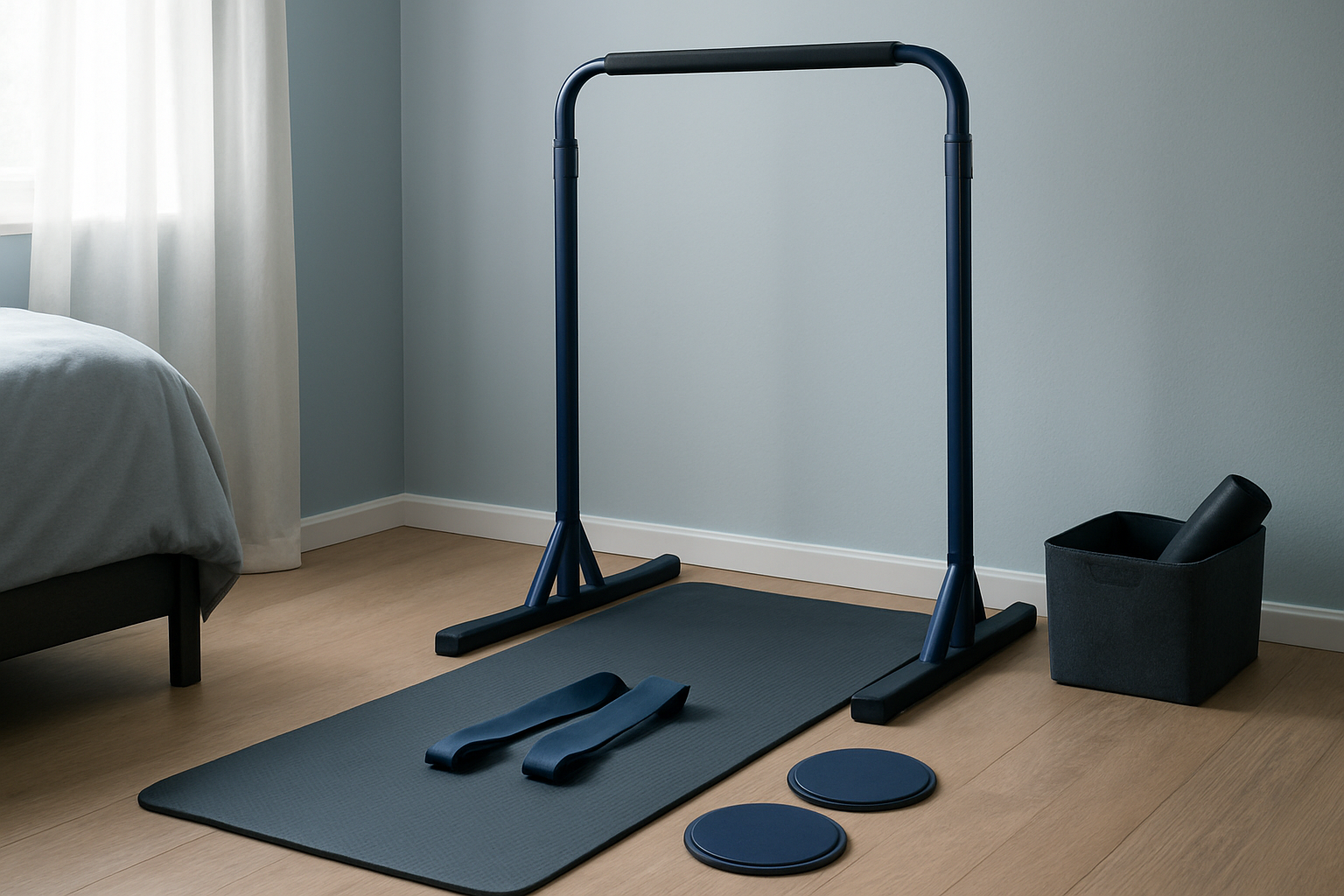
- Measure the usable zone. Mark the floor area where you can safely lie down, reach overhead, bend, and step in different directions.
- Separate storage from training space. If possible, keep equipment in a closet, under-bed container, storage bench, or vertical rack so the workout area stays clear.
- Check every direction of movement. A floor area that fits a mat may not fit a dumbbell press, a band anchored to a door, or a pull-up bar.
- Protect access points. Do not place equipment in front of exits, heaters, electrical panels, or frequently used doors.
- Plan for noise. Use controlled repetitions, avoid dropping weights, and consider low-impact choices if neighbors are close.
- Keep a reset rule. Return weights, bands, and handles to their storage location after every session. Clutter creates avoidable trip hazards.
Buying priorities for different budget patterns
If you want the lowest-cost useful setup
Begin with a mat, a small range of resistance bands, and sliders if your floor supports them. This combination can cover warm-ups, bodyweight strength, mobility, and some conditioning. Add one adjustable loading tool when you are ready to progress.
If you can make one substantial purchase
Choose adjustable dumbbells for broad strength coverage, or a compact cardio machine if cardio is your main goal. A single large purchase should match your most consistent activity, not a theoretical program you may never follow.
If you want a balanced setup over time
Build in stages: mat and bands first, adjustable dumbbells or a kettlebell next, then a suspension trainer or compact bench. Add cardio only after deciding how much room and noise your home can handle. This staged approach reduces duplicate purchases.
If storage is the main constraint
Favor bands, sliders, a mat, a suspension trainer, and adjustable equipment that replaces multiple fixed items. Avoid buying several single-purpose machines. Check the stored dimensions before ordering and decide exactly where each item will live.
Common mistakes in a small home gym
- Buying for an imagined routine: Start with activities you already enjoy or can realistically schedule.
- Ignoring setup space: Equipment dimensions do not show the clearance needed to use it safely.
- Choosing the heaviest option first: More resistance is not automatically better. Control and progression matter.
- Using anchors casually: Doors, tables, and furniture are not automatically suitable anchor points.
- Skipping storage: A pile of equipment can make the room less usable and increase trip risks.
- Assuming a mat solves impact: A mat can improve comfort but may not protect floors from dropped weights or eliminate noise.
Safety guidance
Inspect equipment before use, especially bands, straps, carabiners, handles, adjustment pins, benches, and pull-up bars. Stop using an item if it is cracked, frayed, unstable, or difficult to lock. Keep children and pets away from moving equipment and stored weights.
Use a clear, well-lit area and wear footwear that suits the surface and activity. Begin with a manageable resistance and controlled repetitions. Learn the technique for swings, pull-ups, suspension exercises, and other unfamiliar movements before adding speed or load. Do not drop weights in an apartment or use equipment beyond its stated instructions.
If you have an injury, ongoing pain, a medical condition, or concerns about starting exercise, consult a qualified health or fitness professional before beginning. During training, stop and seek appropriate advice for unusual pain, dizziness, chest discomfort, or other concerning symptoms.
Frequently asked questions
What is the single best piece of equipment for a small home gym?
For many people, adjustable dumbbells offer the broadest strength coverage in a limited space. They are not the best answer for everyone. Someone focused mainly on mobility may need only a mat and bands, while a cardio-focused user may benefit more from a suitable compact machine.
Can resistance bands replace weights?
Bands can provide effective resistance for many exercises, but they feel different from free weights and may not cover every loading goal equally well. They are excellent for portability, warm-ups, pulling movements, accessory work, and beginner training. Adding dumbbells or a kettlebell can expand your options.
Do I need a bench?
No. A bench can improve comfort and support certain exercises, but many effective movements can be performed standing or on the floor. Buy one when its specific uses justify the storage space.
Are doorframe pull-up bars safe for renters?
They can be suitable when the doorframe and bar are compatible and the installation instructions are followed. Inspect the frame, check the fit, and test the setup carefully. Do not use a damaged or unsuitable frame, and do not assume that every removable bar has the same requirements.
How much floor space do I need?
You need enough room to move through the exercises you plan to perform, not merely enough room to place a mat. Measure for lying down, standing with arms extended, stepping, and any anchor-based movement. Keep a clear path around the training area.
What should a beginner buy first?
A beginner can start with a mat and resistance bands, then add adjustable dumbbells or a kettlebell when basic movements feel familiar. This creates a manageable learning curve and avoids filling the room with equipment before you know what you will use.
Final buying advice
The best home gym equipment for small spaces is compact, dependable, versatile, and easy to put away. Begin with your training goal and the measurements of your room. Choose equipment that covers several movement patterns, fits your storage plan, and matches the noise and installation limits of your home.
A practical progression is simple: create a clear training zone, buy a mat and a versatile resistance tool, add adjustable loading when needed, and expand only when your routine proves that the next category will be useful. A small collection used consistently can support a capable home gym without taking over your living space.