The best home gym mirror is not necessarily the largest or most expensive option. For most workout spaces, prioritize a clear, distortion-free reflection, safety-backed construction, secure mounting, and enough height to see the exercises you actually perform.
A mirror can help you check squat depth, spine position, shoulder symmetry, and general exercise setup. It can also make a compact room feel brighter and more open. This review explains what matters, where mirrors help, what can go wrong, and how to choose a practical setup for your training space.
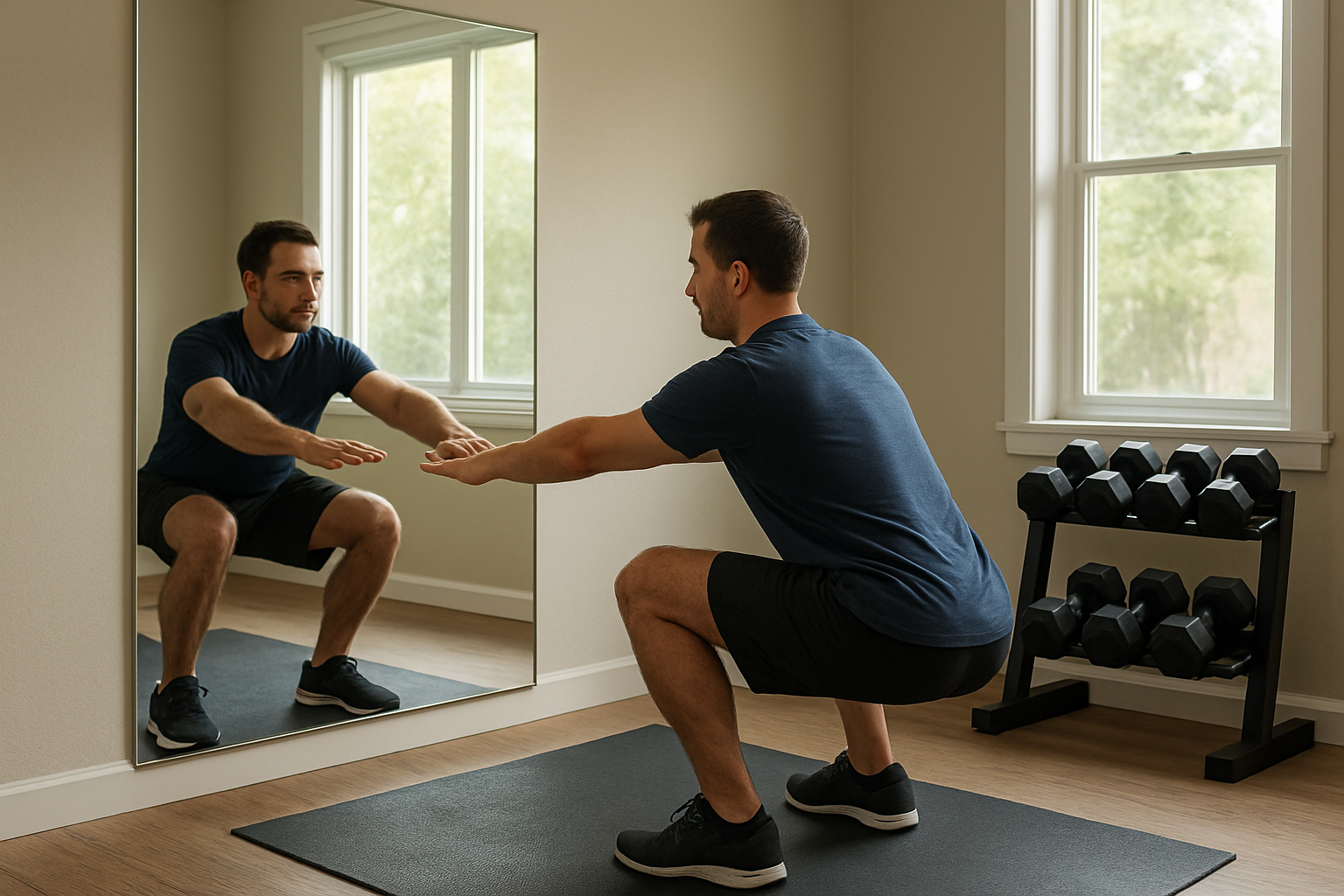
1. Decide what you want the mirror to do
Start with the training problem rather than the wall size. A mirror is most useful when you need visual feedback during movement, but it should supplement—not replace—coaching, video review, or attention to how the exercise feels.
Fitness facilities commonly use mirrors to help lifters and instructors observe form. The American Council on Exercise explains that gym mirrors can help people monitor and correct form, although a reflection only shows one angle and can be misleading if you rely on it constantly.
- Strength training: useful for checking bar path, knee tracking, shoulder position, and balance.
- Mobility and stretching: helpful for comparing left and right sides and maintaining a controlled position.
- Dance, boxing, or martial arts: valuable when you need to monitor foot placement and full-body alignment.
- Floor workouts: a low-mounted or angled mirror may work better than a tall wall panel.
- Room design: a mirror can improve light distribution, but this is a secondary benefit.
2. Compare mirror materials and construction
Home gym mirrors are usually made from traditional glass, acrylic, or modular mirror tiles. Each option involves a different balance of optical quality, weight, impact resistance, and installation difficulty.
Traditional glass generally provides the most natural reflection. Acrylic is lighter and may be easier to handle, but some products can show more distortion, scratch more readily, or develop a less polished appearance over time. Mirror tiles can simplify transport and replacement, though seams may be visible.
For a workout room, look for safety backing or another protective backing system. Safety backing does not make a mirror impossible to break, but it can help retain fragments if the glass is damaged. The U.S. Consumer Product Safety Commission outlines safety-glazing requirements for architectural glass and mirror glazing.
Do not assume that a product described as “tempered” is automatically suitable for every gym installation. Check the full specification for backing, mounting hardware, wall compatibility, and installation instructions.
Use this comparison to narrow the field before looking at dimensions or decorative features.
| What to look for | Why it matters | Warning sign |
|---|---|---|
| Clear, low-distortion reflection | Lets you judge movement more reliably | Wavy lines, stretched edges, or an inconsistent image |
| Safety backing | Can help hold glass fragments together after damage | No clear information about backing or glass construction |
| Secure mounting system | Reduces movement and separation from the wall | Adhesive-only installation for a heavy panel without suitable instructions |
| Rounded or protected edges | Reduces contact risk during installation and use | Sharp, exposed edges near a training area |
| Suitable thickness and weight | Determines handling and wall-support requirements | Product weight is missing from the specifications |
3. Choose a size that matches your exercises
A larger mirror gives you more freedom to move, but “wall-to-wall” is not automatically better. Measure the usable wall, then account for racks, benches, storage, electrical outlets, doors, and the distance between the mirror and your equipment.
For standing exercises, height is often more important than width. You should be able to see your feet, knees, hips, torso, and head from the position where you normally train. For a small workout corner, one tall panel may be more useful than several short decorative mirrors.
For floor training, consider how the reflection changes when you are lying down or seated. A mirror mounted too high may show only the upper body. In that situation, a broad lower panel or a safely secured angled mirror may provide better feedback.
Plan the viewing distance
- Mark the main exercise position on the floor with removable tape.
- Stand, squat, hinge, lunge, and raise your arms from that position.
- Check whether the intended mirror area includes your full body without forcing you to stand unusually close.
- Keep moving equipment away from the glass where possible, especially dumbbells, plates, and barbells.
4. Treat installation as a safety decision
Installation is one of the most important parts of a home gym mirrors review. A good mirror can still be a poor choice if the wall cannot support it or if the mounting method is vague.
Before ordering, identify whether you have drywall, masonry, studs, concrete, or another wall surface. Follow the manufacturer’s hardware requirements rather than substituting a generic adhesive or hook. A professional installer is sensible for large, heavy, or difficult-to-access panels.
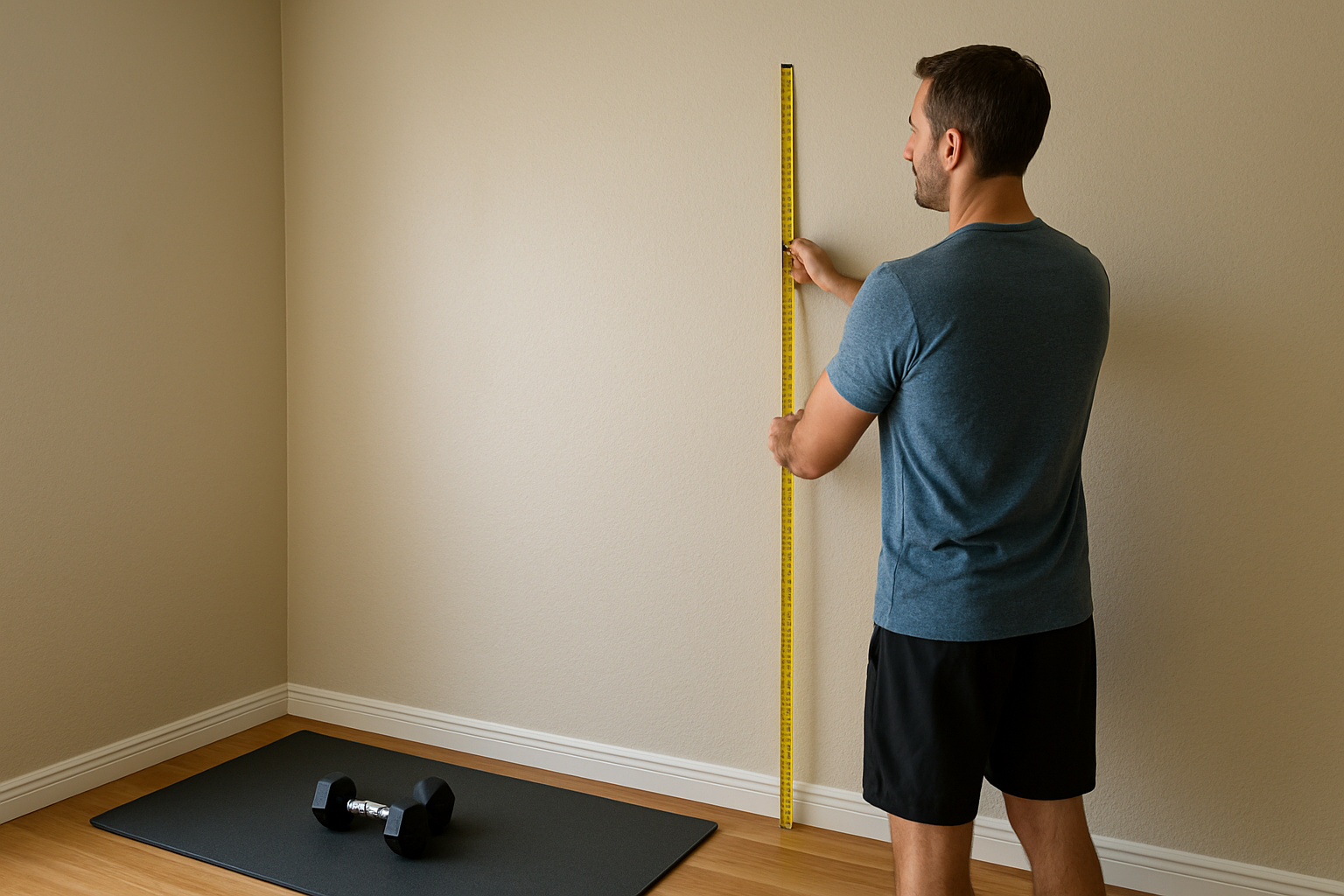
Safety concerns are not theoretical. The CPSC has published recalls involving mirrors that detached from their wall attachment bases and created laceration hazards; its mirror recall notice illustrates why attachment hardware and inspection matter.
- Inspect the glass, backing, brackets, and mounting points before installation.
- Do not install over a damaged wall or into unsuitable anchors.
- Keep the mirror away from direct impact zones and swinging equipment.
- Do not place heavy storage or sharp-edged equipment where it could fall into the mirror.
- After installation, check periodically for movement, cracks, loose hardware, or backing separation.
5. Match the mirror to your room and training style
A garage gym may need temperature-tolerant materials and careful protection from moisture. A bedroom or multipurpose room may benefit from removable panels, a freestanding mirror, or a smaller installation that does not dominate the space.
If you train with a power rack, position the mirror where it helps you observe movement without placing glass directly behind a barbell path. If you use resistance bands, kettlebells, or medicine balls, leave enough space to prevent accidental contact.
Your broader gym plan also matters. If you are still deciding whether home training suits you, compare the practical trade-offs in our guide to home gyms versus commercial gyms for beginners.
6. Consider maintenance and everyday usability
Gym mirrors collect fingerprints, chalk, dust, sweat residue, and cleaning-product film. Select a location where you can reach the surface safely and clean it without leaning equipment against the glass.
Use a soft microfiber cloth and a cleaner suitable for mirrors. Avoid abrasive pads and excessive liquid around edges, backing, outlets, or lighting. Follow the manufacturer’s care instructions, particularly if the mirror has a protective coating or framed mounting system.
Lighting also affects usefulness. Strong glare, windows directly opposite the mirror, or dim side lighting can make it harder to see body position. Test the room at the time of day when you usually train.
7. Know when another option is better
A wall-mounted glass mirror is not the only practical choice. A full-length freestanding mirror may suit renters or people who rearrange their workout space. Acrylic can be easier to handle in some rooms, while small modular panels can reduce the consequences of damaging one section.
Video recording can sometimes provide better feedback because you can review an exercise from several angles. For technical lifts, persistent pain, or uncertainty about form, consider a qualified coach or healthcare professional rather than relying on a mirror alone.
Action checklist before buying
- Measure the wall and the distance from your main training position.
- List the exercises you want to observe.
- Confirm the mirror’s weight, dimensions, backing, and edge treatment.
- Check whether the included hardware suits your wall type.
- Plan clearance from weights, racks, benches, doors, and storage.
- Review delivery, return, and damage-inspection policies before purchase.
- Decide whether professional installation is appropriate.
Common buying mistakes
- Choosing by size alone: a huge mirror is unhelpful if it cannot be mounted securely or is constantly exposed to equipment.
- Ignoring optical distortion: a warped reflection can encourage incorrect form adjustments.
- Assuming adhesive is enough: heavy glass usually requires a mounting system designed for its weight and wall surface.
- Mounting too close to equipment: benches and bars need operating space, not just storage space.
- Forgetting lighting: glare can make a large mirror less useful than a smaller, better-positioned one.
What if your mirror does not work well?
If you cannot see your full body
Move the viewing position or adjust the mirror height if the mounting system allows it. If the wall is too short, use a second panel only when both pieces can be installed safely and the seam will not confuse your visual feedback.
If the reflection looks distorted
Check whether the wall is uneven, the mirror is flexing, or the panel itself has manufacturing distortion. Do not try to correct a visibly warped reflection by changing your technique.
If the mirror moves or makes noise
Stop training near it until you inspect the mounting points. A loose bracket, separating backing, crack, or unexplained movement warrants professional assessment or replacement.
Next actions for choosing a home gym mirror
Write down your main three exercises, measure the wall, and mark the safest viewing zone. Then compare products by reflection quality, safety backing, mounting method, and return support before considering appearance or extra features.
Verdict: A home gym mirror is a worthwhile addition when you use it for specific visual checks and can install it securely. Choose a safety-backed, low-distortion mirror sized for your actual movements; choose modular, portable, or professional-installed alternatives when your wall, budget, or training layout makes a large glass panel impractical.