The best adjustable dumbbells for home strength training are the ones that change weight reliably, feel secure during movement, and cover the loads you will use most often. A compact set can replace several pairs of fixed dumbbells, but the right choice depends on your exercises, available space, lifting experience, and tolerance for slower weight changes.
This adjustable dumbbells review is based on current resistance-training guidance from the American College of Sports Medicine, general exercise information from the National Institutes of Health, and product-selection considerations summarized by the American Council on Exercise. It does not claim hands-on testing of a specific brand or model. Instead, it gives you a framework for comparing sets before purchase.
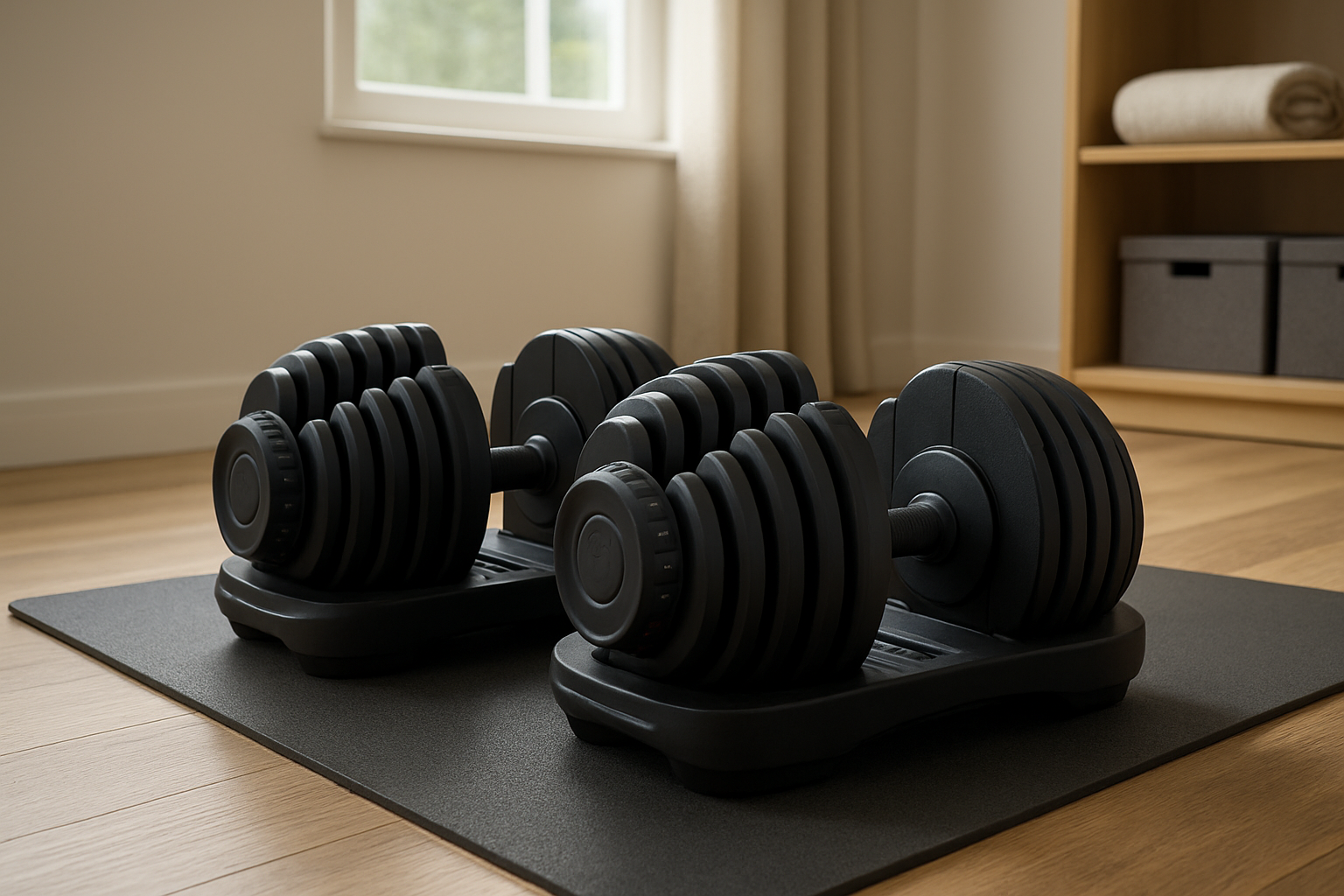
1. Define how you will use adjustable dumbbells
Start with your training plan rather than the product’s advertised maximum. A set that reaches a very high load may still be inconvenient if it begins too heavy for shoulder raises, curls, or rehabilitation-style movements.
List the exercises you expect to perform and estimate the working weight for each hand. Include movements such as goblet squats, Romanian deadlifts, lunges, floor presses, overhead presses, rows, curls, and triceps extensions. Your ideal range should cover current needs while leaving room for gradual progress.
- General fitness: prioritize manageable starting weights, simple adjustments, and comfortable handles.
- Muscle-building: look for enough load and small increments so you can progress without large jumps.
- Strength-focused training: prioritize maximum usable load, stability, and a handle that does not interfere with the lift.
- Small-space workouts: favor compact storage and a secure base that protects the floor.
Resistance training works through consistent progression and repeated practice, not through owning the heaviest equipment available. The 2026 ACSM guidance emphasizes regular training of all major muscle groups and gradual progress, which makes usable range more important than headline specifications.
2. Compare the adjustment mechanism
Adjustable dumbbells usually change weight through plates and collars, selector pins, dials, or sliding mechanisms. Each system can work well, but the practical differences become noticeable when you train with supersets or change loads frequently.
Common adjustment types
- Spin-lock or plate-loaded: generally straightforward and easy to understand, but changing plates takes longer and the ends may extend beyond the handle.
- Selector-pin systems: often allow faster changes, although the pin must be inserted correctly and kept in good condition.
- Dial or selector systems: convenient for changing loads, but they depend on an internal mechanism and a compatible storage cradle.
- Modular handles: can offer flexibility for dumbbell and barbell configurations, but they may require more storage space and assembly.
Look for a positive locking action rather than a vague click or loose selector. Before buying, check whether the manufacturer provides clear instructions for loading, adjustment, cleaning, and inspection. If the mechanism is difficult to understand in product photographs or documentation, it may be frustrating during a busy workout.
Do not assume that faster adjustment is automatically better. A simple plate-loaded set may be preferable if you perform straight sets and value fewer moving parts. A selectorized set may suit you better if you alternate between heavy and light exercises.
3. Evaluate range, increments, and real usability
Weight range is only one part of the specification. The increments between settings determine how smoothly you can progress. Large jumps may force you to change repetitions, technique, or exercise selection before your muscles are ready for the next load.
Check the lightest available setting as carefully as the maximum. Beginners, older adults, and anyone returning after a break may need low loads for pressing, raises, and controlled mobility work. A heavy minimum weight can make an otherwise versatile set unsuitable.
Also consider whether the listed weight is per dumbbell or for the complete pair. Retail listings do not always present this information in the same way. Confirm the unit of measurement, the number of included plates, and whether expansion weights are sold separately.
Use this comparison table when reviewing product pages and manuals:
| What to look for | Why it matters | Warning sign |
|---|---|---|
| Light starting weight | Supports warm-ups, isolation exercises, and gradual progression | The minimum setting is already too heavy for your weakest movements |
| Small, clearly listed increments | Makes progress easier to track | Large jumps with no intermediate settings |
| Secure locking system | Reduces unwanted plate movement during normal lifting | Loose parts, unclear locking instructions, or visible gaps |
| Comfortable handle diameter | Helps maintain a stable grip across longer sessions | Handle feels excessively thick, sharp, or slippery |
| Stable storage tray | Keeps the set organized and supports safe adjustment | Dumbbell rocks, sticks, or does not seat fully |
4. Check comfort, balance, and movement quality
Adjustable dumbbells can feel different from fixed dumbbells even when the total weight is identical. Plates, selector housings, or long handles may change the balance of the implement and affect your wrist position.
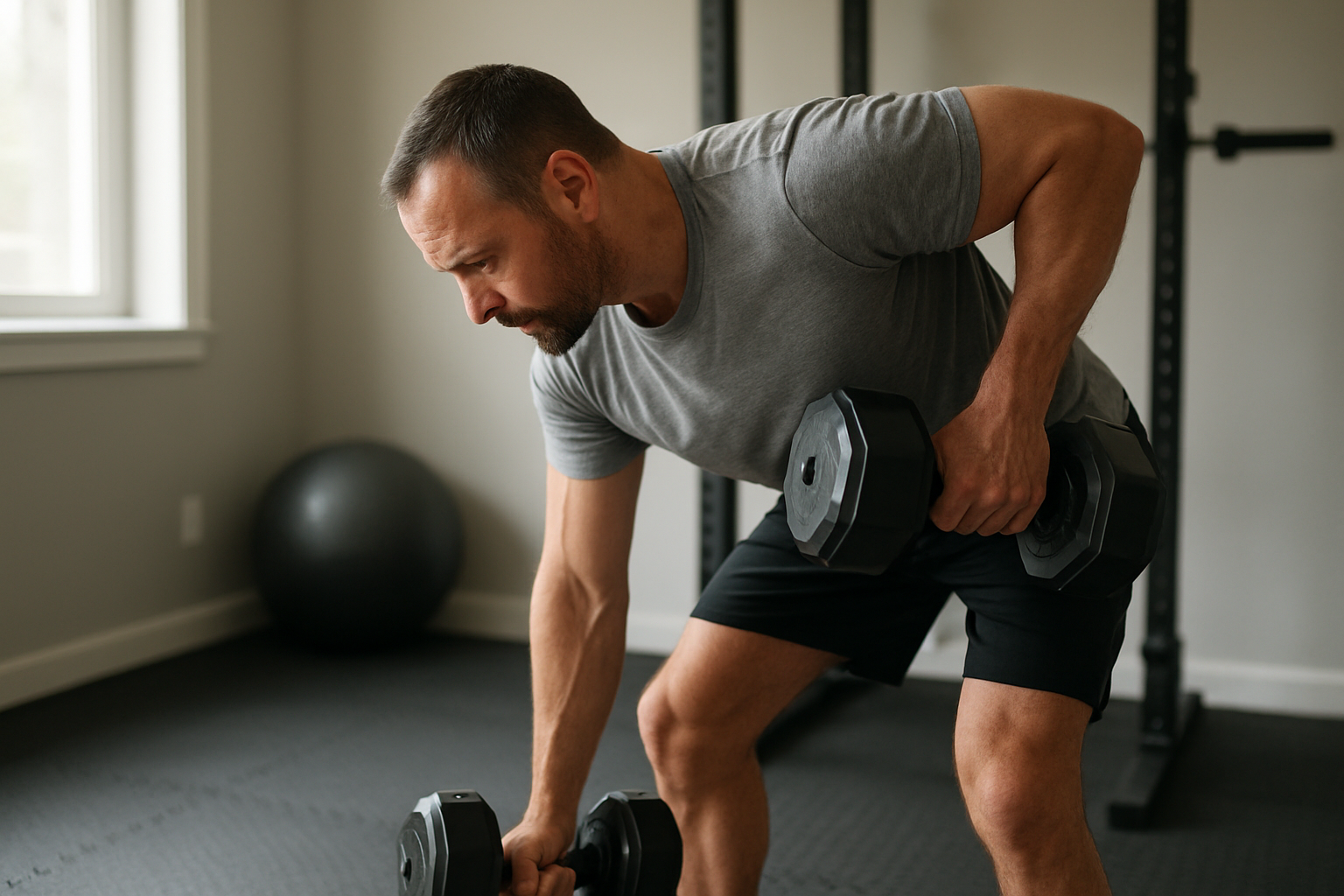
For presses and rows, a slightly unusual balance may be acceptable if the handle remains secure. For curls, lateral raises, and exercises close to your body, bulky ends may feel more intrusive. Pay attention to the distance between your hand and the weight, because extra length can touch your torso or limit your range of motion.
Handle texture should provide grip without creating hot spots. If you have smaller hands, hand pain, or reduced grip strength, read the handle dimensions and return policy carefully. Online photographs rarely show how thick a handle feels in practice.
5. Account for space, noise, and storage
One of the main advantages of adjustable dumbbells is that they can reduce the number of separate pairs in a home gym. They are not always small during use, however. Long handles or wide plate assemblies may require more clearance than expected for lunges, rows, and overhead movements.
Measure the floor area where you will train and the shelf or cabinet where the dumbbells will live. A storage tray is useful, but it should sit on a level surface and allow you to pick up and replace the dumbbell without twisting awkwardly.
- Leave enough room to set the dumbbells down without striking furniture.
- Use a protective mat if the manufacturer permits floor placement and your surface could be damaged.
- Do not leave selector mechanisms under load if the instructions tell you to return the dumbbells to their base.
- Keep children and pets away from loose plates, pins, and locking parts.
6. Understand the limitations and alternatives
Adjustable dumbbells are versatile, but they are not ideal for every training style. Frequent adjustment can interrupt circuits, and some mechanisms are not intended for dropping, swinging, or high-impact movements.
Fixed dumbbells are usually simpler and may feel more balanced, but a complete range takes more money and storage space. A barbell can be more efficient for heavy squats, deadlifts, and presses, while resistance bands are portable and useful when storage or travel matters. Kettlebells may suit swings and ballistic exercises, provided you have the technique and space to use them safely.
For exercise examples and programming ideas, you can also review LaokFitness guides on deadlifts versus hip thrusts and hamstring exercises for strength and flexibility. These resources can help you decide whether dumbbells actually match your preferred lower-body training.
7. Avoid common buying mistakes
Common mistakes
- Choosing the highest maximum weight without checking the minimum setting.
- Ignoring the size of the dumbbell at lighter settings.
- Assuming a pair weighs the advertised total weight per hand.
- Buying a complex adjustment system without reading maintenance instructions.
- Using a mechanism for movements the manufacturer excludes, such as dropping or impact work.
- Forgetting to check replacement-part availability and the return policy.
- Buying one set for every household member without considering different strength levels.
8. Troubleshoot before you commit
What if the dumbbell feels unstable?
Stop the set and check that every plate, collar, pin, or selector is fully engaged. If looseness remains during normal use, do not continue loading or modifying the equipment beyond the manufacturer’s instructions. Contact the seller or manufacturer rather than treating movement as normal.
What if the next weight is too difficult?
Use more controlled repetitions, reduce the number of repetitions, or choose a different exercise until you can progress safely. If the increments are too large for your program, a second lighter pair or micro-plates may be more useful than replacing the entire set.
What if the adjustment takes too long?
Organize workouts around straight sets, group exercises using similar loads, or consider a second pair for common lighter movements. Convenience matters because equipment that repeatedly interrupts your session may reduce how consistently you train.
9. Use this adjustable dumbbells buying checklist
- Write down your main exercises and estimated working weights.
- Confirm the minimum and maximum weight per dumbbell.
- Check the exact increment pattern between settings.
- Identify the adjustment mechanism and its safety instructions.
- Measure handle dimensions and the dumbbell’s overall length.
- Confirm whether a storage tray is included.
- Check warranty terms, spare parts, delivery conditions, and returns.
- Verify that the set is intended for the movements you plan to perform.
10. Make the final decision based on fit
Choose adjustable dumbbells if you want a compact home setup, perform controlled strength exercises, and can work within the set’s adjustment limits. They are particularly practical when your training includes pressing, rowing, squatting, hinging, and arm exercises but you do not want a room full of fixed weights.
Choose another option if you need rapid changes every few seconds, regularly drop equipment, train with heavy barbell-style loads, or dislike the feel of a long or mechanically balanced dumbbell. In those cases, fixed dumbbells, a barbell, bands, or a mixed setup may provide a better training experience.
Conditional verdict: adjustable dumbbells are a strong home strength-training choice when their usable range, increments, locking system, and dimensions match your actual program. Do not buy on maximum weight alone. Compare the complete specifications, plan where the equipment will be stored, and select the simplest system that lets you train consistently and progress gradually.