The best chest exercises with dumbbells and no bench are the dumbbell floor press, squeeze press, floor fly, pullover, push-up dumbbell drag, standing crush press, and dumbbell pullover-to-press. For most people, start with the floor press and squeeze press, then add one movement that challenges your chest through a different angle or range of motion.
You do not need a weight bench to train your chest effectively. The floor can provide a stable pressing surface, while standing and push-up variations add useful options when space, equipment, or joint comfort is limited. This guide compares the most practical choices and shows how to build them into a simple home workout.
1. What to look for in a no-bench chest exercise
A good exercise should let you control the dumbbells, keep your shoulders in a comfortable position, and progress gradually. Because the floor limits how far your elbows can travel below your torso, floor-based presses are often easier to control than bench presses for beginners.
Selection also depends on your goal. Presses are usually the most practical choice for building strength with heavier dumbbells, while fly variations and squeeze presses can make lighter weights feel more demanding. The American College of Sports Medicine’s current resistance-training guidance emphasizes matching training to your goal and progressing consistently rather than relying on complicated techniques.
Before training, clear the floor and check that your dumbbell handles and plates are secure. If you have a current shoulder, elbow, wrist, or chest injury, ask a qualified clinician for exercise-specific guidance before loading the area.
Here is how the main options compare.
| Exercise | Best for | Equipment | What to look for | Warning sign |
|---|---|---|---|---|
| Dumbbell floor press | Strength and general chest training | Pair of dumbbells | Forearms stay mostly vertical; upper arms touch the floor gently | Elbows slam down or wrists bend backward |
| Squeeze press | Chest tension with moderate weights | One or two dumbbells | Dumbbells remain pressed together throughout | Shoulders shrug toward the ears |
| Floor fly | Controlled chest accessory work | Light pair of dumbbells | Soft elbows and slow opening phase | Arms drop heavily into the floor |
| Dumbbell pullover | Chest and upper-body range of motion | One dumbbell | Ribs stay controlled while the weight travels overhead | Low back arches aggressively |
| Push-up dumbbell drag | Chest plus core and shoulder stability | Pair of hex-shaped dumbbells | Hips stay level as one weight moves across the floor | Dumbbell rolls or torso twists sharply |
2. The seven best chest exercises with dumbbells and no bench
1. Dumbbell floor press
Best for: Most home lifters and progressive strength work.
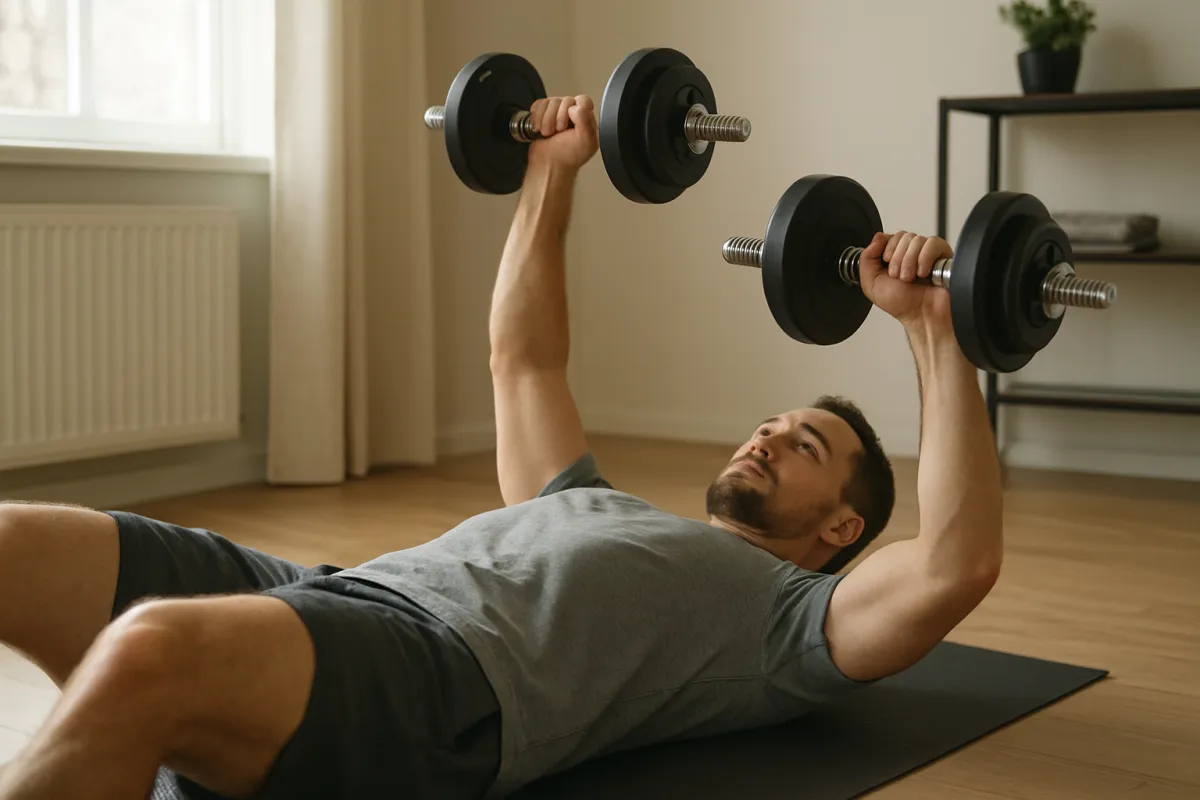
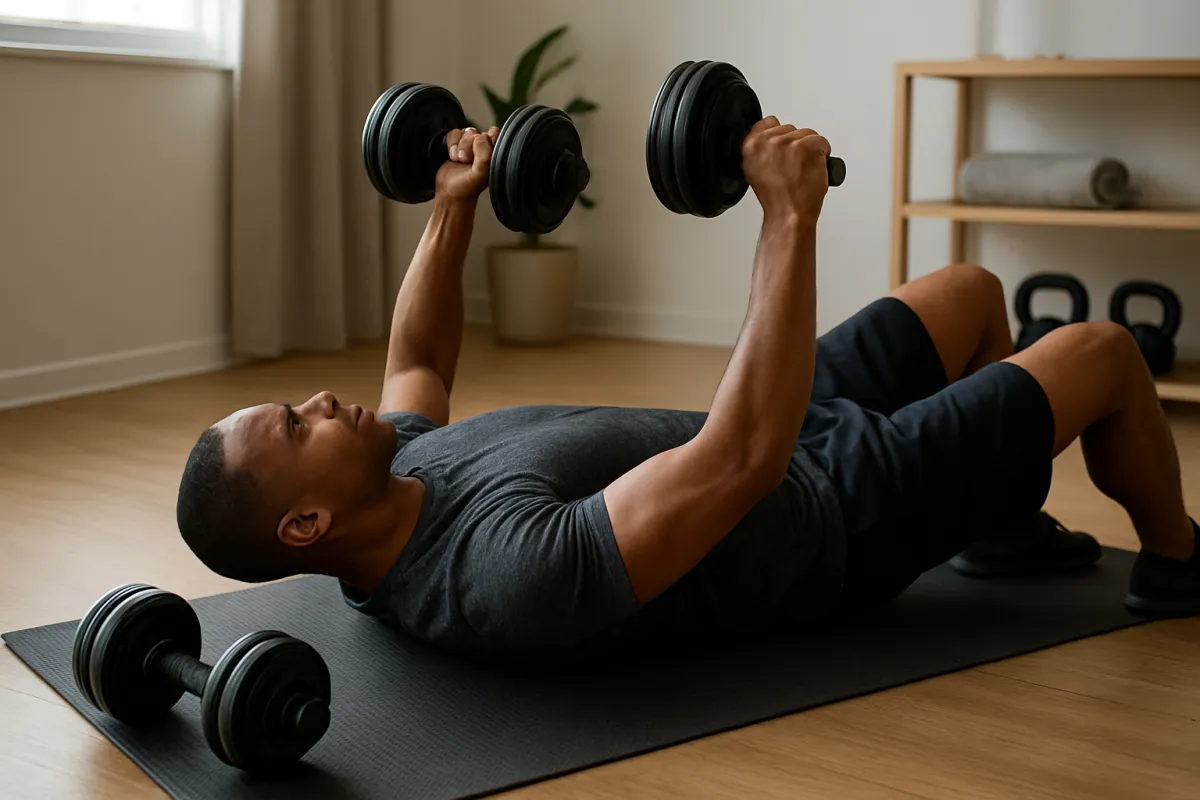
Lie on your back with your knees bent and feet planted. Hold the dumbbells over your chest with neutral or slightly angled wrists. Lower the weights until your upper arms make gentle contact with the floor, pause briefly, and press them upward without bouncing.
The floor naturally limits the bottom position, which can make this a useful starting point if deep pressing irritates your shoulders. Keep your elbows slightly closer to your sides rather than forcing them straight out. ACE’s chest-press instructions also emphasize stable contact points, neutral wrists, and avoiding excessive back arching.
2. Dumbbell squeeze press
Best for: Creating more chest tension with lighter dumbbells.
Set up like a floor press, but press the dumbbells together over the center of your chest. Keep that inward pressure as you lower and raise the weights. The load may be modest, but maintaining the squeeze can make the set challenging without requiring very heavy dumbbells.
This is a good choice when your dumbbell collection is limited or when you want a controlled accessory movement after pressing. Use a steady tempo instead of trying to move quickly.
3. Dumbbell floor fly
Best for: A lighter chest isolation-style movement.
Hold the dumbbells above your chest with a small bend in your elbows. Open your arms slowly until the upper arms approach the floor, then bring the weights back together in a wide arc. Keep the same elbow bend throughout the repetition.
Use substantially lighter weights than you would for a press. If you cannot control the opening phase or feel a sharp stretch in the front of the shoulder, shorten the range of motion or choose the squeeze press instead. ACE lists the lying chest fly as a dumbbell chest exercise, but without a bench the floor should limit the range and help prevent excessive shoulder extension.
4. One-dumbbell pullover
Best for: Training the chest with a different shoulder angle.
Lie on your back and hold one dumbbell above your chest with both hands. With your elbows slightly bent, lower the weight behind your head only as far as you can while keeping your ribs down and your lower back reasonably stable. Pull the dumbbell back over your chest.
This movement can involve the chest, shoulders, and upper back. It is not a replacement for pressing, but it can add variety when you want a movement that does not require two dumbbells working independently.
5. Push-up dumbbell drag
Best for: Chest training combined with core stability.
Place two stable, preferably hex-shaped dumbbells on the floor and assume a high plank with one hand on each handle. Perform a controlled push-up, then drag one dumbbell across the floor to the opposite side. Repeat on the other side.
This is more demanding than a standard press because your chest works while your trunk resists rotation. Use a wider foot position for stability, and reduce the difficulty by performing the push-up from your knees if needed. Do not use round dumbbells that may roll under load.
6. Standing dumbbell crush press
Best for: Small spaces and lifters who prefer standing exercises.
Stand tall and hold one dumbbell vertically between both palms at chest height, or hold two dumbbells pressed together. Squeeze inward and press the weight slightly forward, then bring it back toward your chest while maintaining tension.
This will not match a heavy floor press for overall loading, but it is convenient and can help you practice bracing, controlled pressing, and continuous chest tension. Keep your ribs stacked over your pelvis rather than leaning backward.
7. Dumbbell pullover-to-press
Best for: A more advanced combination movement.
Begin with a one-dumbbell pullover. As the weight returns over your chest, transition into a two-hand or single-arm press, depending on the dumbbell setup and your control. This combines two patterns, so it should be performed with a lighter load than either exercise alone.
Choose this only after you can perform the individual movements without losing rib, wrist, or shoulder control.
3. How to build a no-bench dumbbell chest workout
You do not need all seven exercises in one session. A practical workout can use one main press, one chest-tension movement, and one optional stability or range-of-motion exercise.
- Floor press: 3 sets of 6–12 controlled repetitions
- Squeeze press: 2–3 sets of 8–15 repetitions
- Push-up dumbbell drag or pullover: 2–3 sets of 6–12 repetitions per side, or 8–15 total repetitions
Rest long enough to repeat the exercise with sound technique. When you can complete the top of your chosen repetition range without straining or shortening the movement, increase the dumbbell load slightly or add a repetition. If heavier weights reduce control, keep the same load and improve the tempo first.
For general training structure, the ACSM resistance-training summary is a useful reminder that consistency, appropriate effort, and a plan suited to your goal matter more than advanced methods.
4. Common mistakes that reduce results
- Using a weight that is too heavy: If your wrists fold, elbows flare uncontrollably, or your back arches hard, reduce the load.
- Treating the floor press like a bounce: Let your upper arms touch down softly, pause if needed, and press without using momentum.
- Turning the fly into a press: Keep the elbow angle stable and use lighter dumbbells.
- Ignoring the surface: A slippery floor can make pressing, planking, and dragging exercises unstable.
- Doing too many similar sets: More exercises are not automatically better. Choose movements that cover your goal without causing unnecessary fatigue.
- Skipping progression: Record repetitions and load so you know when to add a small challenge.
5. What if a movement does not feel right?
If you feel general muscular effort in the chest, shoulders, or triceps, that is expected. Sharp pain, sudden weakness, numbness, unusual swelling, or pain that persists after training is not something to push through. Stop the exercise and seek medical advice when symptoms are severe, recurring, or associated with an injury.
For shoulder discomfort, first try a lighter load, a shorter range, and elbows closer to the body. You can also replace floor flyes with squeeze presses, which usually demand less end-range shoulder control. The NHS offers general strength-exercise safety guidance for home training, including using stable equipment and choosing manageable progressions.
6. Simple selection checklist
- Choose the floor press if you want one dependable main exercise.
- Choose the squeeze press if you have lighter dumbbells or want constant tension.
- Choose the floor fly only if you can control the full movement with a light load.
- Choose the dumbbell drag if you also want core and shoulder-stability work.
- Choose the pullover if you want variety and can keep your ribs and lower back controlled.
- Use stable dumbbells and a non-slip surface for every floor-based movement.
7. Final recommendation by scenario
For beginners: Start with the dumbbell floor press and squeeze press. They are easier to learn and simpler to scale than flyes or combination movements.
For muscle growth: Use the floor press as your main movement, then add the squeeze press and a controlled fly or pullover. Progress gradually while keeping the target muscles under control.
For small spaces: Choose the floor press, squeeze press, and standing crush press. They require little room and no bench.
For stronger lifters: Use unilateral floor presses or push-up dumbbell drags to add stability demands, but only with secure dumbbells and controlled form.
The best chest exercises with dumbbells and no bench are the ones you can perform consistently, progress safely, and recover from. For most home workouts, that means making the dumbbell floor press your foundation, using the squeeze press for additional chest tension, and adding only the variations that match your equipment and shoulder comfort.