For a small home gym, the best equipment is rarely the tool with the longest exercise list. It is the tool that fits your space, routine, budget pattern, and comfort with setup. Resistance bands and suspension trainers are both compact, versatile options, but they create resistance in different ways.
Resistance bands provide elastic tension. Suspension trainers use your body weight while your hands or feet connect to straps anchored above or beside you. That difference affects setup, exercise feel, progression, and the kind of workouts each tool supports.
Quick verdict: Resistance bands are usually the easier starting point for renters, beginners, and travelers. They are simple to store, quick to pack, and useful for many low-load and moderate-load exercises. Suspension trainers are a strong choice for people who want bodyweight-focused training, core control, and adjustable leverage, and who have a reliable anchor available. Neither is universally better.
How to compare resistance bands and suspension trainers
A fair comparison should look beyond the number of exercises shown in a product listing. For a small home gym, consider these questions:
- How much space does the equipment need during storage and use?
- Can you set it up without drilling, permanent hardware, or moving heavy furniture?
- Can you create a clear and repeatable path for strength progression?
- Will it travel easily in a suitcase or day bag?
- Does the movement feel comfortable and controllable for your current skill level?
- How might heat, sunlight, abrasion, sweat, and poor storage affect durability?
Cost also matters, but it is more useful to compare cost patterns than to focus on one price. A basic band setup can start small and expand gradually. A suspension setup may involve the trainer itself plus an anchor or compatible attachment, depending on where you plan to use it. The least expensive option at purchase is not always the most useful option in your room.
Side-by-side comparison
| Criterion | Resistance bands | Suspension trainers |
|---|---|---|
| Resistance method | Elastic tension increases as the band stretches. | Body weight and leverage create the challenge. |
| Typical setup | Often ready to use on the floor, around a body part, or with a suitable anchor. | Usually requires a secure overhead, door, or other compatible anchor. |
| Storage | Very compact when coiled or folded. | Compact when packed, but includes longer straps and handles. |
| Portability | Excellent for travel and small spaces. | Good for travel, but an anchor must be available at the destination. |
| Exercise emphasis | Strength, activation, mobility, and assisted movements. | Bodyweight strength, balance, core control, and stability. |
| Progression | Change band tension, length, grip, tempo, or position. | Change body angle, stance, range of motion, leverage, or tempo. |
| Beginner learning curve | Generally straightforward, although anchoring and band control still require care. | Can be approachable, but body angle and stability may make exercises demanding. |
| Main limitation | Resistance can feel uneven and may be harder to quantify. | Requires a trustworthy anchor and enough clear space. |
Resistance bands: strengths and tradeoffs
Compact storage and fast setup
Resistance bands are among the easiest tools to fit into a small home. Loop bands can be stored in a drawer, basket, or shelf. Tube bands with handles and accessories take slightly more room, but they still avoid the floor space required by many traditional strength tools.
Many band exercises need no anchor. You can perform presses, rows, curls, triceps work, lateral steps, squats, and similar movements by standing on or holding the band. An anchor can add more exercise choices, but it also introduces a safety question: the attachment point must be suitable for the force and direction involved.
Exercise variety
Bands can support full-body training, warm-ups, smaller-muscle exercises, and assisted movements. They are useful for upper-body pulling and pressing, lower-body work, shoulder activation, and controlled mobility drills. Different shapes and lengths can change how the band is used.
However, variety does not mean every movement feels equally natural. A band may become easier near the beginning of a movement and harder near the end as it stretches. That can be useful, but it may not match the resistance pattern of a dumbbell or cable. Bands can also move or roll during certain exercises, particularly on smooth floors or against clothing.
Strength progression
Progression with bands can follow several paths. You can use a stronger band, shorten the working length, increase repetitions, slow the lowering phase, add pauses, or change your stance. You can also move from a two-arm or two-leg variation to a single-side variation.
The challenge is that band labels are not always directly comparable across brands or band types. Even when a band is marked with a resistance category, the actual challenge depends on how far it stretches, where you hold it, and the angle of the exercise. For precise load tracking, bands can require more notes and consistency than equipment with clearly defined increments.
Cost patterns
Resistance bands allow a gradual approach. You can begin with a small selection and add different levels, lengths, handles, or anchors as your routine develops. This can make the initial commitment modest, but a complete collection may cost more than a starter set. Replacement is also part of the long-term picture because elastic materials can wear over time.
Suspension trainers: strengths and tradeoffs
Bodyweight-based resistance
A suspension trainer changes the difficulty of an exercise by changing your body position in relation to the anchor. For example, a more upright row is generally easier than a row performed with your body farther beneath the anchor. A pressing movement can become more demanding as you shift your body angle.
This system makes small adjustments meaningful. It can also challenge balance and trunk control because the handles or foot cradles may move. That instability is not automatically better. It is simply a different training demand, and it may be useful for people who enjoy bodyweight-focused exercise.

Setup and anchoring
Anchoring is the central practical issue. A suspension trainer needs an anchor that can safely support the forces created during the exercise. Depending on the product and location, that might involve a purpose-built overhead point, a suitable door attachment, or another compatible structure. The correct option depends on the equipment instructions and the condition of the anchor.
Do not assume that any door, hook, railing, branch, or furniture item is suitable. Check that the anchor is stable, the straps are correctly positioned, and the surrounding space is clear. A door attachment must be installed and closed in the correct direction according to its instructions. If you cannot identify a reliable anchor, the trainer may be a poor fit for your home even if it stores easily.
Exercise variety
Suspension trainers can support rows, presses, squats, lunges, hamstring curls, planks, pikes, and many other bodyweight movements. The handles can create useful options for people who prefer standing exercises or want to reduce some of the balance demands of a floor variation.
They are especially suited to movements where body angle controls difficulty. They are less convenient for exercises that require a fixed external load or a very stable surface. Foot cradles and moving handles can also make basic exercises feel more complex than expected.
Strength progression
Progression is often intuitive: change your angle, move your feet, widen or narrow your stance, increase range of motion, slow the tempo, or add a pause. Single-side variations can raise the challenge substantially. These changes are useful, but they do not provide a simple weight number. Tracking body angle and repetition quality is often more practical than trying to assign an exact load.
Suspension training can support progressive strength work, but heavy or highly specific strength goals may eventually call for equipment that offers more stable and measurable loading. The trainer is not a replacement for every form of resistance.
Storage space and room requirements
Both options are compact when stored, but use space differently. Bands can often be used in a narrow area because many exercises stay close to the body. Anchored band movements need additional clearance so the band does not contact furniture, walls, or other people.
A suspension trainer needs enough open floor space for your body to move toward and away from the anchor. You may need room for lunges, planks, rows, and overhead strap movement. The required space depends on the exercise, but a clear path is essential. A small apartment can work if furniture can be moved safely, yet a crowded room may limit the trainer more than its packed size suggests.
Portability for travel
Resistance bands are usually the simpler travel option. They are light, flexible, and usable in a hotel room, office, or outdoor area without a permanent installation. A door anchor can increase variety, but it also needs a suitable door and careful placement.
Suspension trainers can also travel well because the straps fold or coil. Their portability is less universal, however. You need a safe anchor at the destination, enough space, and permission to use that setup if you are staying in a rental or shared building. For frequent travelers, bands usually create fewer logistical problems.
Durability considerations
Band durability depends on material quality, storage, use, and exposure. Keep bands away from sharp edges, rough surfaces, extreme heat, prolonged direct sunlight, and unnecessary twisting. Inspect them before use for cracks, cuts, deep abrasions, unusual thinning, or other damage. A damaged band can fail under tension.
For suspension trainers, inspect straps, stitching, handles, adjustment points, carabiner-style connectors, and anchor accessories. Look for fraying, loose stitching, bent or damaged hardware, and worn contact areas. Avoid dragging straps across rough surfaces. Follow the manufacturer’s care instructions, and replace components when damage affects safe use.
Neither type should be stored wet or compressed under heavy objects for long periods. A clean, dry storage location helps, but inspection remains important because wear can be difficult to notice at first.
Which is better for beginners?
Resistance bands are often the easier first purchase because many movements are stable and require little setup. A beginner can learn basic patterns such as a squat, row, press, hinge, and lateral step without managing a moving suspension system. Bands also allow small resistance changes when technique is still developing.
Suspension trainers can work for beginners, especially when exercises are kept upright and the body angle is conservative. However, the moving handles and need for an anchor can add complexity. A beginner should start with stable variations, use a controlled range of motion, and avoid making the exercise harder simply by leaning farther away.
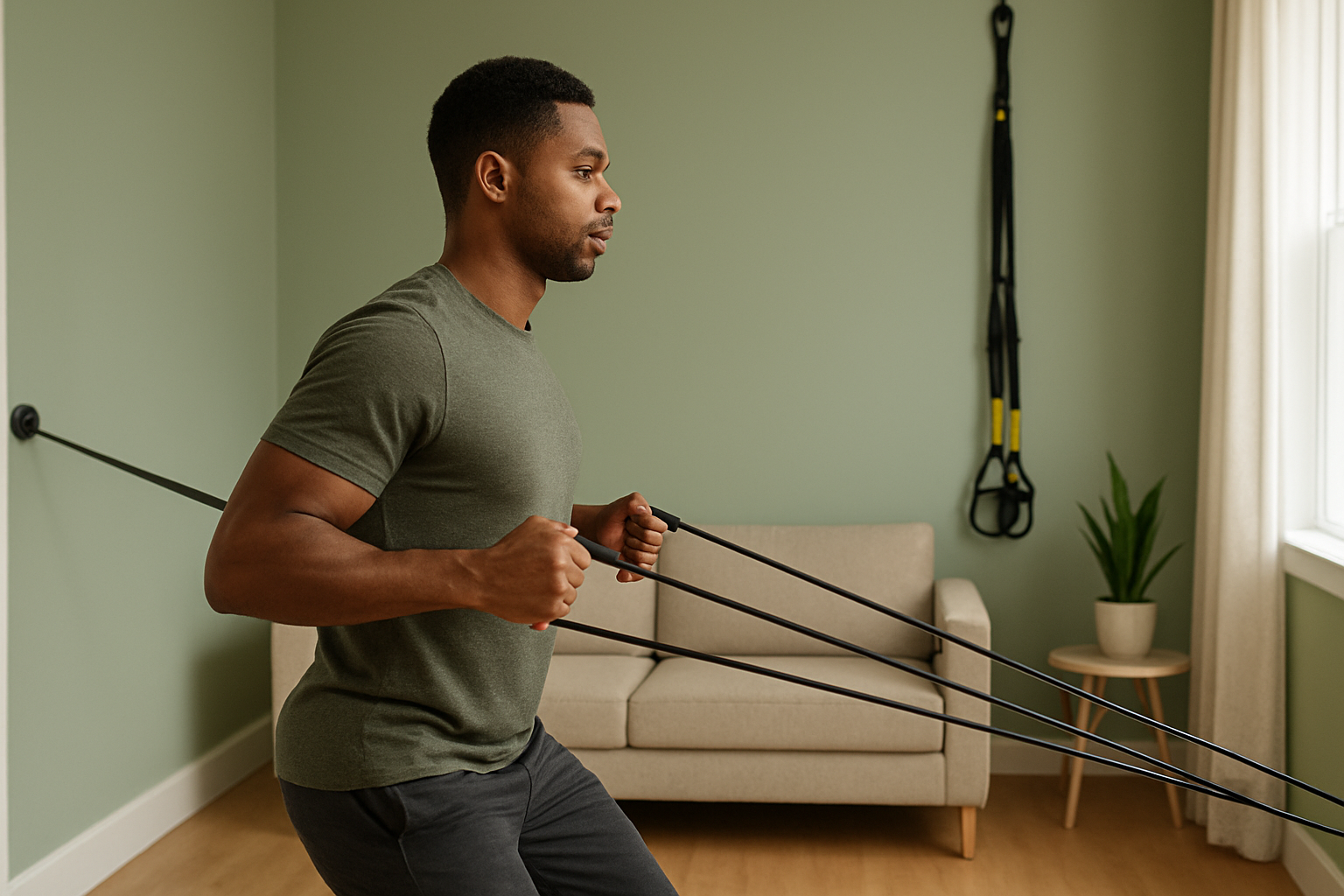
In both cases, the goal should be consistent technique rather than chasing the strongest band or most difficult body angle. If an exercise causes sharp pain, slipping, uncontrolled movement, or loss of position, stop and reassess the setup.
Which is better for progressive strength training?
The answer depends on what progression means to you. If you want a convenient way to increase resistance in small steps, bands offer a practical route through stronger bands, shorter lengths, and harder positions. They can support regular progression for general strength and conditioning.
If you enjoy bodyweight training and want to progress through leverage, balance, and control, a suspension trainer may be more engaging. It can make small changes in angle feel significant, and it offers many unilateral and core-focused options.
For highly measurable strength progression, both tools have limitations. Elastic tension varies through the range of motion, while suspension difficulty depends on body position and stability. Recording the exercise variation, repetitions, tempo, range of motion, and perceived effort can make progress easier to monitor with either tool.
Recommendations by user and situation
Choose resistance bands if you are a renter
Bands are usually the safer default for renters because many exercises require no permanent attachment. If you use an anchor, confirm that it is appropriate for the door or structure and will not damage the property. Bands also make it easier to train in a room where furniture cannot be moved far.
Choose resistance bands if you travel often
Bands are the more flexible travel choice for most people. They can work in small spaces and do not depend as heavily on the destination. Pack them in a way that prevents sharp objects from cutting or scraping the material.
Choose resistance bands if you are new to home workouts
Start with a small, manageable selection and learn a few basic movement patterns. Bands provide a stable introduction to resistance training, although you still need to control the band and keep it away from your face and other people.
Choose a suspension trainer if you enjoy bodyweight training
A suspension trainer is a good match for someone who likes rows, presses, lunges, planks, and leverage-based progressions. Make sure your home has a reliable anchor and enough clearance before buying.
Choose a suspension trainer if you want leverage-based progression
If changing body angle and stability is more appealing than changing bands, suspension training may keep your workouts engaging. Begin with upright variations and progress only when you can control the full movement.
Consider both if you want complementary tools
The two systems can work together. Bands can provide direct elastic resistance and simple warm-up or accessory movements. A suspension trainer can add bodyweight rows, presses, lunges, and trunk work. Buying both makes the most sense when you have enough space, a dependable anchor, and a clear plan for using each tool.
Important limitations and safety notes
Compact equipment is not automatically risk-free. Check bands and straps before every session. Use a clear training area, secure the anchor, and keep tension under control. Do not stretch a band toward your face, neck, or another person. Avoid standing on a band if it is damaged or if your foot placement is unstable.
With suspension training, test the anchor and strap arrangement before applying full body weight. Do not use an uncertain door, loose furniture, weak railing, or damaged hardware. Keep the straps away from sharp edges and avoid exercises that require more balance than you can safely manage.
Use a controlled range of motion and stop if you feel sharp pain, numbness, dizziness, unusual shortness of breath, or loss of control. People with injuries, medical conditions, pregnancy-related concerns, or questions about starting resistance exercise should consult a qualified health professional before training.
Final verdict
In the debate over resistance bands vs suspension trainers, resistance bands win on simplicity, storage, renter-friendliness, and travel convenience. Suspension trainers win for bodyweight variety, leverage-based progression, and exercises that challenge stability and trunk control.
Choose bands if you want the lowest setup barrier and a tool that can fit almost anywhere. Choose a suspension trainer if you have a trustworthy anchor, clear floor space, and a strong interest in bodyweight movement. The best option is the one you can set up safely and use consistently. For a small home gym, practical access matters more than having the most advanced-looking equipment.