You do not need a workout bench to build a useful strength routine at home. A clear floor, adjustable dumbbells, resistance bands, and your bodyweight can cover the main movement patterns: squat, hinge, push, pull, carry, and core control.
The key is not to copy a gym workout exercise for exercise. Instead, choose movements that fit your space and equipment, then progress them gradually. This guide explains how to strength train at home without a bench, including setup, exercise choices, substitutions, safety checks, and a practical two- or three-day full-body plan.
What you need before you start
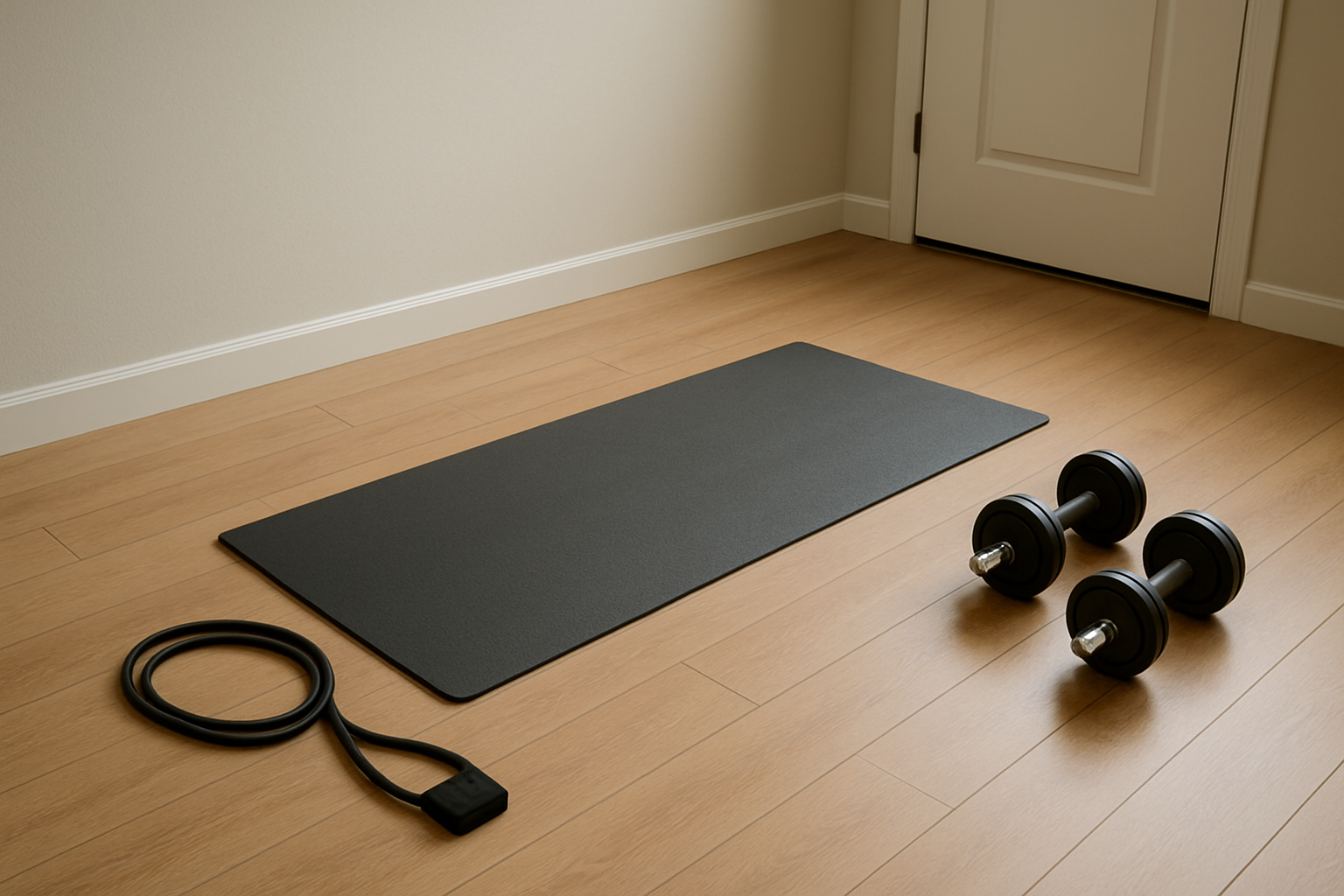
Start with the simplest setup that lets you move safely. You may need only:
- A clear area large enough to lie down, stand, and extend your arms without hitting furniture.
- An exercise mat, carpet, or other comfortable surface for floor work.
- Adjustable dumbbells or one pair of dumbbells that you can control.
- A long resistance band or loop band. If you use a long band for pulling, use only a secure anchor designed for that purpose.
- Supportive footwear if it helps you feel stable. Many floor exercises can be done barefoot or in comfortable socks, depending on the surface.
A bench can make some exercises more convenient, but it is not required. The floor provides a stable base for pressing and core exercises. Standing movements can train the legs, hips, shoulders, and upper back without elevation.
Setup checkpoint
Before your first set, remove loose rugs, cords, and small objects from the area. Check that dumbbell plates are locked or tightened according to the equipment instructions. Test a band with gentle tension. Do not use a band that is cracked, frayed, or damaged.
Build each workout around movement patterns
A balanced full-body session does not require many exercises. Choose one movement from most of the categories below. You can add a second exercise for an area that needs more practice, but more is not always better.
- Squat: bend the knees and hips while keeping control through the feet.
- Hinge: move from the hips while keeping the spine steady. Examples include deadlifts and good mornings.
- Push: press the floor, dumbbells, or a band away from you.
- Pull: draw a band or dumbbell toward your body.
- Carry or brace: hold weight while walking or resisting movement through the trunk.
- Core control: use the trunk to resist arching, twisting, or shifting.
This structure helps you train the whole body even when you do not have a bench or a large collection of machines.
Step 1: Warm up and practice the movements
Spend about five to eight minutes preparing. Begin with easy movements rather than tiring yourself out.
- Walk around the room or march in place for one to two minutes.
- Perform slow bodyweight squats and hip hinges.
- Circle the shoulders and move the arms through a comfortable range.
- Practice a light band row or a few incline push-ups against a wall.
- Do one easy practice set of the first two exercises.
Use the warm-up to identify stiffness, pain, or equipment problems. A gradual increase in effort is more useful than forcing a deep stretch or fast movement.
Step 2: Choose bench-free strength exercises
Squat options
Goblet squat: Hold one dumbbell close to your chest. Sit between your hips, keep your feet planted, and stand by pushing through the floor. Use a chair or wall behind you as a depth reference if that helps you control the range. Do not treat the chair as a target that you must drop onto.
Bodyweight squat: Use this option to practice control or increase repetitions. You can pause briefly near the bottom or slow the lowering phase to make light resistance more challenging.
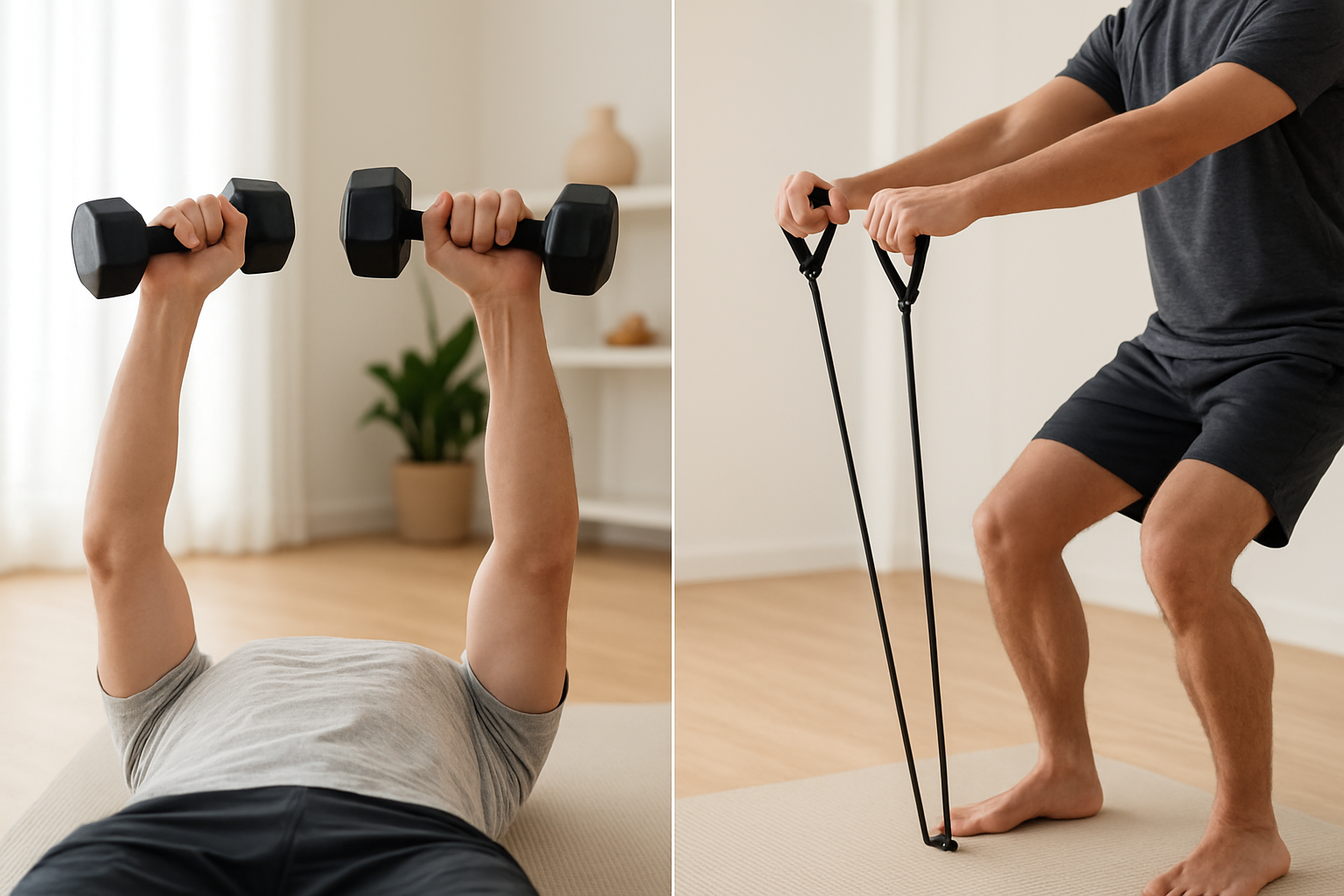
Band squat: Stand on a loop band and hold the other part near shoulder height if the band and your grip allow it. Keep the tension moderate and check the band before every set.
Substitutions: If squats bother your knees, reduce the depth, use a wider or narrower stance that feels natural, or practice sit-to-stands from a stable chair. If balance is limited, hold a door frame or sturdy support lightly.
Hinge options
Dumbbell Romanian deadlift: Hold dumbbells at your sides or in front of your thighs. Soften your knees, push your hips back, and lower the weights along your legs. Stop when you feel a strong but manageable stretch in the back of your thighs. Stand by driving your hips forward without leaning backward.
Suitcase deadlift: Place one dumbbell beside one foot. Hinge down, keep your chest controlled, and lift the weight while resisting the urge to lean toward it. Switch sides after each set or exercise.
Band good morning: Stand on a long band and place the band across your upper back, not your neck. Hinge at the hips and return to standing. Use low tension until you can keep the band secure.
Substitutions: Practice an unloaded hip hinge with your hands on your hips. You can also use a light backpack held close to your body if it is stable and does not shift.
Push options
Push-up: Start against a wall, then progress to a countertop, a sturdy table, or the floor. Keep your body in a controlled line and lower only as far as you can maintain good form.
Dumbbell floor press: Lie on your back with your knees bent and feet on the floor. Hold the dumbbells above your chest with your wrists steady. Lower your upper arms until they gently contact the floor, then press the weights upward. The floor limits the range of motion, which is useful when you have no bench.
Half-kneeling one-arm press: Kneel with one foot forward and press a dumbbell overhead with the hand opposite or on the same side, depending on which stance feels stable. Keep your ribs from flaring and avoid leaning backward.
Band chest press: Secure a long band behind you at about chest height using a suitable anchor. Step forward enough to create light tension, then press the handles or band ends forward. Never attach a band to an untested object that could move or cause the band to snap back.
Substitutions: Use a wall push-up for a lower challenge, or a floor push-up with hands elevated on a stable surface for a moderate challenge. If overhead pressing is uncomfortable, use a floor press or a band chest press.
Pull options
One-arm dumbbell row: Hinge slightly and support your free hand on your thigh. Pull the dumbbell toward your hip, keeping the shoulder away from your ear. Lower it slowly. Train both sides for the same number of repetitions.
Band row: Anchor the band securely in front of you or loop it around a stable object at about chest height. Pull toward your ribs and pause briefly without shrugging.
Supported bent-over row: Hold two dumbbells, hinge at the hips, and row both weights toward your body. Keep the load light enough to avoid swinging.
Substitutions: If you cannot safely anchor a band, use one-arm dumbbell rows. If bending is uncomfortable, perform a light standing band row with a higher anchor or practice shoulder-blade movement without resistance.
Carry and core options
Suitcase carry: Hold one dumbbell on one side and walk slowly through a clear area. Keep your torso upright and resist leaning. Switch hands for the next set.
Dead bug: Lie on your back with your knees bent and arms reaching upward. Slowly lower the opposite arm and leg while keeping your lower back in a comfortable, controlled position. Shorten the range if your back arches excessively.
Side plank: Support yourself on your forearm and knees, or progress to a longer lever as your control improves. Keep the movement steady rather than trying to hold the position at all costs.
Bird dog: From hands and knees, extend one arm and the opposite leg without twisting. Return them to the floor and switch sides.
Step 3: Use a simple training dose
For most beginners, begin with two or three working sets of each exercise. A set of about six to 12 controlled repetitions works well for many dumbbell and band exercises. Bodyweight movements may use a wider range, such as five to 15 repetitions, depending on the exercise.
Stop each set with a small amount of effort left. You should be able to complete the next repetition with stable technique, but the final repetitions should not feel effortless. If you cannot control the weight, reduce the load, shorten the range, or choose an easier variation.
Effort checkpoint
After a set, ask three questions:
- Could I perform the movement again without changing my form?
- Did the target muscles work more than the joints?
- Can I recover before the next planned session?
If the answer to the first two questions is no, adjust the exercise. If the answer to the third is no, reduce volume or add more recovery time.
A practical two-day full-body plan
Train on nonconsecutive days, such as Monday and Thursday. Rest or perform easy activity between sessions. Complete a general warm-up first.
Day A
- Goblet squat: two to three sets of six to 12 repetitions.
- Dumbbell Romanian deadlift: two to three sets of six to 12 repetitions.
- Wall, countertop, or floor push-up: two to three sets of controlled repetitions.
- One-arm dumbbell row: two to three sets of eight to 12 repetitions per side.
- Dead bug: two sets of five to 10 controlled repetitions per side.
Day B
- Reverse lunge or supported split squat: two to three sets of six to 10 repetitions per side.
- Suitcase deadlift: two to three sets of six to 12 repetitions per side.
- Dumbbell floor press: two to three sets of six to 12 repetitions.
- Band row or supported bent-over row: two to three sets of eight to 15 repetitions.
- Suitcase carry: two to three walks of about 20 to 40 controlled steps per side.
Rest about one to three minutes between demanding sets. You can use shorter rests for easy bodyweight work and longer rests when your breathing or grip needs more time.
A practical three-day full-body plan
If you prefer three shorter sessions, train on days such as Monday, Wednesday, and Friday. Keep at least one easier day between strength sessions.
Day 1: Squat and horizontal push
- Goblet squat: three sets of six to 10 repetitions.
- Dumbbell floor press: three sets of six to 12 repetitions.
- One-arm dumbbell row: three sets of eight to 12 repetitions per side.
- Dead bug: two sets per side.
Day 2: Hinge and vertical push
- Dumbbell Romanian deadlift: three sets of six to 10 repetitions.
- Half-kneeling one-arm press: two to three sets of six to 10 repetitions per side.
- Band row: three sets of eight to 15 repetitions.
- Side plank: two controlled holds per side.
Day 3: Single-leg work and conditioning
- Supported split squat: two to three sets of six to 10 repetitions per side.
- Push-up variation: two to three sets of controlled repetitions.
- Suitcase carry: two to three walks per side.
- Bird dog: two sets of five to 10 repetitions per side.
Choose the two-day plan if consistency is your main challenge. Choose the three-day plan if you prefer shorter workouts and can recover well between sessions. Either approach can work when you train regularly and progress gradually.
Step 4: Progress without a bench
Progression means giving your muscles a slightly greater challenge over time. Use one change at a time.
- Add repetitions: Move toward the top of your chosen repetition range while keeping control.
- Add a set: Increase from two sets to three when your recovery is good.
- Increase resistance: Add a small amount of dumbbell or band tension when the current load feels manageable.
- Improve the variation: Move from a wall push-up to a countertop push-up, or from a bodyweight squat to a goblet squat.
- Slow the movement: Take two or three seconds to lower the weight or pause briefly at a difficult point.
- Improve range of motion: Move through a larger comfortable range only when you can keep stable technique.
Record the exercise, resistance, sets, repetitions, and how it felt. When you complete all planned sets at the top of the range for more than one session with good form, consider a small progression.
Troubleshoot common problems
The workout feels too easy
First check your technique and range of motion. Then add repetitions, slow the lowering phase, or use a harder variation. Do not rush to make every exercise heavy.
You cannot feel stable on the floor
Use a mat with enough grip, place your feet firmly, and reduce the load. For split squats and presses, hold a nearby stable support for balance. Stability is a skill that improves with practice.
Your lower back takes over
Reduce the range, lower the resistance, and slow the movement. In deadlifts, push the hips back rather than squatting down. In floor presses and core exercises, keep your ribs and pelvis controlled without forcing your back flat.
You have limited space
Replace walking carries with a stationary suitcase hold. Use one-arm rows instead of wide movements. A short, focused session can still cover the main movement patterns.
You do not know where to anchor a band
Do not improvise with a light door handle, movable furniture, or an object that can shift. Use unanchored band exercises or dumbbell rows instead. If you use a door anchor, follow its instructions and test the setup with gentle tension before applying force.
Common mistakes to avoid
- Choosing weight before learning the movement: Start lighter than you think you need and build skill.
- Using momentum: Swinging a dumbbell or snapping a band reduces control and can make the exercise less predictable.
- Training to failure every session: Hard work has a place, but constant failure can make recovery and technique harder.
- Skipping pulling exercises: Include rows or another safe pulling movement to balance pressing work.
- Changing too many variables at once: If you increase weight, sets, and repetitions together, it is harder to identify what caused excessive fatigue.
- Ignoring the room: A clear path and stable equipment matter as much as the exercise list.
Safety guidance
Strength training should feel challenging, not sharp, alarming, or uncontrolled. Stop an exercise if you feel sudden pain, unusual weakness, numbness, dizziness, chest discomfort, or shortness of breath that does not settle with rest. Seek appropriate medical care for serious or persistent symptoms.
Use a range of motion that you can control. Keep dumbbells close to your body during deadlifts, set them down carefully, and avoid placing fingers where adjustable plates can pinch. Keep children and pets away from moving equipment. If you are pregnant, returning after an injury, managing a health condition, or unsure whether a movement is appropriate, consult a qualified health professional before starting or changing a strength program.
Your next actions
- Clear a safe workout area and inspect your dumbbells and bands.
- Choose the two-day or three-day plan based on the schedule you can maintain.
- Practice one squat, hinge, push, pull, and core exercise with easy resistance.
- Write down your starting variations, sets, and repetitions.
- Repeat the plan for several sessions before making a small progression.
You can strength train effectively at home without a bench by focusing on movement quality, steady practice, and gradual progression. Keep the equipment simple, use substitutions when needed, and let consistency guide the plan.